You won. Now collect.
The judge ruled in your favor. The debtor owes you money. But the court doesn't hand you a check — it hands you a piece of paper and sends you home. You wait 30 days for voluntary payment, and nothing arrives. You call the clerk's office and hear the same thing everyone hears: "We can't give legal advice or tell you which enforcement tool to use."
Maine gives judgment creditors real enforcement power — disclosure hearings, writs of execution, trustee process, real estate liens, even civil arrest for debtors who ignore a subpoena. The problem is that these tools are scattered across different statutes, different forms, different offices and different fee schedules. The court's website lists the forms alphabetically with no instructions. Pine Tree Legal Assistance publishes helpful overviews, but nothing that walks you through the multi-office enforcement sequence from start to finish.
The Maine Judgment Collection System
This guide is built around one idea: enforcement is an administrative sequence, not a guessing game. Each chapter follows the exact order Maine law requires — the waiting period, the disclosure hearing filing, the subpoena, the sheriff service, the hearing itself, and every enforcement order that can come out of it. You don't need to figure out which office to visit next or which form connects to which.
The guide covers judgments issued by any of Maine's 29 District Court locations. It is current with the $10,000 small claims limit under P.L. 2025, c. 261 (effective January 1, 2026), court fees under Administrative Order JB-05-26 (effective March 9, 2026), and the 10-year lien provisions under 14 M.R.S. § 4651-A.
What's Inside
- 30-day enforcement timeline — the mandatory waiting period mapped out day by day, so you know exactly when to file your first disclosure request and don't waste a rejected filing
- Disclosure hearing preparation system — step-by-step instructions for Form SC-003, the $30 entry fee, getting the clerk to issue a signed subpoena (CV-030 or CV-035, $5), and arranging sheriff service on the debtor, with the full fee breakdown by county
- Asset discovery question framework — a structured set of questions to ask the debtor under oath at the 14 M.R.S. § 3125 hearing, organized by asset category: employment, bank accounts, vehicles, real estate and personal property
- Installment payment order guide — how the court calculates payment schedules under 14 M.R.S. § 3126-A and what to do when a payment is missed, including the contempt process for willful non-compliance
- Writ of execution and trustee process — how to request the writ ($25 fee), direct the sheriff to seize non-exempt property, and reach bank accounts through trustee process with the statutory notice requirements
- Real estate lien recording — recording an Abstract of Execution at the County Registry of Deeds to create a 10-year lien under 14 M.R.S. § 4651-A, including the one-time renewal option for an additional 10 years
- Exemptions reference — the complete list of debtor protections under 14 M.R.S. § 4422, including the $80,000 homestead exemption ($160,000 for elderly or dependent households), $10,000 vehicle exemption, retirement accounts and tools of trade, so you know what's reachable before you spend money on enforcement
- Fee and interest tracking ledger — a printable worksheet that logs every court fee, sheriff service charge, partial payment and post-judgment interest calculation, giving you a running balance at every stage
- Multi-office handoff map — the exact sequence of touchpoints between the District Court clerk, the County Sheriff's civil process division, and the County Registry of Deeds, so no paper gets lost between offices
- Satisfaction of judgment procedure — how to file the paperwork once the debtor has paid, release any recorded liens, and close the case properly to avoid post-satisfaction liability
Who This Is For
You have a money judgment from a Maine District Court and the other side has not paid. You might be:
- A homeowner who won a judgment against a contractor and has no idea what the contractor owns or earns
- A small landlord with a damage or back-rent judgment who needs to find the former tenant's bank account or employer
- A small business owner holding an unpaid judgment against a customer or vendor
- A sole trader whose debtor ignored the judgment and stopped returning calls
- Anyone in Maine with a judgment of $10,000 or less who wants to handle enforcement without hiring a collection lawyer or handing 25%–50% of the recovery to an agency
The guide assumes you have never enforced a judgment before and explains every step in plain language.
Why Not Just Use Free Resources?
You should use the free resources — this guide links to every one of them. The Maine Judicial Branch publishes the official forms (SC-003, CV-030, CV-035), the court fee schedule, and basic instructions for each form. Pine Tree Legal Assistance offers self-help articles on small claims procedure and links to every downloadable form.
What none of these provide is a single enforcement workflow that connects the forms to each other in order. The court's forms come as separate PDFs. Pine Tree Legal's pages cover individual steps but don't map the sequence across offices. The clerk will tell you they can't recommend an enforcement strategy. And if you file in the wrong order — requesting a writ before the disclosure hearing, or missing the subpoena service deadline — the process stalls and the debtor gains time to move assets.
This guide puts every enforcement step in the right order, with the right form and the right office at each stage, so you move through the system without backtracking.
Satisfaction Guarantee
Full refund, no time limit. If the guide doesn't help you, email [email protected] and you'll get your money back.
What You Get
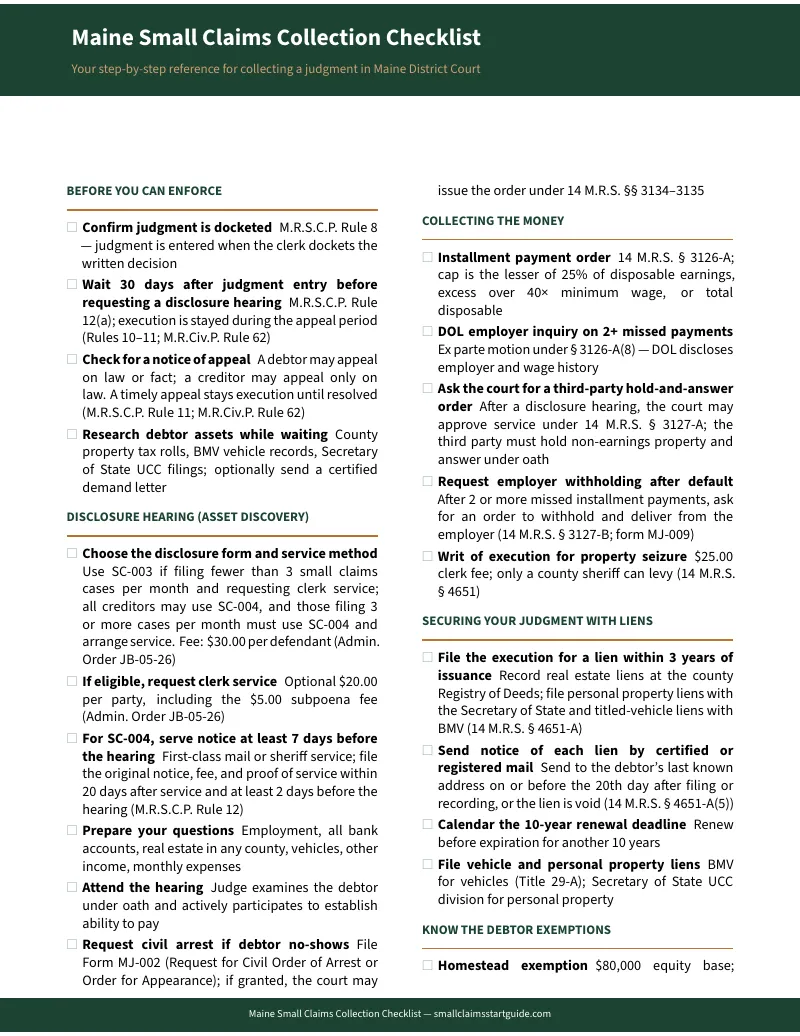
An instant PDF download — no subscription, no recurring charges, no software to install. The guide is yours to keep, print, and reference at every stage of enforcement. The free checklist gives you the overview; the full guide gives you the execution system.
Includes 6 printable PDFs:
- The full step-by-step guide (50 pages, 14 chapters)
- The Maine Small Claims Collection Checklist (25 items)
- Fee and Interest Tracking Ledger — log court fees, sheriff charges, partial payments and post-judgment interest with a running balance
- Disclosure Hearing Question Script — structured questions organized by asset category to bring to the 14 M.R.S. § 3125 hearing
- Debtor Exemptions Quick Reference — the complete list of protected property and income under 14 M.R.S. § 4422
- Multi-Office Filing Tracker — log every filing across the District Court, County Sheriff and Registry of Deeds
All files are ready to download immediately after purchase. Everything is formatted for US Letter printing and works on any PDF reader.
Get the full Maine Small Claims Judgment Collection Guide — everything you need to enforce your judgment, track the debtor's assets, and collect what you're owed.
Frequently Asked Questions
What if the rules change after I buy?
We update the guide when the rules change. Email us any time, even years later, and we'll send you the current edition free.