
You Won Your Louisiana Small Claims Case. Now Collect.
The judge ruled in your favor. You have a money judgment. But the other side didn't hand you a check on the way out — and now you're learning that the Louisiana court system won't do it for you either.
The clerk can't tell you what to file next. The sheriff's office wants specific forms and an advance deposit before they'll act. And Louisiana's civilian legal tradition means the terminology — fieri facias, judicial mortgages, garnishment interrogatories — doesn't look like anything you've seen in a Google search for "how to collect a judgment."
Meanwhile, every week that passes is another week the debtor has to move money, change jobs, or sell property — because they know most people give up.
The Louisiana Judgment Enforcement Roadmap
This is the guide that turns a piece of paper into money in your account. It maps the entire enforcement process from the day your judgment becomes final to the day you file the cancellation of the judicial mortgage — every form, every fee, every office handoff, in the order you actually use them.
No one else publishes this for Louisiana. Nolo's national guide covers enforcement in a few generic pages that skip Louisiana's unique procedures entirely — no writs of fieri facias, no marshal instructions, no parish-by-parish routing. Court websites in East Baton Rouge, Shreveport, and New Orleans each publish their own local garnishment packets, but none of them connect the steps across parishes or explain when to use a judicial mortgage instead of a wage garnishment. And the Louisiana Legislature's online statutes give you the law in raw, unformatted text without any step-by-step workflow.
The Judgment Enforcement Roadmap connects the steps no other resource does: confirming your judgment is final, petitioning for a Writ of Fieri Facias under C.C.P. Article 2411, serving garnishment interrogatories through the city marshal or parish sheriff, recording a judicial mortgage with the Parish Clerk of Court, and filing the mandatory cancellation when the debtor pays — with the advance deposits, exemption limits, and interest calculations at each stage.
What's Inside
- The appeal window and what to do during it — whether your judgment is immediately enforceable (City Court Small Claims Division under La. R.S. 13:5209) or subject to a 15-day appeal (Justice of the Peace Court), how to confirm finality and the Notice of Judgment under C.C.P. Article 1913, and what to prepare before enforcement begins
- Judgment debtor examinations — how to petition for a Judgment Debtor Rule to compel the debtor to disclose their bank accounts, wages, and property under oath when you don't know what they own
- Writs of fieri facias, start to finish — petitioning the court under C.C.P. Article 2411, delivering the writ to the parish sheriff or city marshal with the advance deposit, what happens during a seizure of personal property, and what to do when the return comes back unsatisfied
- Wage garnishment with Louisiana's specific caps — the 25% disposable earnings limit under La. R.S. 13:3881, the statutory floor of 30 times the federal minimum wage per week, employer service procedures through the marshal, and garnishment interrogatories
- Bank account garnishment — serving the financial institution, the non-self-executing exemption process, how debtors claim protected funds under La. R.S. 13:3928, and avoiding sanctions for seizing exempt property
- Judicial mortgages across Louisiana parishes — recording a certified judgment copy with the Parish Clerk of Court to encumber real estate for 10 years under Civil Code Article 3359, the difference between the Parish Clerk and the court clerk, and how the mortgage survives property transfers
- Louisiana's exemptions decoded — what the debtor can legally protect under La. R.S. 13:3881 (wages, retirement, homestead, tools of trade, Social Security, disability benefits) so you don't waste advance deposits on assets that will be released
- Post-judgment interest ledger — Louisiana's statutory judicial interest rate under La. R.S. 13:4202, calculating accrued interest from the date of judicial demand, and tracking partial payments so you always know the current balance owed
- Closing the case properly — filing a Request for Cancellation and Satisfaction of Judgment under Civil Code Articles 3366 and 3368, why failing to cancel a judicial mortgage exposes you to statutory damages, and how to confirm the judgment is marked as satisfied across all parishes where it was recorded
Who This Guide Is For
- Individual judgment holders who won a small claims case (up to $5,000 in City Court or JP Court) and haven't been paid after the appeal window
- Small-business owners, landlords, and independent contractors who need a repeatable system for collecting unpaid judgments without paying an attorney each time — Louisiana collection attorneys charge $250–$400/hr or take 33%–50% contingency, making legal help cost-prohibitive for most small claims
- Family helpers and office managers assisting someone through the court process and looking for clear, step-by-step instructions
Why Free Resources Aren't Enough
Everything in this guide is based on public Louisiana law — and the official court forms are available from your local clerk's office. That's not a secret, and we don't pretend otherwise.
The problem isn't access to the forms. It's knowing which forms to file, in what order, to which office, with what fees — and understanding the gaps between them where most self-represented creditors get stuck.
East Baton Rouge City Court publishes a garnishment packet. Shreveport City Court publishes a different one. Neither tells you when a judicial mortgage makes more sense than a garnishment, or how to record one with the Parish Clerk of Court — a different office entirely from the court clerk who issued your judgment. And Louisiana's legal aid organizations focus almost entirely on helping debtors claim exemptions, not on helping creditors enforce judgments.
The result is that creditors bounce between offices, file paperwork in the wrong place, or advance sheriff deposits on assets that turn out to be exempt — wasting time and money they can't recover.
Satisfaction Guarantee
If the guide doesn't deliver what we describe here, email [email protected] for a full refund — no time limit, no conditions.
This is an independent procedural reference. It does not provide legal advice, file documents on your behalf, or guarantee any financial recovery. For complex situations involving bankruptcy, disputed property, or out-of-state enforcement, the guide includes clear referral points to legal counsel.
Get Started
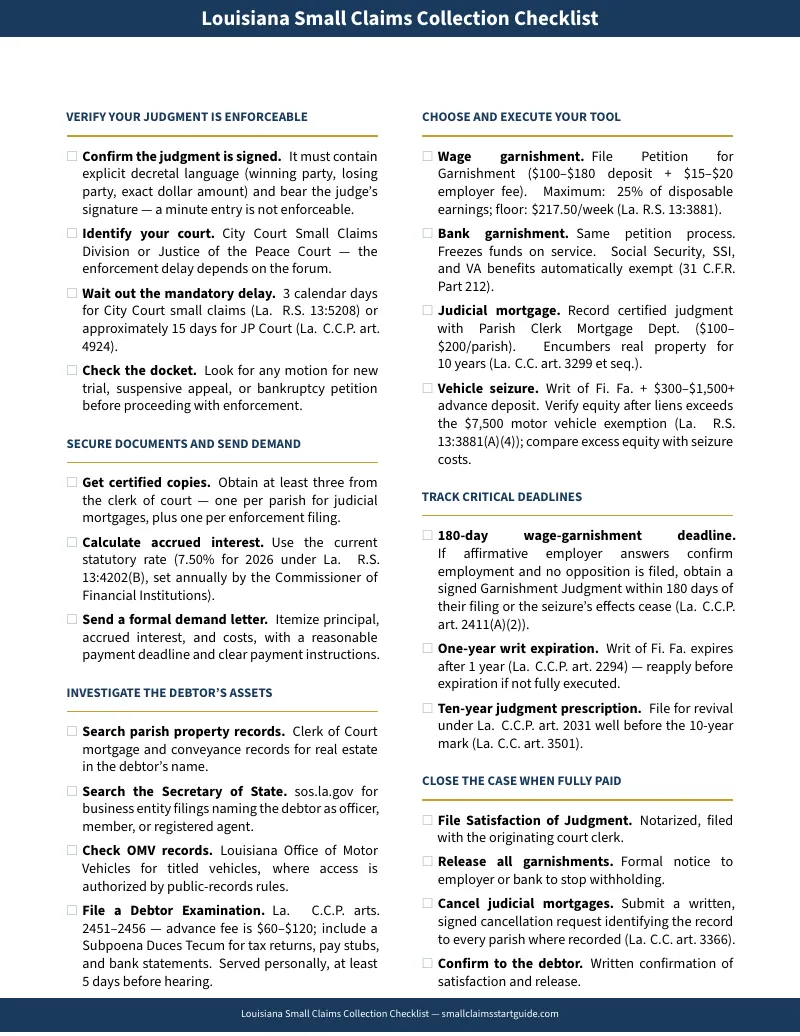
The free checklist gives you the overview — the enforcement tools, key deadlines, and exemption categories on one page. When you're ready for the full procedures, the complete guide is .
Frequently Asked Questions
What if the rules change after I buy?
We update the guide when the rules change. Email us any time, even years later, and we'll send you the current edition free.