
You won your case. The court is not going to collect the money for you.
The judge agreed the other side owes you. The clerk stamped "Entered" on the judgment and moved on to the next file. You asked how to actually get paid and learned the answer: the Kentucky Court of Justice does not collect debts. The Office of the Circuit Court Clerk will hand you blank AOC forms — AOC-150, AOC-145, AOC-140, AOC-191 — but court staff are prohibited from telling you which one to use, how to fill it out, or where to send it. Reddit threads talk about garnishment like it is one step. It is not. And the P-6 Small Claims Handbook stops at "you have a judgment" as though the money follows automatically.
You now own a piece of paper worth up to $2,500 plus interest. Turning it into money requires filing the right form with the right county office, serving the right party at the right address, and knowing which of the debtor's assets the law can reach and which it cannot. One wrong form number, one missed service address, and you have spent $35 to $50 in sheriff fees on a filing that gets rejected.
The County Office Routing System
The Kentucky Small Claims Judgment Collection Guide maps every enforcement tool to the specific AOC form, the county office that processes it, and the officer who serves it — so you file once, correctly, instead of discovering at the clerk's counter that your paperwork belongs in a different office across the street. It covers the full collection path from the mandatory 10-day appeal window through formal satisfaction of judgment when you finally get paid.
This is not a national overview that mentions Kentucky in a sidebar. It is not a debtor-defence guide published by legal aid. It is not the raw statute text of KRS Chapter 426 without operational instructions. It is a sequential enforcement guide built for the person holding an unpaid small claims judgment in a Kentucky District Court, navigating the process without a lawyer — because at the $2,500 jurisdictional cap, hiring one would consume the judgment itself.
What's Inside
The 10-Day Appeal Window — Know When You Can Start
Under KRS 24A.340, the debtor has 10 calendar days from the judgment entry date to file a Notice of Appeal. Any garnishment or execution order filed before that window closes is procedurally invalid. The guide walks you through checking the docket, confirming no appeal or supersedeas bond is in place, running a PACER bankruptcy check, and determining the earliest safe date to file your first enforcement action.
Finding What the Debtor Owns
You cannot garnish wages if you do not know the employer. You cannot levy a bank account without knowing which bank. Kentucky gives judgment creditors two discovery tools: written post-judgment interrogatories served directly on the debtor and formal debtor examinations conducted through the Master Commissioner. The guide covers both — how to serve the interrogatories, what questions to ask, and what to do when the debtor ignores them (Form AOC-198 to compel, AOC-198.1 for the court order). It also covers public record searches through the County Clerk's office and the Property Valuation Administrator.
Wage Garnishment — AOC-150 and AOC-150.5
Kentucky's continuous wage garnishment is the most effective tool when the debtor is employed. The employer withholds the lesser of 25% of disposable earnings or the amount exceeding 30 times the federal minimum hourly wage per week, every pay period, until the judgment is satisfied. The guide walks through the entire AOC-150 filing: calculating the garnishment amount, identifying which notice-of-rights form must accompany the order, serving the employer through the County Sheriff, and filing the supplemental order (AOC-150.5) when the debtor changes jobs. Getting the employer service wrong is the most common reason garnishments fail — one missing attachment, and the employer's payroll department sends everything back.
Bank Account Garnishment — AOC-145 and AOC-150.1
When you know the debtor's bank, a non-wage garnishment freezes whatever is in the account at the moment of service. The bank holds the funds for 14 days while the debtor has 20 days to file an exemption challenge. The guide covers the AOC-145 affidavit, the AOC-150.1 order, protected federal benefits under 31 CFR Part 212 (Social Security, SSI, VA payments), and the timing sequence that prevents you from losing the frozen funds to processing fees charged before the court releases the money to you.
Execution Orders — AOC-135 and AOC-140
If the debtor owns personal property — a vehicle, equipment, inventory — a writ of execution directs the County Sheriff to seize it. The guide covers the AOC-135 notice (which includes the $3,000 household goods exemption and the $2,500 vehicle exemption under KRS Chapter 427), the AOC-140 Order for Sale that authorizes the Sheriff to sell seized property, and the practical logistics: providing the Sheriff with precise property descriptions, addresses, and service fees.
Real Estate Judgment Liens — KRS 426.720 and House Bill 83
Recording a judgment lien with the County Clerk's land records office puts a cloud on every parcel the debtor owns in that county. The debtor cannot sell or refinance without paying you first. House Bill 83, effective June 29, 2023, changed the rules: liens now expire 10 years from the judgment entry date with one optional 5-year renewal, and the notice filed with the County Clerk must include the exact date of final judgment entry. The guide covers the recording procedure, the $46 filing fee, the mandatory exemption notice you must send the debtor, and how to renew before the 10-year clock runs out.
Exemptions — What the Law Puts Off Limits
Kentucky exemptions protect specific categories of income and property from enforcement. Social Security, SSI, VA benefits, TANF, and unemployment benefits are federally or state-protected from garnishment. The household property exemption under KRS 427.010 shields up to $3,000 in personal property. The vehicle exemption under KRS 427.010(1) protects up to $2,500 in equity. The guide lists each exemption, its statutory basis, and its practical effect on your enforcement strategy — so you know before you spend money on a levy whether the debtor's assets are reachable.
Post-Judgment Interest — 6% Under KRS 360.040
Kentucky judgments accrue interest at 6% per annum. Many creditors still calculate at the old 12% rate, which was reduced to 6% by Senate Bill 4 effective July 14, 2018 — judgments entered before that date still carry the 12% rate. The guide includes a printable interest calculation ledger that tracks principal, accumulated interest, court costs, and service fees on one worksheet — so the numbers you put on your garnishment paperwork match what the clerk and the court expect to see.
Foreign Judgment Domestication
When the debtor moves out of Kentucky or has assets in another state, enforcement requires domesticating your judgment under the Uniform Enforcement of Foreign Judgments Act (KRS 426.950 through 426.975). The guide covers filing an authenticated copy, the required affidavit, and the mandatory 30-day notice period before local enforcement tools can issue in the new jurisdiction.
Satisfaction of Judgment — Closing the Record
Once the debtor pays in full, you are legally required to file a Satisfaction of Judgment using Forms AOC-191 (motion) and AOC-191.1 (order). Failing to do so can expose you to sanctions and leaves the debtor with a live judgment on their record. The guide covers the filing procedure and the requirement that the motion be signed before the Circuit Court Clerk.
Who This Is For
- Individuals owed money after a small claims ruling. You won a case over an unpaid loan, a security deposit, vehicle repair damage, or property damage. The court said you are owed the money. Now you need to know how to collect it without spending more than the judgment is worth.
- Sole traders and small business owners with an unpaid judgment. A customer, client, or former tenant owes you money under a court order. You treat collection as a business operating cost and need the correct forms and procedures rather than a $300-per-hour attorney for a $2,500 claim.
- Family members helping a judgment holder. You are the tech-literate adult child, sibling, or friend helping someone navigate the forms and offices. You do the research and prepare the paperwork; the named judgment creditor signs the filings.
- Anyone holding a Kentucky small claims judgment who has not been paid. Whether the judgment is recent or years old, the guide covers enforcement tools, the 15-year judgment lifespan, and preservation strategies like real estate liens.
Why Not Just Use the Free Court Resources?
You should — and the guide tells you exactly where to find each one. The Kentucky Court of Justice publishes every AOC form at kycourts.gov. County Clerks accept lien filings. The Sheriff's office serves your garnishment orders. KyJustice.org publishes consumer law information.
What none of these offices do is put the enforcement tools in sequence, match each form to the office that processes it, or tell you which enforcement tool to use first based on what you know about the debtor's assets. Clerks are legally barred from selecting forms or advising on procedure. KyJustice.org's garnishment guides are written for debtors defending against wage seizure, not creditors pursuing it. And the P-6 Small Claims Handbook covers filing and the hearing — it stops at the point where you need to start collecting.
The guide organizes what is already public into the order you actually need it, with the forms matched to the offices and the worksheets matched to the math. It sits between the free resources (which you still use) and a private attorney (which makes no economic sense for a $2,500 judgment).
What This Is Not
This guide explains collection procedure. It does not give legal advice, predict outcomes, or guarantee that the debtor will pay. It is not published by, affiliated with, or endorsed by the Kentucky Court of Justice, any District Court, or any government agency. If you need legal advice about your specific situation, contact a Kentucky attorney. If you need free help, the guide lists Kentucky Legal Aid organizations and courthouse resources.
Satisfaction Guarantee
Full refund, no time limit. If the guide is not what you expected, email [email protected] and we will refund you — no questions, no deadline.
Get Started
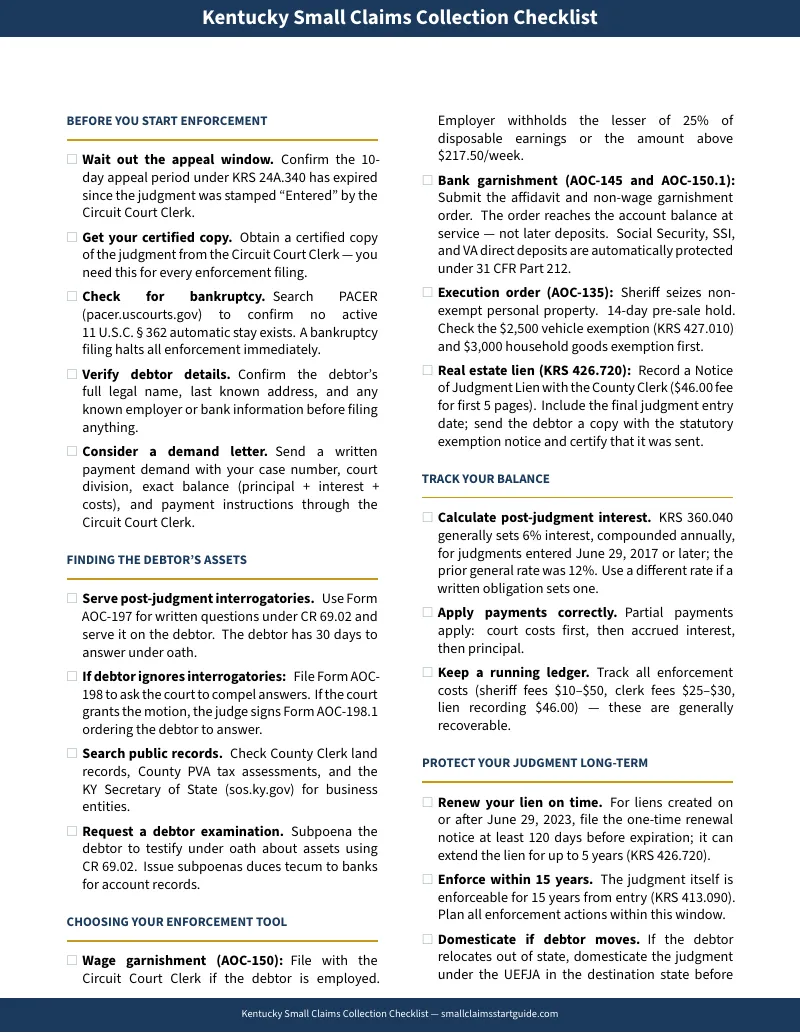
Download the free Kentucky Small Claims Collection Checklist — a one-page summary of the waiting period, enforcement options, key forms, and exemptions. If you want the full guide with step-by-step instructions and four printable worksheets (enforcement planner, interest ledger, asset discovery checklist, and form filing tracker), get the complete Kentucky Small Claims Judgment Collection Guide for .
Frequently Asked Questions
What if the rules change after I buy?
We update the guide when the rules change. Email us any time, even years later, and we'll send you the current edition free.