You know you're owed money. You don't know how to get it into a courtroom.
Your contractor took a deposit and vanished. Your landlord kept your security deposit past the statutory deadline and never sent an itemized statement. A client owes you for work you finished months ago. You searched "how to file small claims in Kentucky" and found the P-6 Small Claims Handbook on kycourts.gov, a couple of Reddit threads, and a Nolo guide that covers all fifty states in four hundred pages — none of which told you, start to finish, what to do and in what order in a Kentucky District Court.
You don't need fifty states. You need to know which of Kentucky's 120 counties to file in, how much the filing fee is, how to find the defendant's legal name so your judgment actually sticks, how to get the papers served when the court won't do it by regular mail, and what to bring to a hearing where you're speaking for yourself. One wrong entity name on Form AOC-175, one missed service deadline, and your case stalls before the judge hears a word.
The Clerk-Ready Filing System
The Kentucky Small Claims Filing Guide takes the entire process — from checking whether your claim fits the $2,500 statutory limit through to what happens after the judge's decision — and puts it in one printable sequence with checklists, worksheets, and a deadline calendar. Every step references the specific Kentucky form, the KRS citation, and the timeline.
This is not a national overview that mentions Kentucky in a footnote. It is not a form-filling service that charges hundreds of dollars for software that generates blank PDFs without explaining how to fill them. It is not a debt-defence product that helps people answer claims — this guide is for people filing them. And while the Kentucky Court of Justice posts downloadable forms at kycourts.gov, those forms come without step-by-step instructions, without service tracking tools, and without guidance on the evidence attachment trap on Form AOC-175 that catches first-time filers every week.
What's Inside
Checking the Limit and the Clock
Kentucky's Small Claims Division handles money claims and personal property disputes up to $2,500 under KRS 24A.230. The statute of limitations varies by claim type: 10 years for a written contract executed after July 15, 2014 under KRS 413.160, 5 years for an oral contract or property damage under KRS 413.120, and 4 years for a UCC sale-of-goods breach under KRS 355.2-725. The guide walks through each limit and shows you how to calculate your deadline from the date the breach or injury occurred.
The Demand Letter — Document the Dispute Before You File
Judges notice when a plaintiff skipped the demand letter. Sending one establishes that you tried to resolve the dispute before bringing it to court, creates a dated record of notice, and often produces payment without a hearing. The guide includes a demand letter framework with mailing instructions and covers what to include, how to send it by certified mail, and how long to wait before filing.
Identifying the Defendant — Getting the Legal Name Right
Suing a trade name instead of the underlying LLC or corporation can render your judgment unenforceable. The guide walks through verifying the defendant's legal entity through the Kentucky Secretary of State's Business Entity Search, determining whether to name a DBA, LLC, or individual, and finding a registered agent address for corporate defendants. This is one of the most common small claims mistakes — and one of the most expensive.
Venue Rules — Filing in the Right County
Kentucky has 120 counties across 60 judicial circuits. Filing in the wrong county lets the defendant move to dismiss for improper venue, forcing you to start over with new fees. The guide explains venue rules by defendant type — individuals, corporations, LLCs — under KRS Chapter 452, including the practical differences between urban courthouses like Jefferson County (Louisville) with long clerk counter lines and rural county seats with limited hours.
Filing Form AOC-175 and Paying the Fee
The guide walks through Form AOC-175 (Small Claims Complaint) field by field: naming the defendant correctly, writing a clear factual statement, and signing the sworn affidavit on the annual filing cap under KRS 24A.250. It covers how filing fees vary by county and the fee waiver option using Form AOC-026 for filers who meet the income threshold — including the strict 30-day window to pay or appeal if the waiver is denied.
Service of Process — Getting the Papers to the Defendant
Filing the claim is half the job. Getting the papers properly served is the other half, and failed service is one of the most common reasons claims stall. The guide covers two primary service methods — certified mail with return receipt (Green Card / PS Form 3811) and county sheriff delivery — along with what to do when certified mail comes back refused versus unclaimed (the law treats these very differently). The service tracking log keeps every attempt, date, method, and result in one place.
The AOC-175 Evidence Attachment Trap
Page 1 of Form AOC-175 states in small print: "Only the Complaint form will be served on Defendant. Attachments WILL NOT be served." Filers routinely assume that attaching contracts, invoices, and photos to their complaint means the defendant has seen the evidence. They arrive at the hearing and discover the defendant never received it — resulting in continuances and delays. The guide explains exactly how to prepare and deliver evidence separately so this doesn't happen to you.
Evidence Assembly — What the Judge Needs to See
The hearing is informal but the judge still needs organized evidence. Showing up with a stack of loose papers in no particular order is the easiest way to lose a case you should win. The guide covers how to build a three-set evidence binder — one copy for the judge, one for the opposing party, one for yourself — with contracts, invoices, photographs, repair estimates, text messages, and witness statements indexed and hearing-ready.
The Hearing — What Actually Happens
Kentucky small claims hearings are held before a District Judge. The guide covers what the courtroom looks like, how the judge runs the proceeding, how to present your evidence clearly, how to respond to the defendant's arguments, and what happens if the defendant does not show up. Most hearings last 15 to 30 minutes — they are designed for people without legal training.
After the Decision — Appeals and Next Steps
If you win, the judgment means the court says the defendant owes you the money. It does not collect the money for you. Either party may appeal within 10 days under KRS 24A.340. The guide covers the appeal timeline, entry of judgment, and your basic options for enforcing a judgment — with a clear handoff to the separate Kentucky Small Claims Judgment Collection Guide for the full enforcement process.
Printable Worksheets and Planning Tools
The kit includes the step-by-step guide plus eight printable tools: a 24-item master checklist, a case eligibility worksheet, a demand letter tracker, a defendant verification worksheet, an AOC-175 field preparation worksheet, a service tracking log, an evidence organizer, and a deadline calendar mapping every statutory window from demand letter through appeal. Print them, write on them, check off each step as you go.
Who This Is For
- Tenants owed a security deposit. Kentucky law gives landlords a specific window to return the deposit or provide an itemized statement of deductions. Wrongful withholding can entitle the tenant to damages. The guide covers the statutory timeline, how to calculate your claim, and how to document unit condition at move-out.
- Homeowners with a contractor dispute. The roofer, plumber, or remodeler took your deposit and abandoned the project or delivered substandard work. Contractors who operate under trade names or use post office boxes can be difficult to serve — the guide covers how to find the correct legal entity name and how to use sheriff service when certified mail fails.
- Small landlords owed rent or damage costs. A former tenant left owing rent or caused damage beyond the deposit. Money claims go through small claims — evictions are a separate process under KRS Chapter 383. The guide covers landlord money claims only, with guidance on documenting damages and locating a former tenant for service.
- Sole traders and small businesses with unpaid invoices. A client stopped paying. The guide covers how sole proprietors and businesses file, the corporate-representative exception under KRS 24A.240, and the 25-claim annual cap under KRS 24A.250 that limits how many filings you can bring per year.
- Car buyers or sellers in a private sale gone wrong. Undisclosed mechanical defects, unreleased vehicle titles, or non-payment. The guide covers how to gather vehicle ownership records and organize evidence from a private transaction.
- Anyone owed money in Kentucky under $2,500. If you would rather spend an evening with a step-by-step guide than navigate scattered court pages, Reddit threads, and raw statute text, this is for you.
Why Not Just Use the Free Court Resources?
You should use them — and the guide tells you exactly when and where. The Kentucky Court of Justice publishes the P-6 Small Claims Handbook, downloadable forms (AOC-175, AOC-026, AOC-180), and county clerk contact pages. Kentucky Legal Aid organizations provide free assistance to low-income residents through kyjustice.org.
What these resources do not do is put the information in the order you need it. The P-6 Handbook explains the rules but not the step-by-step filing sequence. Court forms are blank PDFs without line-by-line instructions. Legal aid is income-restricted and carries high case volume. County clerks manage judicial records and collect fees but are legally barred from giving legal advice, evaluating your claim, or helping you complete your paperwork.
The guide does the organizational work: every form, every fee, every deadline, in the order you encounter them, with checklists and worksheets you can print and work through. It sits between the free information (which you still need) and a $250-to-$750 attorney (which makes no economic sense for most claims under $2,500).
What This Is Not
This guide explains the procedure. It does not give legal advice, predict outcomes, or tell you how to argue your case. It is not published by, affiliated with, or endorsed by the Kentucky Court of Justice, any District Court, or any government agency. If you need legal advice, contact a lawyer. If you need free help, the guide lists Kentucky Legal Aid, the Kentucky Bar Association's Lawyer Referral Service, and courthouse resources.
Satisfaction Guarantee
Full refund, no time limit. If the guide is not what you expected, email [email protected] and we will refund you — no questions, no deadline.
Get Started
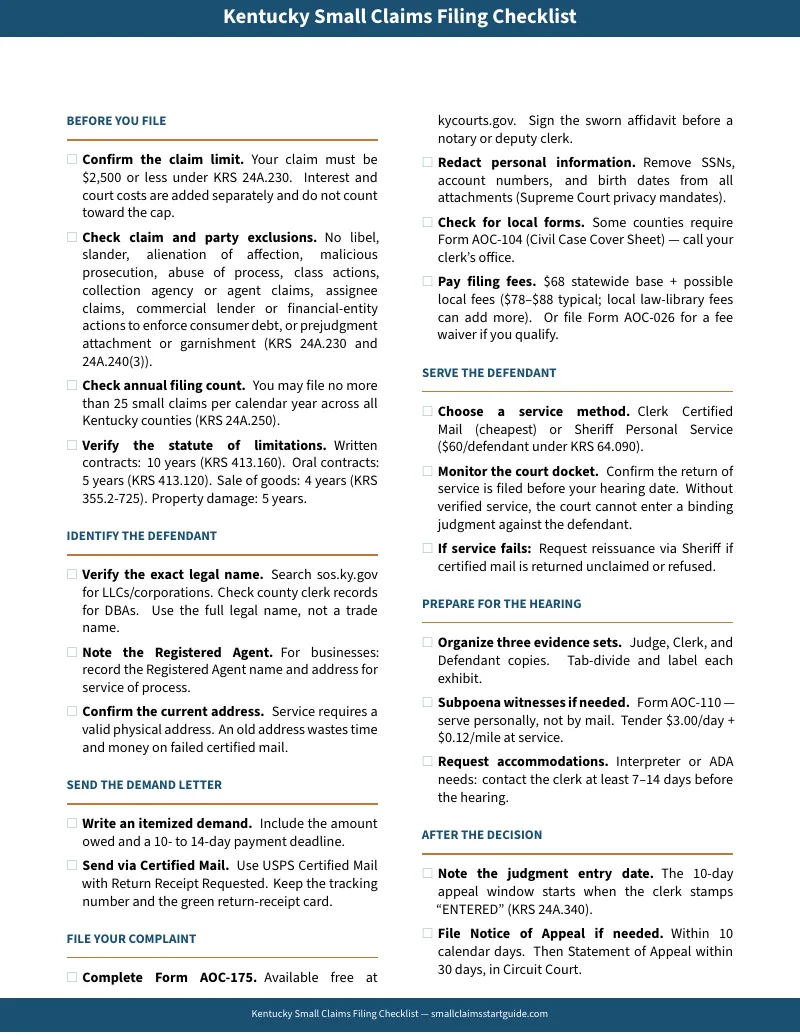
Download the free Kentucky Small Claims Filing Checklist — a one-page summary of the limit, forms, fees, service steps, and deadlines. If you want the full guide with step-by-step instructions, printable worksheets, and the deadline calendar, get the complete Kentucky Small Claims Filing Guide for .
Frequently Asked Questions
What if the rules change after I buy?
We update the guide when the rules change. Email us any time, even years later, and we'll send you the current edition free.