Served With a Small Claims Lawsuit in Kansas?
The summons landed — maybe delivered by a county sheriff, maybe by certified mail — and now you have a hearing date circled on the calendar and a stack of legal papers you are not sure how to read. The clock is running, and the consequences of doing nothing are real: a default judgment, then garnished wages or a frozen bank account, all because you did not show up.
The problem is not that the information does not exist. Kansas publishes the statutes. The Judicial Council posts the forms. County clerks answer the phone. But none of those sources walks you through what to do, in what order, from the defendant's side. The court packets are written for plaintiffs. The widely circulated Kansas Legal Services brochure still cites a $4,000 jurisdictional limit and a 10-day appeal window — both outdated. And the generic "lawsuit answer templates" sold online are built for Chapter 60 civil cases where a written answer is mandatory within 21 days. In Kansas small claims, filing one of those templates is unnecessary and can create procedural confusion — because under K.S.A. 61-2705, no written answer is required. Your obligation is to appear at the hearing.
The Kansas Defendant's Procedure System
This guide replaces the scattered, plaintiff-focused, frequently outdated information with a single chronological workflow built for the person who just got served. It covers every stage from the moment you open the envelope to the weeks after the judge rules — with the current Kansas statutes, the correct forms, and the actual deadlines.
The difference between this guide and the free resources is not the legal information itself — all of that is public. The difference is organization. Free sources tell you fragments: "bring evidence," "you can file a counterclaim," "appear on the hearing date." This guide shows you how to read the summons, when to file the counterclaim, what to put in the evidence binder, and where to go on hearing day — with printable worksheets that turn each step into a concrete task.
What You Get
- 48-page step-by-step guide covering the full defendant timeline — from served papers to post-judgment obligations — under K.S.A. 61-2701 et seq.
- Served-Paper Decoder worksheet — a structured form to record the case number, county, judge, demand amount, sheriff service date, and hearing date from your summons, so every detail is in one place
- Key Date and Deadline Organizer — a timeline worksheet that calculates your hearing date, counterclaim filing window, 14-day appeal deadline, and 30-day asset disclosure window
- Evidence Packaging Index — a binder template to organize contracts, text messages, receipts, and photographs into three indexed sets (judge, plaintiff, you) so you walk into court with a professional evidence file
- Day-of-Hearing Logistics Checklist — courthouse arrival, security screening, clerk check-in, ADA and language accommodation requests, and courtroom etiquette reminders
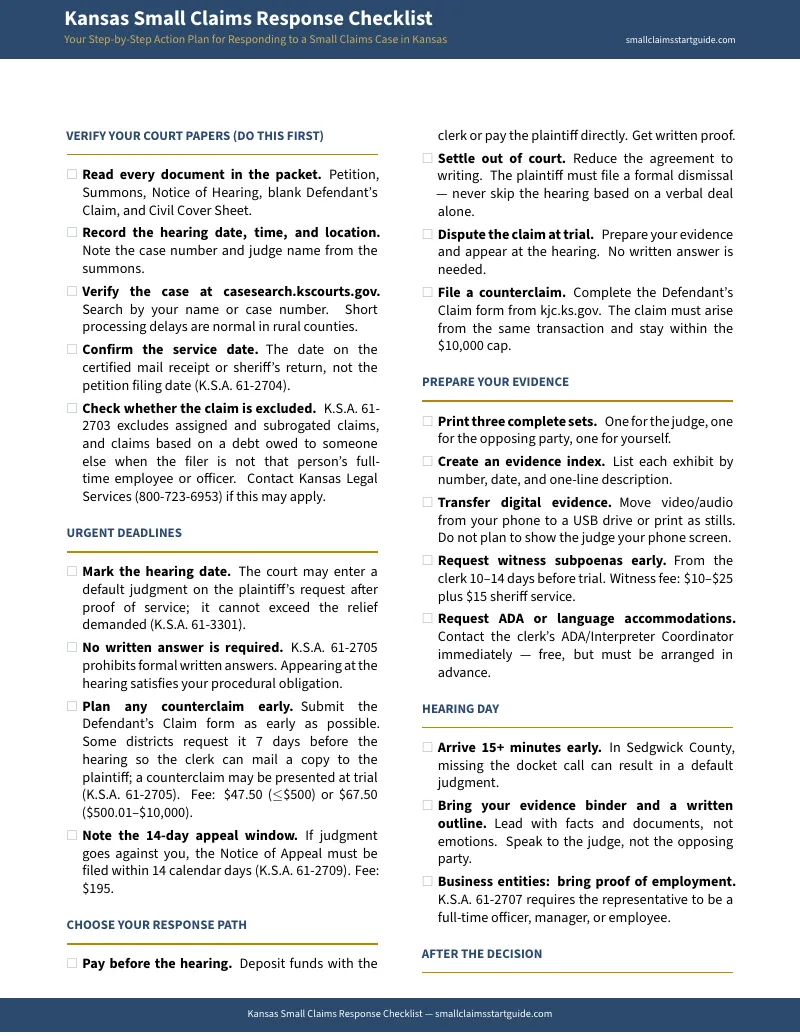
- 22-item response checklist (also available as a free standalone download) summarizing every deadline, form, and step on two pages
The Guide Covers
- How to read every section of the Kansas District Court summons and petition — what the case caption, demand amount, and hearing notice mean in plain language
- The K.S.A. 61-2705 appearance rule: why no written answer is needed, what happens if you file one anyway, and why the 21-day deadline from Chapter 60 does not apply to small claims
- What happens if you miss the hearing — default judgment, enforcement tools available to the plaintiff, and how to file a motion to set aside the default for good cause
- Your four options laid out side by side: dispute the entire claim, admit part and dispute the rest, settle before the hearing, or file a counterclaim
- How to file a counterclaim using the Defendant's Claim form — the $10,000 cap, the docket fee ($47.50 for claims up to $500, $67.50 for claims over $500), service requirements, and the deadline
- Who can appear in court for a business — the K.S.A. 61-2707 rule for corporations, LLCs, and other entities, and the documentation some courts ask for
- How to organize physical evidence into three indexed binder sets, including how to print and redact text messages, emails, and mobile photos
- What the hearing looks like, how the judge runs it, how to present your side clearly, and what to expect from the plaintiff's presentation
- The 14-day appeal window under K.S.A. 61-2709, how a de novo trial on appeal works, and the mandatory attorney fee-shifting provision
- Post-judgment requirements: the Judgment Debtor's Statement of Assets form, the 30-day disclosure deadline, and what enforcement tools the plaintiff can use
Who This Guide Is For
- Homeowners sued by a contractor — the roofer, plumber, or painter filed a claim over a disputed bill or unfinished work
- Tenants or former tenants — your landlord filed a claim for unpaid rent or property damage beyond the deposit
- Landlords named in a deposit dispute — a former tenant says you owe their security deposit back
- Small business owners — a customer, client, or vendor filed a claim against your business, and you need to know how to designate a representative under K.S.A. 61-2707
- Private sellers — the buyer of a vehicle, appliance, or other item says it was misrepresented
- Anyone served with a Kansas small claims summons who wants to respond with confidence instead of anxiety
What This Guide Does Not Cover
This is a procedure guide, not legal advice. It does not evaluate your case, predict outcomes, or tell you how to argue your side. It is not affiliated with any Kansas court, the Judicial Council, or any legal aid organization. Official court forms are free at kscourts.gov.
Debt-collection lawsuits are outside its scope. Kansas law under K.S.A. 61-2703 prohibits debt collectors, debt buyers, and collection agencies from using small claims procedure. If your summons is from a creditor of that kind, the guide directs you to Kansas Legal Services (800-723-6953) and free debt defense resources.
Why Not Piece It Together for Free?
You absolutely can. The statutes are on ksrevisor.gov. The forms are on kjc.ks.gov. The county clerk will confirm your hearing date and accepted payment methods. But here is what the free sources do not do:
- They do not put the steps in order from the defendant's perspective — court packets are written for plaintiffs
- They do not clear up the "written answer" confusion — generic legal sites push answer templates designed for Chapter 60 civil cases, which do not apply in Kansas small claims
- They do not provide worksheets for organizing evidence, tracking deadlines, or preparing for the hearing
- The widely indexed Kansas Legal Services brochure still cites a $4,000 jurisdictional limit and a 10-day appeal window — both wrong under current law
This guide does not sell forms or replace free legal aid. It saves you the hours of sorting through fragmented, plaintiff-oriented, sometimes outdated sources and gives you a single document that covers the procedure from start to finish, with the worksheets to execute each step.
Full Refund, No Time Limit
If the guide does not help, email [email protected] for a full refund. No time limit, no hoops.
Get Started
Download the free 22-item response checklist to see the steps at a glance. When you are ready for the full walkthrough — with the worksheets, the evidence organizer, the deadline calculator, and 48 pages of detailed instructions — get the complete guide.
The hearing date is set. The only question is whether you walk in prepared.
Frequently Asked Questions
What if the rules change after I buy?
We update the guide when the rules change. Email us any time, even years later, and we'll send you the current edition free.