You Won Your Kansas Small Claims Case. The Court Won't Collect It for You.
You filed the claim, showed up to the hearing, and the judge ruled in your favour. The debtor owes you money — that part is settled. But weeks or months later, nothing has arrived. No check, no deposit, no contact. And when you called the district court clerk, you got the answer nobody warns you about: "We don't collect judgments. That's your responsibility."
Now you are staring at a stack of unfamiliar court forms — garnishment orders, writs of execution, orders to appear for examination — with no instructions attached. The Kansas Judicial Council publishes blank PDFs. Kansas Legal Services covers pre-judgment filing. Nobody covers what happens after you win.
The Kansas Judgment Collection Roadmap
This is a 53-page guide that puts the entire Kansas post-judgment enforcement process in order — from confirming that the 14-day appeal window has closed to filing a Satisfaction of Judgment once the last dollar arrives. It replaces the fragmented mix of blank forms, outdated blogs, and scattered statute pages with one clear sequence you can follow from start to finish.
Every enforcement tool in the Kansas Chapter 61 toolbox is covered — debtor examinations, wage garnishment, bank garnishment, sheriff levies, and judgment liens — with the exact Kansas Judicial Council form name, the filing fee, the service method, and the timeline for each one. You will know which tool to reach for based on what you learn about the debtor's situation, not because you guessed.
What's Inside
The 14-Day Clearance Check
Kansas law prohibits enforcement during the 14-day appeal stay after judgment under K.S.A. 61-2709. Filing a garnishment order one day too early wastes the $12.50 surcharge and resets the process. The guide walks you through confirming the appeal window has closed so your first filing sticks.
Debtor Examinations Under Oath
If you do not know where the debtor works, banks, or what they own, the Hearing in Aid of Execution under K.S.A. 61-3604 compels them to appear in court and disclose it under oath. The guide covers how to request the order, serve it, prepare your questions, and what happens if the debtor does not show up — including the bench warrant process.
Wage Garnishment — Earnings
Once you know the debtor's employer, an Order of Garnishment (Earnings) directs the employer to withhold up to 25% of disposable wages each pay period and send it to you. The guide covers the form, the employer answer timeline, what to do when the debtor claims head-of-household or other exemptions, and how to handle multiple garnishments on the same debtor.
Bank Garnishment — Non-Earnings
An Order of Garnishment (Non-Earnings) freezes the debtor's bank account. The bank has a set window to answer, and the debtor has a window to claim exemptions. The guide walks you through the process, joint account complications, and what to do when the bank answer shows a zero balance.
Sheriff Levy and Sale
When the debtor has tangible personal property — vehicles, equipment, inventory — a Writ of General Execution under K.S.A. 61-3602 directs the sheriff to seize and sell it. The guide covers sheriff service fees under K.S.A. 28-110, what happens at a sheriff's sale, and which property is off-limits under Kansas exemptions.
Judgment Liens on Real Property
Transcripting a small claims judgment to the District Court under K.S.A. 60-2202 creates a lien against the debtor's land. The lien sits there quietly until the debtor tries to sell or refinance — then it must be satisfied before the transaction closes. The guide covers the transcript process, filing fees, and the homestead exemption limits.
Interest, Fees, and the Running Balance
Every dollar you spend on enforcement — the $12.50 surcharge per motion, sheriff process fees, service costs — is legally added to what the debtor owes. Statutory post-judgment interest accrues on the entire balance each year under K.S.A. 16-204 (8.25% for FY 2026, 7.75% for FY 2027). The guide includes a balance ledger worksheet so you always know the exact amount owed.
Dormancy Prevention
A Kansas judgment goes dormant after 5 years without enforcement activity under K.S.A. 60-2403. After dormancy, you have just 2 years to revive it under K.S.A. 60-2404 — miss that window and the judgment is permanently gone. The guide includes a timeline tracker and walks you through the revivor motion.
Closing the Case
When the debtor pays in full — whether in a lump sum, through garnishment, or in instalments — you have a statutory obligation to file a Satisfaction of Judgment. The guide covers the form, the filing process, and what happens if payments come in stages.
Who It's For
- Individual judgment holders — you won a dispute over a security deposit, a personal loan, property damage, or an unfulfilled agreement, and the debtor has not paid.
- Small business owners and sole proprietors — a client or customer owes you for completed work, delivered goods, or unpaid invoices. At $275–$400 per hour for a Kansas civil attorney, hiring counsel to collect a judgment under $10,000 does not make economic sense.
- Default judgment holders — the defendant did not appear and the court entered judgment. A default judgment is enforceable like any other, using the same tools and the same timeline.
- Creditors who tried and stalled — you filed a garnishment and got a zero-balance answer, or the debtor changed jobs, or you are not sure what to try next. The guide covers the decision tree for choosing the right tool based on what you know about the debtor.
Why Court Forms Alone Aren't Enough
The Kansas Judicial Council publishes every form you need for free. That is not the problem. The problem is that the forms arrive without instructions. No filing sequence. No fee schedule. No explanation of which form to use when. No guidance on what to do when the debtor claims an exemption or a garnishee answer comes back empty.
District court clerks accept correctly prepared filings. They do not — and legally cannot — tell you which form to file, what strategy to follow, or how to calculate interest. Kansas Legal Services covers pre-judgment filing assistance. Nolo's national guide mentions garnishment in general terms but does not include Kansas Judicial Council form names, Chapter 61 execution rules, or current surcharge amounts under Supreme Court Order 2026-FN-071.
The guide fills the gap between having a judgment and collecting it — the part where you need to know the forms, the sequence, the fees, and the deadlines for your state.
Full Refund, No Time Limit
If the guide is not what you expected, email [email protected] for a full refund. No time limit, no questions.
Start Collecting
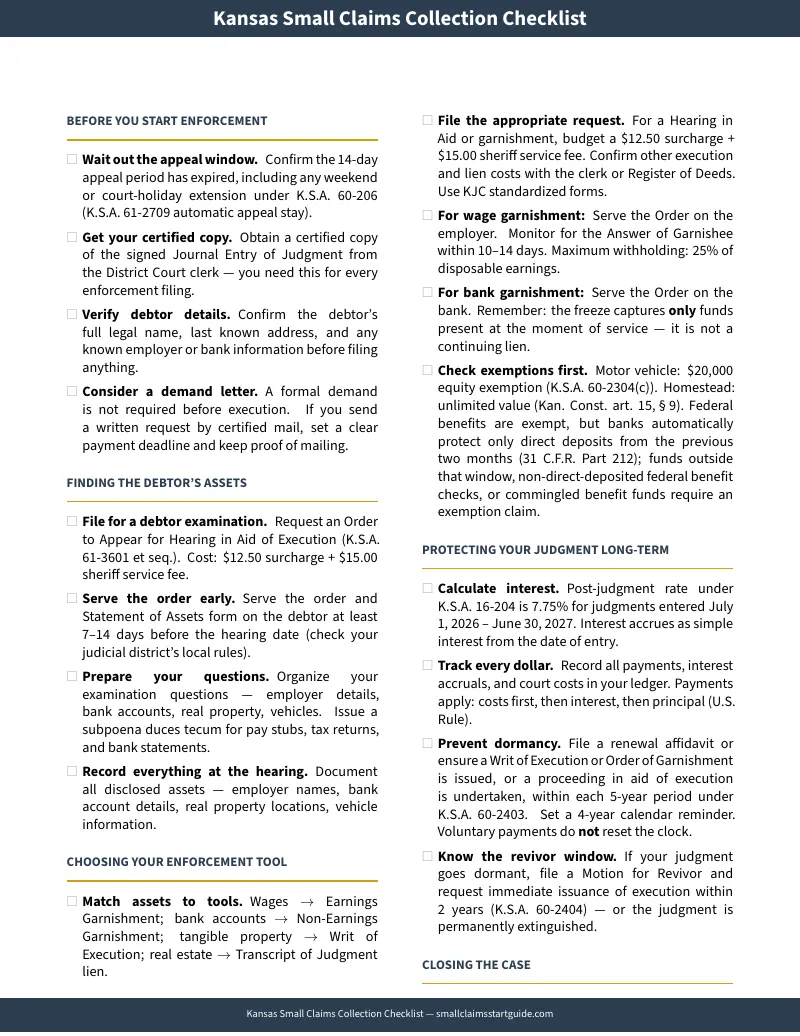
Download the free collection checklist — a two-page overview of the enforcement tools, forms, and deadlines — or get the full 8-PDF kit: the 53-page guide plus six printable worksheets for tracking your balance, preventing dormancy, planning your enforcement strategy, preparing for debtor examinations, filing garnishments, and closing the case.
The judgment says you are owed the money. The guide shows you how to collect it.
Frequently Asked Questions
What if the rules change after I buy?
We update the guide when the rules change. Email us any time, even years later, and we'll send you the current edition free.