
You know the court exists. You don't know which form to file first.
Your contractor took a $3,500 deposit and disappeared. Your landlord kept your security deposit past the 30-day window and never sent an itemized statement. A client owes you for work you finished months ago. You searched "how to file small claims in Kansas" and found the Kansas Judicial Branch self-help page, a Kansas Legal Services brochure that still says the limit is $4,000, and a Nolo guide that covers all fifty states in four hundred pages — none of which told you, start to finish, what to do and in what order in a Kansas District Court.
You don't need fifty states. You need to know which Kansas county to file in under K.S.A. 61-2708, whether the base docket fee is $35 or $55, how to find the defendant's legal name so your judgment actually sticks, how to get the papers served within the 90-day window, and what to bring to a hearing where attorneys aren't allowed. One wrong entity name on the petition, one missed venue rule, and your case stalls before the judge hears a word.
The Kansas Small Claims Filing Workflow
The Kansas Small Claims Filing Guide takes the entire process — from checking whether your claim fits the $10,000 cap through to what happens after the judge's decision — and puts it in one printable sequence with checklists, worksheets, and a deadline calendar. Every step references the specific Kansas form, the K.S.A. citation, and the timeline.
This is not a national overview that mentions Kansas in a footnote. It is not a form-filling service that charges $99 to $299 for software that generates blank PDFs without explaining how to fill them. It is not a debt-defence product that helps people answer claims — this guide is for people filing them. And while the Kansas Judicial Council posts downloadable forms at kscourts.gov, those forms come without step-by-step instructions, without service tracking tools, and without guidance on the venue trap in K.S.A. 61-2708 that catches first-time filers.
What's Inside
Checking the Limit and the Clock
Kansas small claims handles money judgments and personal property recovery up to $10,000 under K.S.A. 61-2703. That cap replaced the historical $4,000 ceiling — older sources citing $4,000 are outdated. The statute of limitations varies by claim type: five years for a written contract under K.S.A. 60-511, three years for an oral contract under K.S.A. 60-512, and two years for property damage under K.S.A. 60-513. The guide walks through each limit and shows you how to calculate your deadline from the date the breach or injury occurred.
The Demand Letter — Document the Dispute Before You File
Kansas does not require a demand letter for most claims, but sending one is strongly advisable: it documents that you asked for payment and were refused, gives the other side a chance to settle without court, and strengthens your case at the hearing. For worthless check claims under K.S.A. 60-2610, the 30-day written demand is mandatory before filing. The guide includes a demand letter framework with mailing instructions and covers what to include, how to send it, and how long to wait before filing.
Identifying the Defendant — Getting the Legal Name Right
Suing a trade name instead of the underlying LLC or corporation renders any resulting judgment legally void. The guide walks through verifying the defendant's legal entity through the Kansas Secretary of State Business Entity Search portal, determining whether to name a DBA, LLC, or individual, and finding a registered agent address for corporate defendants. This is one of the most common mistakes in small claims — and one of the most expensive.
Venue Rules — Filing in the Right County
Kansas has 105 counties in 31 judicial districts. Filing in the wrong one gets your case dismissed. K.S.A. 61-2708 gives you four venue options, but the fourth — the county where the cause of action arose — carries a residency requirement that trips up many filers. The guide explains all four options and how to choose the right courthouse, including the practical differences between metropolitan courthouses with automated queues and rural county seats with limited clerk hours.
Filing the Petition and Summons
The guide walks through the petition and summons forms field by field: naming the defendant correctly, writing a clear factual statement, signing under oath, and meeting the notarization requirement. It covers the filing fees — $35 base for claims up to $500, $55 for claims over $500, plus county surcharges — and the poverty affidavit option under K.S.A. 60-2001 for those who cannot afford the fees. Three filing routes are covered: in-person counter filing, postal mail, and electronic filing where the judicial district supports it.
Service of Process — Getting the Papers to the Defendant
Filing the claim is half the job. Getting the papers properly served on the other side is the other half, and failed service is one of the most common reasons claims stall. The guide covers three service methods: certified mail with return receipt, county sheriff delivery at $15 per defendant, and court-appointed special process servers. It explains the 90-day service deadline under K.S.A. 61-2902, what to do when certified mail comes back refused versus unclaimed (the law treats these very differently), and how to request a 30-day extension. The service tracking log keeps every attempt, date, method, and result in one place.
Counterclaims and Transfers
The defendant may file a counterclaim arising from the same transaction under K.S.A. 61-2706. If the counterclaim exceeds $10,000, either party may request a transfer to regular civil proceedings — where attorneys are permitted. The guide covers how counterclaims change the hearing dynamic and what to expect if the case transfers.
Evidence Assembly — What the Judge Needs to See
The hearing is informal but the judge still needs organized evidence. Showing up with a stack of loose papers in no particular order is the easiest way to lose a case you should win. The guide covers how to build an evidence binder: contracts and agreements, invoices and receipts, photographs with dates, repair estimates, text messages and emails, and witness statements. The evidence organizer worksheet keeps everything indexed and hearing-ready.
The Hearing — What Actually Happens
Kansas small claims hearings are held before a District Judge, and attorneys are not permitted to appear for either party under K.S.A. 61-2707. The guide covers what the courtroom looks like, how the judge runs the proceeding, how to present your evidence clearly, how to respond to the defendant's arguments, and what happens if the defendant does not show up. Most hearings last 15 to 30 minutes — they are designed for people without legal training.
After the Decision — Appeals and Collection Basics
If you win, the judgment means the court says the defendant owes you the money. It does not collect the money for you. Either party may appeal within 14 calendar days under K.S.A. 61-2709 — and the appeal triggers a de novo trial before a different judge where attorneys are permitted. The guide covers the appeal timeline, the mandatory attorney fee-shifting provision for frivolous appeals, and the Judgment Debtor's Statement of Assets form that maps the road to collection.
Printable Worksheets and Planning Tools
The kit includes printable worksheets plus the 25-item master checklist: a deadline calendar mapping every statutory window from demand letter through appeal, a cost calculator covering docket fees plus service fees, a service tracking log, an evidence organizer, a case eligibility worksheet, a defendant entity verification worksheet, and a fill-in demand letter template with mailing record. Print them, write on them, check off each step as you go.
Who This Is For
- Tenants owed a security deposit. Kansas law requires landlords to return the deposit or provide an itemized statement of deductions within 30 days of lease termination. Wrongful withholding entitles the tenant to damages of one and a half times the amount withheld. The guide covers the statutory timeline, how to calculate your claim, and how to document the unit condition at move-out.
- Homeowners with a contractor dispute. The roofer, plumber, or remodeler took your deposit and abandoned the project or delivered substandard work. Contractors who operate under trade names or use post office boxes can be difficult to serve — the guide covers how to find the correct legal entity name and how to use sheriff service when certified mail fails.
- Small landlords owed rent or damage costs. A former tenant left owing rent or caused damage beyond the deposit. Money claims go through small claims — evictions are a separate process under K.S.A. 61-3801 et seq. The guide covers landlord money claims only, with guidance on documenting damages and locating a former tenant for service.
- Sole traders and small businesses with unpaid invoices. A client stopped paying. The guide covers how sole proprietors and businesses file and the 10-case annual cap under K.S.A. 61-2704 that limits how many claims you can bring per year.
- Buyers refused a refund. You paid for something that never arrived, was defective, or did not match the description. The guide covers identifying the correct legal name of a business through the Kansas Secretary of State's online search.
- Anyone owed money in Kansas under $10,000. If you would rather spend an evening with a step-by-step guide than navigate scattered Judicial Branch pages, legal aid brochures with outdated limits, and raw statute text, this is for you.
Why Not Just Use the Free Court Resources?
You should use them — and the guide tells you exactly when and where. The Kansas Judicial Branch at kscourts.gov publishes a small claims self-help page, downloadable Judicial Council forms, and links to county clerk offices. Kansas Legal Services publishes brochures and an automated guided interview tool for security deposit disputes.
What these resources do not do is put the information in the order you need it. The Judicial Branch self-help page explains the rules but not the step-by-step sequence. Judicial Council forms are blank PDFs without line-by-line instructions. Kansas Legal Services brochures are helpful but some still cite the outdated $4,000 limit. County clerk web pages list local fee schedules but do not explain venue selection, entity verification, or evidence preparation. And clerks can explain administrative procedures but are legally barred from giving legal advice, evaluating your claim, or helping you organize your evidence.
The guide does the organizational work: every form, every fee, every deadline, in the order you encounter them, with checklists and worksheets you can print and work through. It sits between the free information (which you still need) and a $150-to-$350-an-hour attorney (which makes no economic sense for most claims under $10,000).
What This Is Not
This guide explains the procedure. It does not give legal advice, predict outcomes, or tell you how to argue your case. It is not published by, affiliated with, or endorsed by the Kansas Judicial Branch, Kansas courts, or any government agency. If you need legal advice, contact a lawyer. If you need free help, the guide lists Kansas Legal Services, the Kansas Bar Association lawyer referral service, and courthouse resources.
Satisfaction Guarantee
Full refund, no time limit. If the guide is not what you expected, email [email protected] and we will refund you — no questions, no deadline.
Get Started
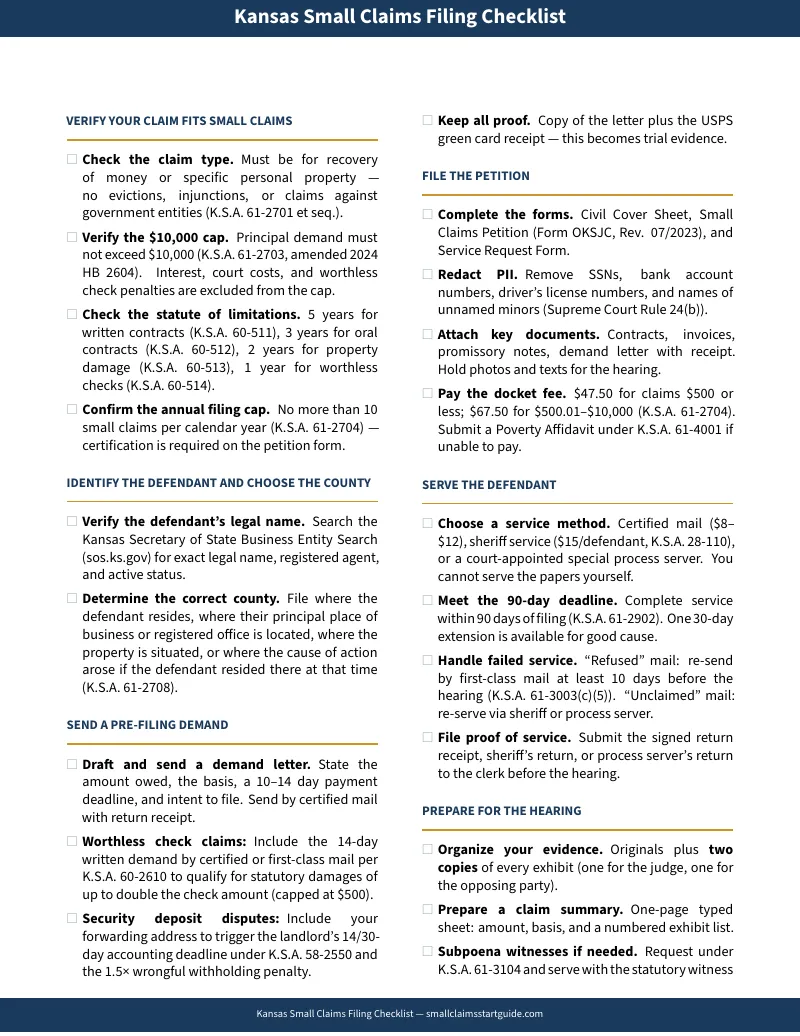
Download the free Kansas Small Claims Filing Checklist — a two-page, 25-item summary of the limit, forms, fees, service steps, and deadlines. If you want the full guide with step-by-step instructions, printable worksheets, and the deadline calendar, get the complete Kansas Small Claims Filing Guide for .
Frequently Asked Questions
What if the rules change after I buy?
We update the guide when the rules change. Email us any time, even years later, and we'll send you the current edition free.