You've been served. The 20-day clock is already running.
The certified mail arrived with a green card to sign, or a sheriff appeared at your door. Either way, an Original Notice and Petition for a Money Judgment is now sitting on your table, and somewhere in the text it says you have 20 calendar days to file an Appearance and Answer — not business days, calendar days, weekends included. Miss that window and the plaintiff can take a default judgment against you under Iowa Code § 631.5(6). No hearing. No chance to explain your side. Just a judgment for whatever the plaintiff claimed, up to $6,500, plus post-judgment interest and court costs on top.
You call the Clerk of the District Court. They're polite, but they can't help — Iowa Judicial Branch policy prohibits court clerks from giving legal advice, interpreting the claim, or telling you how to fill out the answer form. They point you to the Electronic Document Management System (EDMS) and wish you luck. You search online and find a Nolo book that covers all 50 states in two chapters, a few legal blogs that assume you're the plaintiff, and a commercial filing service that only works if you're suing someone. Nothing tells you how to respond to a small claims case in Iowa, specifically, step by step, on a deadline.
The Iowa Response Navigator
This guide replaces the scattered information with a single, sequential procedure built for defendants in the Small Claims Division of the Iowa District Court. It starts the moment you receive the papers and walks through every step: verifying the court papers are real, calculating your exact deadline under Iowa Code § 631.4(1), completing and eFiling your Appearance and Answer (eForm 3.11) through EDMS, deciding whether to counterclaim on eForm 3.13, preparing your evidence for the magistrate hearing, and understanding what happens after the judge rules.
Every step references the specific Iowa statute, court form number, and procedural rule you need at that moment. Nothing generic. Nothing borrowed from another state.
What's Inside
- Court paper decoder — a page-by-page walkthrough of the Original Notice and Petition (Form 3.1), identifying the case number, the county, the claim amount, the plaintiff's allegations, and the three dates that have different legal meanings (court filing date, service date, and receipt date).
- 20-day deadline calculator — a step-by-step worksheet that applies Iowa's time-computation rules to Iowa Code § 631.4(1). Identifies Day 0 (the service date — not when you read the papers), counts calendar days, adjusts for weekends and state holidays, and marks your exact filing deadline. Separate instructions for the 60-day period available to certain nonresident defendants.
- eForm 3.11 completion guide — field-by-field instructions for the Appearance and Answer form. How to formulate a factual denial, partial admission, or full admission that addresses each allegation. How to avoid the vague language that magistrates disregard.
- EDMS eFiling walkthrough — step-by-step navigation of Iowa's mandatory electronic filing system. Account setup, case lookup by county and case number, document category selection ("Small Claims Common Filings"), PDF upload, and how to confirm your filing with a Notice of Electronic Filing (NEF). Plus troubleshooting for session timeouts, PDF format errors, and category mismatches.
- Counterclaim walkthrough — when eForm 3.13 makes sense (the plaintiff owes you money from the same transaction or occurrence), how to complete it, the $6,500 jurisdictional cap on counterclaims, and how filing one changes the hearing dynamics.
- Mediation preparation — what court-annexed mediation involves, how to prepare your materials before the mediator session, and how to document a settlement agreement so it's enforceable.
- Hearing preparation system — how to build three matching evidence packets (magistrate copy, plaintiff copy, personal reference copy) with a numbered exhibit index. How to organize contracts, invoices, receipts, photos, and text messages chronologically. Iowa's relaxed evidentiary standard in small claims and what it means for your exhibits.
- Post-decision navigation — the 20-day appeal window to District Court under Iowa Code § 631.13, the $215 appeal docketing fee, what review on the electronic audio record means, the 60-day window to set aside a default judgment under § 631.12, and how to file a Release and Satisfaction (eForm 3.23) after settlement or payment.
- Emergency same-day response protocol — a condensed sequence for getting eForm 3.11 filed through EDMS when your deadline is imminent. Covers paper-filing exemption applications for defendants with genuine technical barriers.
- Free legal aid directory — contact information for Iowa Legal Aid (1-800-532-1272), University of Iowa Student Legal Services, county mediation programs, and ADA/accessibility resources including Relay Iowa TTY service.
Who This Guide Is For
- Homeowners served by a contractor over disputed renovation or repair work
- Former tenants sued for alleged property damage or unpaid rent
- Landlords served by a former tenant over a withheld security deposit under Iowa Code § 562A.12
- Small business owners, LLC officers, or partners served by a customer — Iowa Code § 631.14 allows non-attorney officers or regular employees to appear on behalf of business entities
- Private sellers served over an alleged defect or misrepresentation in a vehicle or personal property sale
- Anyone in Iowa who has been served with a non-debt small claims case and wants to respond without hiring an attorney
This guide covers non-debt monetary disputes in the Small Claims Division (up to $6,500). It does not cover lawsuits brought by lenders, debt buyers, or collection agencies — those involve different consumer protection defenses under the Iowa Consumer Credit Code (Chapter 537). If you've been sued over a consumer debt, contact Iowa Legal Aid at 1-800-532-1272 or visit iowalegalaid.org for free help.
Why Not Just Use the Free Resources?
The court forms are free — and the guide links directly to every one of them at iowacourts.gov. But the forms are the easiest part. What the Iowa Judicial Branch website doesn't give you is the workflow: how to verify your deadline with calendar-day precision, how to navigate the EDMS eFiling portal without choosing the wrong document category and getting your filing rejected, how to frame your factual denial so it actually addresses each allegation, and how to organize your evidence so the magistrate can follow your case in a 15-minute hearing.
Court clerks process filings, but they're legally barred from telling you how to complete the form or what to do next. Iowa Legal Aid helps qualifying low-income Iowans, but income eligibility caps at 125–200% of the federal poverty guidelines exclude many working defendants. The Interactive Court Forms (IICF) software walks you through document preparation but doesn't help you organize evidence, prepare for the hearing, or navigate post-decision options. The national guides cover defendants in a single generic chapter without Iowa's mandatory eFiling steps, 20-day deadline rules, or specific form numbers.
This guide gives you the complete Iowa defendant response procedure in sequential order, from the day you're served through the day after the decision.
Independent Publisher — Not a Court Resource
Small Claims Start Guide is an independent publisher. This guide is not affiliated with, endorsed by, or produced by the Iowa Judicial Branch, the Iowa District Court, or any county court. It explains the procedure — it does not give legal advice, predict case outcomes, or file documents on your behalf. If your situation is complex, consult a licensed Iowa attorney.
Get the Checklist Free, or Get the Full Guide
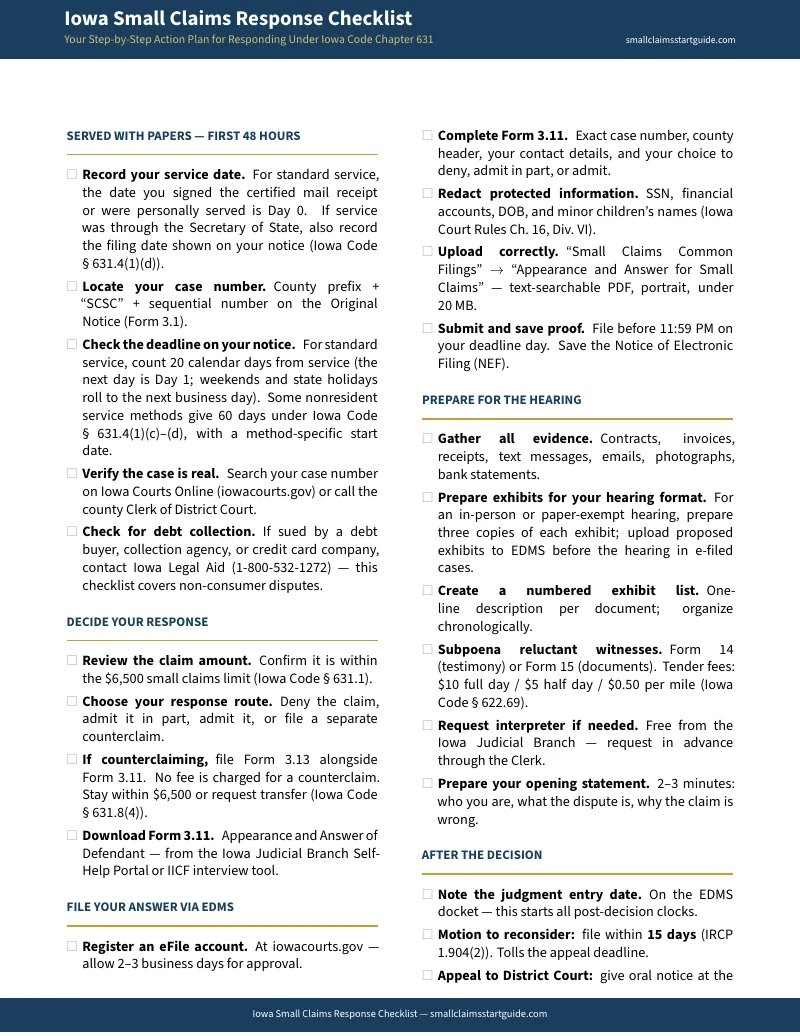
Download the free Iowa Small Claims Response Checklist — a printable summary of the response deadline, your options, the forms you need, and the hearing preparation steps. It tells you what to do. The full guide tells you how, step by step, with the form instructions, deadline calculator, EDMS walkthrough, evidence organizer, and printable worksheets that turn the checklist into action.
Full refund, no time limit. Questions? Email [email protected].
Frequently Asked Questions
What if the rules change after I buy?
We update the guide when the rules change. Email us any time, even years later, and we'll send you the current edition free.