
You're owed money. The court system is supposed to help. So why does it feel like a maze?
You know exactly what happened. The contractor vanished with your deposit. The landlord kept your security deposit past the 45-day deadline. The customer stopped returning calls on a $6,000 invoice. The damage is real, the amount is clear, and you want what you're owed.
Then you try to file. Indiana runs two entirely different small claims court systems — nine Township courts in Marion County and Circuit/Superior Court dockets in the other 81 counties. Each with its own forms, its own fees, its own local rules. The official state manual is 28 pages of statutory text. And when you call the clerk's office for help, you learn they're legally prohibited from telling you how to fill out the forms or which court to choose.
Most people stall right here. Not because their claim isn't valid — because the paperwork feels overwhelming when nobody is allowed to walk them through it.
The Indiana Filing Roadmap — Every Step in Order, Nothing Left to Guess
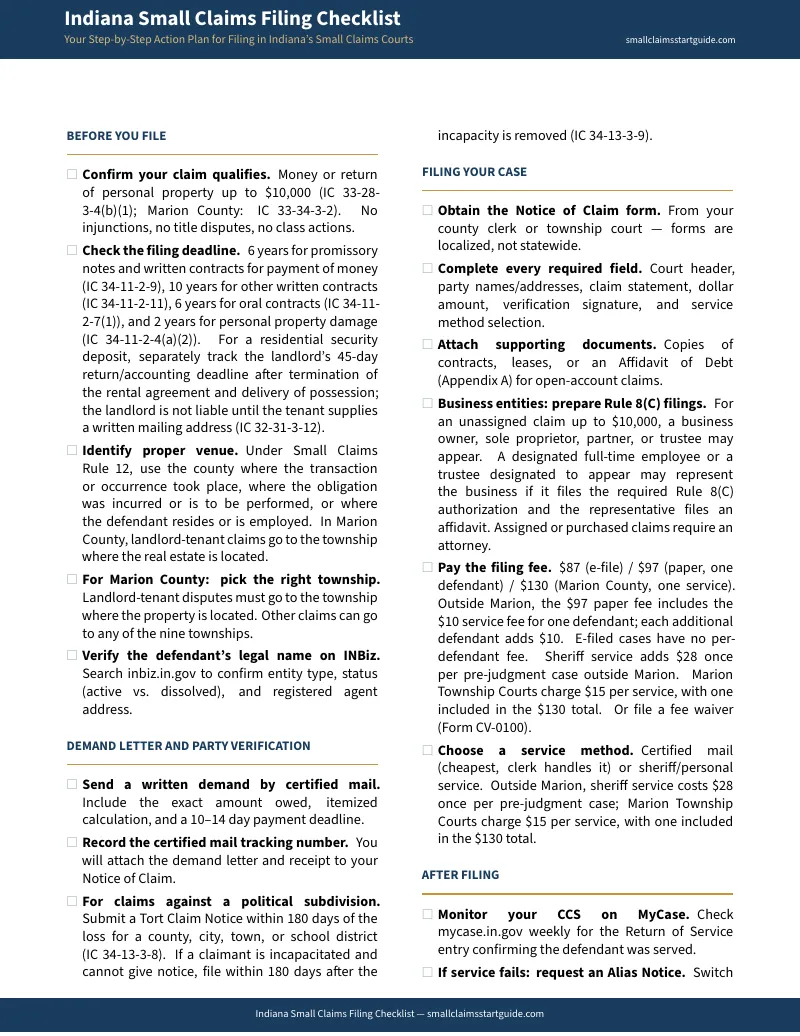
This guide takes Indiana's fragmented court rules, scattered county forms and dense statutory language and turns them into a single chronological workflow. You start at "do I have a claim?" and end at the hearing with your evidence organised. Every decision point has a clear answer. Every form requirement is spelled out. Every deadline is calculated for you.
It is not legal advice and it does not predict outcomes. It is a procedural roadmap — the filing system that keeps your case from being dismissed on a technicality before a judge ever looks at the merits.
What's Inside the Full Guide
- Dual-track court navigator — a decision tree that tells you exactly which of Indiana's two court systems handles your case, from Marion County's townships to the 81-county dockets, with the correct forms and fees for each
- Venue verification matrix — the three tests under Small Claims Rule 12, worked through for contractor disputes, landlord-tenant claims and unpaid invoices, so you file in a court that won't transfer or dismiss your case
- Statute of limitations reference — every filing deadline mapped to your claim type: 10 years for written contracts, 6 years for oral agreements, 2 years for property damage, plus the landlord's 45-day security deposit rule under IC 32-31-3-12
- Demand letter builder — the exact components judges want to see, with certified mail tracking instructions and a delivery log to attach to your court filing
- INBiz entity lookup steps — how to verify a business's legal name, active status and registered agent before you file, because a judgment against the wrong entity name is unenforceable
- Notice of Claim assembly — what the form requires whether you file by paper at the counter or through Indiana's E-Filing System, including the Affidavit of Debt for open-account claims
- Complete fee schedule — e-filing ($87), paper ($97 for one defendant), Marion County ($130 for one service), sheriff service ($28), additional defendants and fee waivers, with a worked example showing the total for a two-defendant claim
- Service of process tracker — a log that tracks certified mail return receipts, sheriff service confirmations and alias summons requests when initial service fails
- Rule 8(C) business compliance — the January 2025 update that lets business owners and employees represent LLCs, corporations and partnerships for claims up to $10,000, with step-by-step instructions for the corporate resolution and compliance affidavit
- Hearing preparation dossier — how to build a three-set exhibit binder (judge's copy, defendant's copy, yours) under Indiana's informal evidence standard, with an exhibit index template
- Post-judgment overview — what the judgment order means, how 8% statutory interest starts accruing, and where the separate collection guide picks up
- Six printable worksheets — a pre-filing venue and jurisdiction checklist, demand letter tracker, Notice of Claim assembly checklist, service of process log, hearing evidence index and court cost calculator, each designed to print and fill in as you move through the steps
Who This Is For
- Homeowners owed thousands by a contractor who took the deposit and disappeared
- Tenants whose landlord kept the security deposit past Indiana's 45-day statutory deadline
- Small landlords pursuing unpaid rent or property damage beyond normal wear and tear
- Sole traders, freelancers and small business owners with unpaid invoices under $10,000
- Consumers pursuing refunds, vehicle repair disputes or neighbour property damage
Why Not Just Use the Free Court Website?
The official Indiana Small Claims Manual is free and publicly available. The county clerk's forms are free. The statutes are free. None of that is a secret.
What's missing is the bridge between those raw materials and actually filing. The state manual devotes a full page to the statute of limitations chart but doesn't tell you how to calculate your deadline for a partially performed contract. The Clark County form gives you checkboxes for service method but doesn't explain what happens when certified mail comes back "unclaimed." The Marion County township brochures cover their own local rules but don't explain how the other eight townships differ.
Court clerks are statutorily prohibited from helping you complete the forms, advise on venue selection, or review your filing for accuracy. Their words, posted on their own websites: "Our staff are not legally permitted to provide legal advice or assistance in completing these forms."
The guide doesn't replace those free resources — it organises them into a filing sequence you can follow from start to finish, with the context the raw forms and rules leave out.
Satisfaction Guarantee
Full refund, no time limit. If the guide doesn't help, email [email protected] and you'll get your money back. No forms to fill in, no expiry date.
Start Filing with Confidence
Download the free checklist to see the filing steps at a glance. When you're ready for the full walkthrough — the forms, the fees, the deadlines, the worked examples and the tracking logs — the complete guide is waiting at .
Frequently Asked Questions
What if the rules change after I buy?
We update the guide when the rules change. Email us any time, even years later, and we'll send you the current edition free.