You have been served with a small claims summons. The return date is coming. You do not know what to do first.
You have read the summons three times. You have Googled "Illinois small claims defendant" and found the Illinois Courts website, a few county clerk pages, an Illinois Legal Aid Online article, and a Reddit thread that might apply to a different county. You still do not know whether you need to file a written answer, what happens on the return date, or what to bring to court. The circuit clerk's office cannot help — Illinois law prohibits court staff from giving legal advice or procedural strategy.
The free resources exist. The state publishes blank Appearance and Answer forms. ILAO has a guided interview. But blank forms do not tell you when a written answer is legally required versus when showing up on the return date is enough. They do not explain how to organise text messages, invoices, and photographs into evidence a judge can follow in a fifteen-minute hearing. And none of them puts the steps in order for someone who has been served and needs to respond.
The Illinois Small Claims Response System does one thing: it takes you from "I just got served" to "I am walking into court prepared." It is a step-by-step procedural guide with printable worksheets — a summons verification log, county protocol checklist, evidence binder organizer, deadline tracker, settlement preparation worksheet, and hearing preparation outline — that turns scattered information into a single, organised defence file.
Why a guide when the forms are free?
Official court forms are blank templates. The Appearance form asks you to fill in fields without explaining whether your county requires you to file one before the return date or whether showing up in person is sufficient. The Answer form exists — but under Illinois Supreme Court Rule 286(a), you are not required to file a written answer in small claims unless the court specifically orders one. Your appearance on the return date counts as a general denial. That single fact, which most defendants do not know, is the difference between panicking over paperwork and walking in calm.
Free resources are scattered across five different websites — the state judiciary, ILAO, your county circuit clerk, the eFileIL portal, and whatever your county posts about Zoom hearings versus in-person appearances. Each site is organised by topic, not by what a defendant needs to do next. The guide stitches them into one sequence so you are not jumping between tabs trying to figure out whether you need to file something before you show up.
What is inside
- Summons verification walkthrough — a field-by-field breakdown of every element on your summons so you can confirm the case number, court location, plaintiff identity, and return date, and know immediately whether the papers are legitimate
- Return date explained — the 40-to-61-day window under Rule 101(b), why it is not your trial date, what actually happens that day (administrative call, possible mediation, or same-day hearing depending on your circuit), and what happens if you are not there
- Written answer decision framework — Rule 286(a) means most small claims defendants do not need to file one, but local county rules and specific judicial orders can change that. The guide walks you through the decision so you know exactly what applies in your courthouse
- Four response options — disputing the claim, admitting part or all of it, negotiating a settlement, or filing a counterclaim if the plaintiff owes you money. Each option includes the form requirements, deadlines, and practical consequences
- Evidence binder organizer — a structured exhibit system built around Rule 286(b) informal hearing standards. Organise contracts, invoices, text messages, photographs, repair estimates, and receipts in chronological order with labelled exhibits the judge can follow
- County protocol checklist — Cook County's mandatory mediation through the Center for Conflict Resolution, McLean County's Zoom initial appearances, Madison County's tiered fee structure, and a verification process for confirming your own courthouse's rules
- Hearing walkthrough — what to expect in the courtroom, how the judge runs an informal hearing, how to present your evidence, how to respond to the plaintiff's evidence, and common mistakes that hurt credibility
- Default judgment recovery — if you already missed the return date, the guide covers the 30-day motion to vacate under 735 ILCS 5/2-1301(e), what "good cause" means in practice, and how to file through eFileIL or in person
- Post-decision options — the 30-day appeal window, how appeals from small claims court work, payment plans, and when talking to a lawyer makes sense
- Fee waiver instructions — if you cannot afford court fees, the guide covers the Supreme Court Rule 298 application process, eligibility criteria, and what to expect at the hearing
- Printable worksheets — summons verification log, county protocol checklist, evidence binder organizer with chronological exhibit index, deadline and calendar tracker, settlement preparation worksheet, and hearing preparation outline — six fill-in tools you print and keep with your case file
Who this is for
- Homeowners sued by a contractor — the contractor claims you owe for work you believe was incomplete, defective, or outside the agreed scope, and you need to organise invoices, photographs, and written estimates into a coherent defence
- Former tenants sued by a landlord — your landlord claims damage beyond normal wear and tear or unpaid rent, and you need to dispute the claims with your own photographs, the move-in condition report, and communications about the security deposit
- Small business owners sued by a customer — a customer claims your product was defective or your service was not performed, and you need to present contracts, invoices, and evidence of completed work
- Private vehicle sellers — the buyer claims you sold a car with undisclosed defects, and you need to present the bill of sale, any written "as-is" disclosure, and communications about the vehicle's condition
- Anyone served with a non-debt civil claim under $10,000 in Illinois — if it is not a consumer debt collection lawsuit from a lender, debt buyer, or collection agency, this guide covers the response procedure
What about debt collection lawsuits?
Consumer debt lawsuits brought by banks, credit card companies, debt buyers, or collection agencies involve different federal and state protections — including the Fair Debt Collection Practices Act — and free legal defence resources exist specifically for those cases. This guide does not cover them. If you have been sued over a consumer debt, the guide directs you to Illinois Legal Aid Online and CARPLS for free assistance.
Why not just call the circuit clerk?
You can call the clerk's office. Staff can confirm your hearing date and courtroom number. But by Illinois law, circuit court clerks are prohibited from giving legal advice or procedural strategy — they cannot review your evidence, tell you whether to file an answer, or help you prepare for the hearing. The guide handles the procedural side: what to file, in what order, by what deadline, with what evidence.
Satisfaction guarantee
Full refund, no time limit. If the guide does not help, email [email protected] and you get your money back. No forms, no questions.
Get started tonight
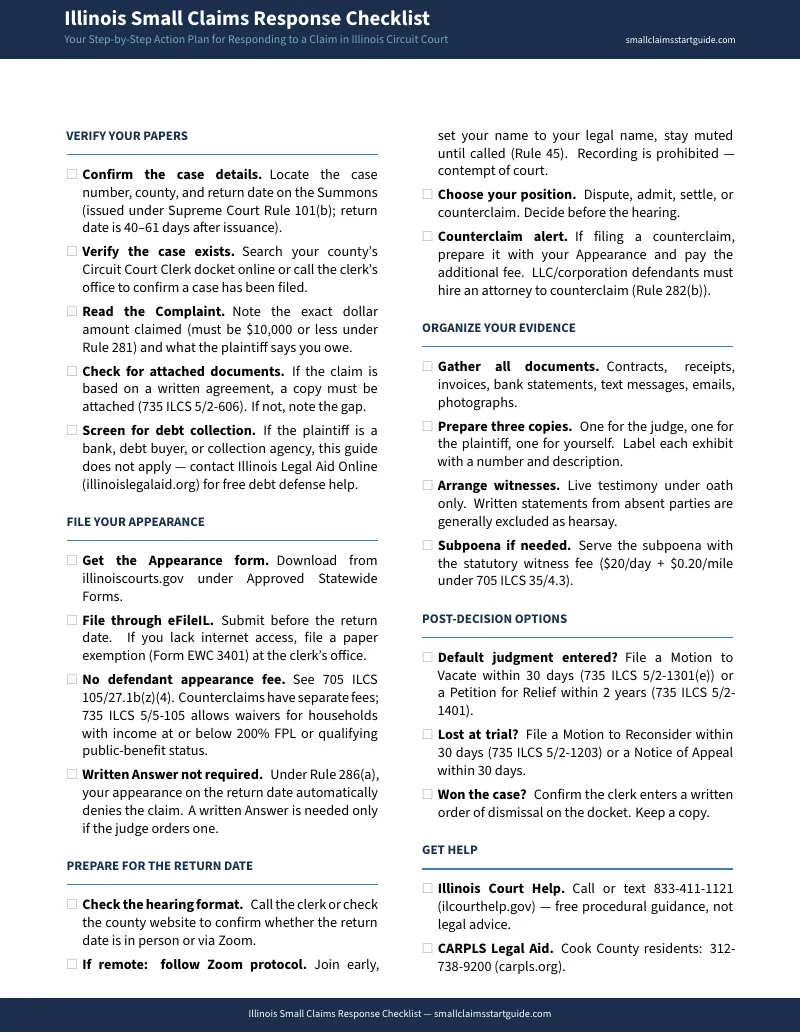
Download the free checklist to see the response steps at a glance. When you are ready for the full walkthrough — every deadline, every response option, every evidence organiser, every step from summons to hearing — the complete guide is and yours the moment you purchase.