You Won. They Haven't Paid. The Court Won't Help.
You sat through the hearing, presented your evidence, and walked out with a judgment in your favor. Then you waited for a check that never came. When you called the Circuit Clerk's office, they told you the same thing every Illinois judgment creditor hears: "We cannot collect your money — you must file the enforcement paperwork yourself."
That's the reality of small claims court in Illinois. The court enters the judgment. You enforce it. Every citation, every garnishment, every lien — it's on you to file the right forms, pay the sheriff, and follow through without making the kind of procedural mistake that delays your recovery by months.
The Illinois Judgment Collection Roadmap
This guide isn't a list of definitions or a summary of what's theoretically possible. It's a sequenced enforcement workflow — built specifically for Illinois Circuit Courts — that tells you exactly which tool to use based on what you know about the debtor, which form to file, where to file it, and what happens at each step.
The Judgment Collection Roadmap works because it mirrors the actual administrative process: the court clerk, the sheriff, the county recorder, and the e-filing portal each have specific requirements that aren't published in one place anywhere else. One rejected filing on eFileIL because your PDF wasn't flattened correctly. One garnishment served on an exempt account. One missing sheriff instruction letter. Any of these sets your recovery back weeks — and the debtor keeps your money the entire time.
What's Inside the Guide
- Enforcement Strategy Selector — maps your situation (known employer, known bank, unknown assets, real estate owner) to the specific statutory instrument and form you need. Stop guessing which paperwork to file first.
- Citation to Discover Assets Walkthrough — the complete procedure for compelling the debtor to appear in court and disclose their income, bank accounts, and property under oath, with the steps for getting a body attachment if they don't show up.
- Wage Deduction Order Process — how to garnish the debtor's paycheck within the legal limits (the lesser of 15% of gross disposable earnings or the excess over 45 times the minimum wage), including the employer interrogatories and the hearing timeline.
- Bank Account Garnishment — third-party citations and non-wage garnishment procedures for reaching funds the debtor holds at banks and financial institutions, with the exemption thresholds that protect you from sanctions.
- Real Estate Lien Recording — how to file a Memorandum of Judgment with the County Recorder of Deeds so the debtor cannot sell property without satisfying your judgment first — a passive enforcement tool that collects 9% interest while you wait.
- Personal Property Levy — the execution and sheriff sale process for seizing non-exempt personal property, including the current exemption limits ($4,000 wildcard, $2,400 vehicle equity) you need to know before you request a writ.
- 9% Interest and Cost-Tracking Ledger — a printable worksheet for calculating the daily statutory interest that accrues on your judgment under 735 ILCS 5/2-1303 and tracking every recoverable filing fee, sheriff fee, and court cost.
- eFileIL and Sheriff Logistics — the electronic filing requirements (including the PDF flattening step that trips up most self-represented filers), sheriff service cover letter instructions, and county-specific procedural notes for Cook, DuPage, Lake, and downstate counties.
- Satisfaction of Judgment Protocol — the steps to legally close your case once you've been paid in full, including the filing deadlines and delivery requirements that protect you from penalties.
Who This Is For
You already won your Illinois small claims case. You hold an unpaid monetary judgment of up to $10,000 from an Illinois Circuit Court. You're representing yourself (individuals and sole proprietors — LLCs and corporations need an attorney under Supreme Court Rule 282). And you're done waiting for a voluntary payment that isn't coming.
Why Free Court Forms Aren't Enough
Every official form referenced in this guide is freely available from the Administrative Office of the Illinois Courts and county clerk websites — and we link directly to each one. You are not paying for forms.
You're paying for the operational workflow that connects those forms into a coherent enforcement sequence. The court's self-help pages give you a blank Citation to Discover Assets. They don't tell you how to investigate the debtor's assets beforehand, how to draft the sheriff instruction letter that accompanies service, how to flatten the interactive PDF so eFileIL doesn't reject your filing, or what questions to ask during the citation examination. A single administrative rejection on a correctly filled form — because of a technical filing issue — delays asset recovery by 30 to 60 days while the debtor spends your money.
Attorney-assisted collection costs $250 to $450 per hour. For a judgment under $5,000, that math doesn't work. This guide gives you the same procedural knowledge for a fraction of a single billable hour.
Satisfaction Guarantee
If the guide doesn't meet your expectations for any reason, email [email protected] for a full refund, no time limit. We read every message.
Get Started Now
Your judgment accrues 9% statutory interest every day it goes unpaid. Every week you wait is another week the debtor has to move assets, change jobs, or relocate. The enforcement tools are available right now — the guide shows you exactly how to use them.
The guide includes:
- 50-page step-by-step enforcement guide (PDF)
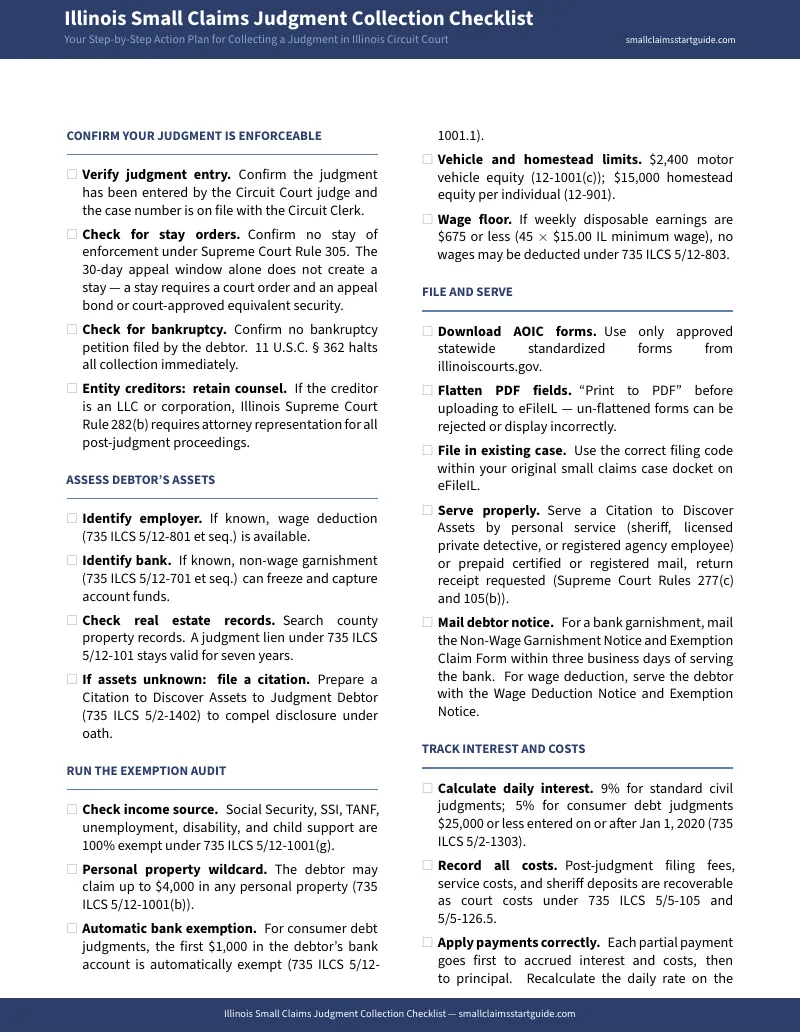
- Illinois Small Claims Collection Checklist (PDF)
- Enforcement Strategy Selector worksheet
- Cost and Interest Ledger
- Service Tracking Log
- Citation Examination Prep Sheet
- Exemption Quick Reference card
- Case Closure Checklist
Your download includes 8 PDFs — the complete guide plus 7 printable planning tools. Files are available immediately after purchase.
Frequently Asked Questions
What if the rules change after I buy?
We update the guide when the rules change. Email us any time, even years later, and we'll send you the current edition free.