
You won the case. The debtor still hasn't paid.
The magistrate ruled in your favor. The judgment says you're owed the money. But the court doesn't collect it for you — no phone call from the clerk, no sheriff showing up at the debtor's door, no automatic freeze on their bank account. You're holding a piece of paper and the other side is acting like the case never happened.
Now you're searching for answers: Can I garnish their wages? How do I find their bank account? What forms do I need? The Court Assistance Office gives you blank PDFs. The clerk can't tell you how to fill them out — Idaho law prohibits court staff from giving procedural guidance. Legal Aid doesn't represent judgment creditors. And the free online resources either focus on filing the initial claim (not collecting afterwards) or they're written for debtors trying to stop you.
The Idaho Collection Execution System — every enforcement tool, every form, every hand-off, in order
This is not a stack of forms or a legal theory overview. It's a step-by-step execution system built around the specific way Idaho's Small Claims Department handles post-judgment enforcement — the statutes, the CAO form series, the iCourt filing portal, and the physical hand-offs between court clerks and County Sheriff Civil Divisions that no free resource explains.
Where free tools give you SC 9-1 and leave you to figure out what happens after the clerk signs the writ, the Collection Execution System walks you through the entire chain: which affidavit to file, which fee to pay, how to prepare the sheriff's written directions, where to deliver the packet, and what to do when the debtor claims exemptions or changes jobs mid-garnishment.
What's inside
- Enforcement timing rules — the distinction between default judgments (execute immediately) and contested hearing judgments (mandatory 30-day appeal waiting period under IRSCA Rule 15), so you don't file a writ that gets rejected because the stay hasn't expired.
- Debtor examination procedure — how to file the Motion and Affidavit for Examination of Judgment Debtor, compel the debtor to appear in court under oath, and ask the specific asset-discovery questions that reveal employers, bank accounts, vehicles, and real property. This is how you find out what the debtor actually owns before you spend money on writs.
- Wage garnishment from affidavit to paycheck — the Affidavit for Writ of Continuing Garnishment (SC 9-2), the 25% disposable earnings cap under Idaho Code § 11-712, the employer's garnishment notice obligations, and what happens when the debtor switches employers during an active garnishment.
- Bank account levies — the Writ of Execution (SC 9-6) directed at a specific bank branch, the sheriff's service procedure, and how to identify which accounts hold exempt funds (Social Security, disability, veterans' benefits under Idaho Code § 11-604) before you spend the fees on a levy that gets challenged.
- Personal property seizure — when and how a County Sheriff can seize vehicles, equipment, tools, and inventory; the written directions the sheriff requires; and the public sale process that converts seized property into cash applied to your judgment.
- Real property liens — how to record a transcript of judgment with the County Recorder so the debtor cannot sell or refinance their home without satisfying your judgment first. The lien attaches to all real property the debtor owns in that county.
- Sheriff Packet Preparation Worksheets — the exact documents, copy counts, fee checks, and written service directions that every County Sheriff Civil Division requires alongside each issued writ. This is the gap no free resource fills: the court issues the writ electronically, but the sheriff needs a physical paper packet with specific written instructions, and a missing piece means the packet comes back unprocessed.
- Exemption rules and response procedures — what income and property Idaho law protects from seizure, how to recognize exempt funds before you waste fees targeting them, and how to contest an invalid exemption claim using form SC 9-4 within the statutory deadline.
- Post-judgment interest ledger — a tracking worksheet for calculating annual interest under Idaho Code § 28-22-104(2), recording partial payments, and maintaining the running balance you're legally owed. The interest rate changes annually per the State Treasurer, and no official calculator exists.
- Judgment renewal procedure — how to file for renewal before the statutory expiration period, so you can keep enforcing for up to a decade while the debtor's financial situation changes.
- Cross-county enforcement — what to do when the judgment was entered in Ada County but the debtor's employer is in Canyon County or their bank branch is in Kootenai County. Different sheriffs, different fees, different submission rules.
- Satisfaction of Judgment forms — how to close the case after the debtor pays in full (SC 10-1), and the statutory liability for failing to file satisfaction after receiving full payment.
Who this is for
- Individual creditors who won a small claims judgment and the other side won't pay — whether it's an unreturned security deposit, an unpaid personal loan, or a contractor who was ordered to refund your money.
- Small business operators and sole traders holding a judgment for an unpaid invoice or breached service agreement — and you need a repeatable workflow, not a one-time guessing session.
- Landlords with a damage judgment against a former tenant who has moved and is ignoring the court order — the guide covers debtor examinations and cross-county enforcement for exactly this scenario.
- Anyone who already won in the Small Claims Department (claims up to $15,000) and needs the next step — the enforcement procedure that the court does not hand you when it enters the judgment.
Why not just use the free court forms?
The Idaho Court Assistance Office publishes every enforcement form you need — for free, at courtselfhelp.idaho.gov. The writ affidavits, the garnishment forms, the debtor examination papers, the satisfaction filings — all free, all publicly available. That part is genuinely free and it should be.
What the CAO does not publish is a procedure. The forms are scattered across dozens of unlinked PDF and RTF files. There's no guidance on which form to file first, what to write in the affidavit fields, or how to calculate the accrued interest the writ must state. The forms tell you that the issued writ must be delivered to the County Sheriff — but they don't provide the mandatory Written Directions form that every sheriff's civil division requires alongside the writ. The iCourt portal lets you file electronically, which makes it feel like the process is digital — but after the clerk signs the writ, you need to print it, attach copies, write a fee check, and physically deliver or mail a paper packet to the sheriff's office. No free resource explains that bridge.
Court clerks can hand you blank forms and confirm hearing dates. They are prohibited by Idaho Supreme Court directives from giving procedural guidance, reviewing your completed forms, or explaining how enforcement works. Court Assistance Officers in rural counties are often available one day per month. Legal Aid Services in Idaho dedicates its resources to family law, housing defense, and domestic violence — they do not represent judgment creditors. The guide fills the gap where these free resources stop.
What this guide does not do
This is a procedural navigation guide, not legal advice. It does not guarantee that the debtor has assets, does not predict collection outcomes, and does not replace an attorney's judgment on the merits of your situation. No document can extract money from a debtor who has zero non-exempt assets or has filed for federal bankruptcy protection. What the guide does is show you how to find assets, choose the right enforcement tool, prepare the paperwork correctly, and keep the judgment alive while the debtor's circumstances change.
Small Claims Start Guide is an independent publisher. It is not affiliated with the Idaho Supreme Court, the Court Assistance Office, any county court, or any government agency.
Your purchase
The full guide comes as a downloadable PDF — 51 pages covering every stage from enforcement timing to filing the Satisfaction of Judgment. You also get the quick-start checklist, the enforcement strategy planner, the sheriff packet checklist, the debtor examination question list, the payment tracking worksheet, the judgment renewal tracker, and the forms-to-offices roadmap — 8 printable PDFs in total.
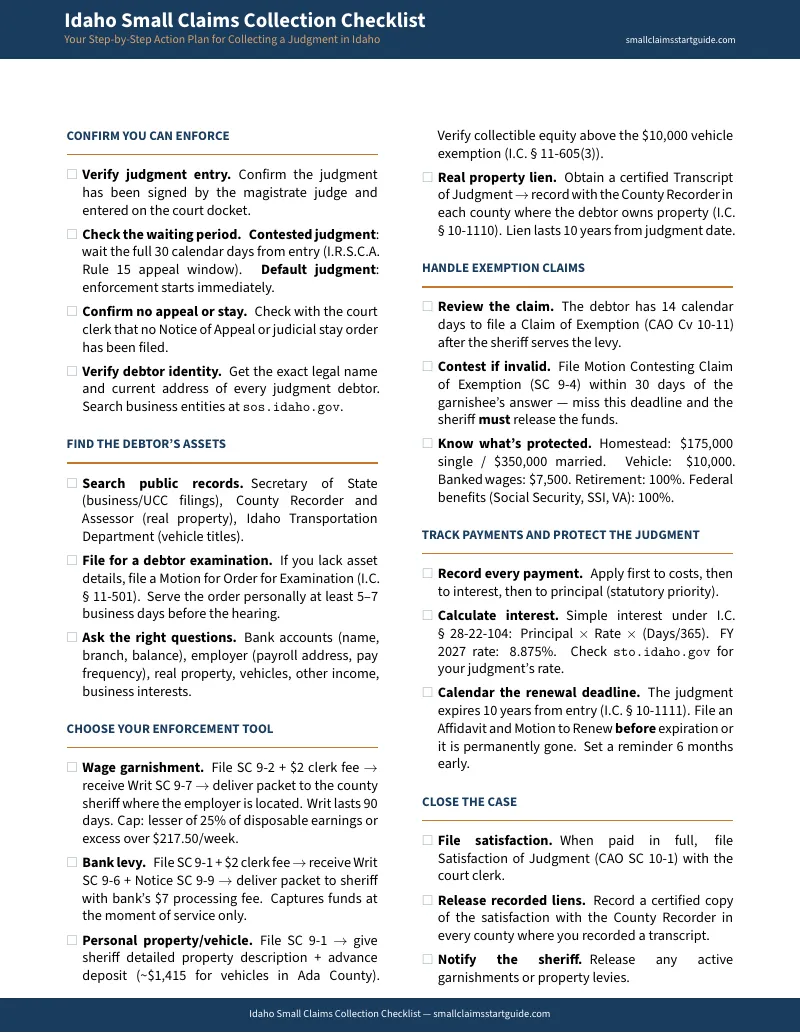
Not sure yet? Download the free checklist first — it covers the enforcement options, the forms, and the exemptions on a single page. If you want the full procedure, the sheriff packet worksheets, and the interest tracking ledger, the complete guide is .
Full refund, no time limit. Email [email protected].
Frequently Asked Questions
What if the rules change after I buy?
We update the guide when the rules change. Email us any time, even years later, and we'll send you the current edition free.