
You know you're owed the money. You just don't know how to get it back.
The contractor took your deposit and vanished. The landlord kept your security deposit for "cleaning" that was normal wear and tear. The customer received your work and stopped returning calls. You know the amount, you have the receipts, and you've been patient long enough.
Idaho's small claims court was built for exactly this — disputes up to $15,000, resolved by a magistrate judge, no lawyer allowed in the room. But the court gives you blank forms and a filing window, not a plan. The Court Assistance Office can't tell you what to write on the complaint, which county to file in, or how to organize your photos and text messages so the judge can actually use them. Court clerks are prohibited from giving that guidance.
The Idaho Filing Roadmap — every step from demand letter to hearing, in order
This is not a stack of forms. It's a procedural preparation system built around the specific way Idaho's Small Claims Department works — the statutes, the CAO forms, the iCourt filing platforms, and the magistrate hearing format.
Where free tools give you a blank complaint form and leave you to guess what happens next, the Filing Roadmap puts the entire sequence in front of you: which letter to send first, which form to file second, how to serve the other side, and what to bring to the hearing. Every step references the Idaho statute or court rule behind it, so you know why you're doing it, not just that you should.
What's inside
- Demand letter templates for three claim types — security deposits (with the mandatory 3-day statutory demand under I.C. § 6-320 that most tenants skip, killing their case before it starts), unpaid invoices, and contractor disputes. Each template is built around the elements Idaho magistrates look for at trial.
- Entity verification walkthrough — how to search the Idaho Secretary of State business registry at sos.idaho.gov to find the defendant's actual legal name and registered agent. A complaint that names "Joe's Plumbing" instead of the registered LLC produces a judgment you can't enforce against anyone.
- County venue decision tree — Idaho Code § 1-2301 requires filing in the county where the defendant lives or where the dispute arose. File in the wrong county and the defendant moves to transfer, costing you weeks. The decision tree walks through residence, contract performance, rental property location, and property damage situs.
- CAO form-by-form walkthrough — the Claim of Plaintiff (SC 1-2), Small Claims Summons (SC 1-1), Affidavit of Competence and Non-Military Service (SC 5-1A), and the fee waiver motion (FW 1-9) — with what to write in each field and how many copies you need.
- Three filing channels explained — paper filing at the clerk's window, the Guide & File interview tool, and File & Serve electronic filing. Each channel has different formatting requirements and the guide tells you which one your county uses.
- Service of process tracking ledger — certified mail through the clerk ($10.10), county sheriff service with the required Letter of Instruction, and private process server. The ledger tracks mailing dates, tracking numbers, green-card return dates, and affidavit completion — everything you need for the Affidavit of Service the court requires.
- Evidence binder template — magistrate hearings are brief. Judges cannot scroll through your phone. The binder template shows you how to organize contracts, photos, invoices, bank statements, and text messages into the four-copy indexed format that Idaho magistrates expect, with exhibit tabs and a cover sheet.
- Hearing preparation framework — how to structure a five-minute factual statement, what order to present evidence, how to respond to the judge's questions, and what not to say. No attorney is allowed to represent you at trial under I.C. § 1-2308, so you need to present your own case clearly.
- Deadline calendar — the 21-day defendant answer window, the hearing date, the 30-day de novo appeal period, all five statutes of limitations, and the pre-judgment and post-judgment interest rates (12% and 8.875% for FY2027). Miss one deadline and the case stalls or dies.
- Post-judgment orientation — what happens after you win, including the appeal window, execution, garnishment, and when to move to the judgment collection stage.
Who this is for
- Tenants whose landlord withheld a security deposit for routine wear and tear — the guide includes the mandatory 3-day demand letter that Idaho law requires before you can file.
- Homeowners who paid a contractor deposit and the work was never finished — the guide covers entity verification so your complaint names the right legal entity, not just a trade name.
- Sole traders and freelancers with an unpaid invoice — the guide explains electronic filing mandates for business entities and the prohibition on attorney representation.
- Buyers who purchased something defective and were refused a refund — the guide covers how to document the purchase, the defect, and the refusal.
- Neighbours dealing with property damage — the guide walks through proving causation and identifying the correct property owner.
Why not just use the free court forms?
The Idaho Court Assistance Office publishes every form you need — for free, at courtselfhelp.idaho.gov. That part is genuinely free and it should be.
What the CAO does not publish is a procedure. The forms arrive as disconnected PDFs. There is no guidance on which form comes first, what to write in the "Statement of Claim" field, how to calculate your damages, how to find the defendant's legal name, or how to organize evidence so the magistrate can review it during a brief bench trial. Court clerks are prohibited by Idaho Supreme Court directives from answering these questions. The Court Assistance Officers in rural counties are often available only one day per month.
The guide fills the space between the forms and the hearing. It does not replace the forms — it tells you what to do with them, in what order, and why each step matters under Idaho's specific statutes and court rules.
What this guide does not do
This is a procedural preparation guide, not legal advice. It does not tell you whether your claim will succeed, does not predict outcomes, and does not replace an attorney's judgment. It is not published by, endorsed by, or affiliated with the Idaho Judicial Branch, any county court, or any government agency. If you need legal representation, Idaho Legal Aid Services and the Idaho State Bar Lawyer Referral Service are listed in the guide.
Your purchase
The full guide comes as a downloadable PDF — 48 pages covering every stage from the demand letter to the post-judgment orientation. You also get seven standalone printable worksheets: a demand letter template, entity verification worksheet, venue decision checklist, service tracking log, evidence index, hearing preparation checklist, and a master deadline calendar — plus the quick-start checklist.
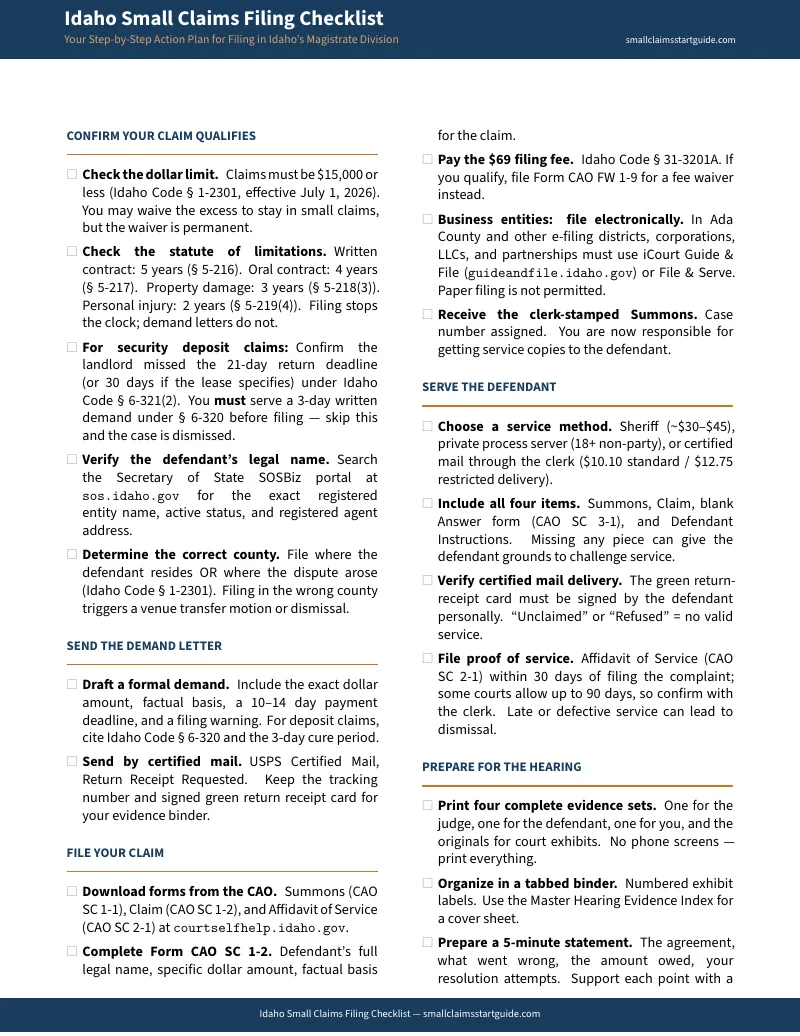
Not sure yet? Download the free checklist first — it covers the key steps and deadlines on a single page. If you want the full procedure, the demand letter templates, and the evidence preparation system, the complete guide is .
Full refund, no time limit. Email [email protected].
Frequently Asked Questions
What if the rules change after I buy?
We update the guide when the rules change. Email us any time, even years later, and we'll send you the current edition free.