Served with a small claims lawsuit in Hawaii? Here is what the court papers are actually telling you to do.
You opened an envelope — or a stranger handed you papers at your front door — and now you are reading a "Statement of Claim and Notice" with a case number and a court date. Your stomach dropped. You went online and found a Nolo book that covers all fifty states, the Judiciary's Small Claims brochure written mostly for people filing claims, and a handful of blog posts that told you to file a written answer within twenty days.
That twenty-day deadline does not apply to you. It belongs to the Regular Claims Division. In Hawaii's Small Claims Division, there is no written answer to file. Your obligation is to appear — physically or by Zoom — on the hearing date printed on Part II of the papers you were served. Miss it, and the judge enters a default judgment: you lose without being heard, the plaintiff gets everything they asked for, and you have exactly 10 days to file a Motion to Set Aside.
The problem is not that the information is hidden. It is scattered across the Judiciary's brochure, four circuit-specific court form pages, the Rules of the Small Claims Division, and HRS Chapter 633 — and almost none of it is written for the person being sued. That gap between "you have been served" and "you are ready for the hearing" is where people make the mistakes that cost them: missing the appearance, showing up without evidence, not knowing they could have filed a counterclaim, or bringing a lawyer to a security deposit hearing where attorneys are banned.
The Hawaii Respondent Navigation System
The Hawaii Small Claims Response Guide is a complete, step-by-step procedural navigation system built specifically for defendants in Hawaii District Court small claims cases. It takes the entire respondent workflow — from decoding the papers you were served, through evidence preparation and the hearing, to the options after the judge rules — and puts it in one printable document with checklists, worksheets, and a hearing-day preparation sheet.
This is not a national overview that mentions Hawaii in a footnote. It is not the Judiciary's brochure repackaged. And it is not written for plaintiffs who need filing instructions. It is the respondent's process, in order, for one state.
What's Inside
Decoding the Court Papers — Form DC05 vs. Form DC06
The Statement of Claim and Notice comes in two versions, and the version you received changes the rules. Form DC06 covers general money claims up to $5,000 — contractors, unpaid invoices, vehicle disputes. Form DC05 covers residential security deposit disputes, which have no dollar cap and a strict attorney prohibition. The guide walks through every section of both forms: locating the case number, identifying the judicial circuit (First on Oahu, Second on Maui, Third on Hawaii Island, Fifth on Kauai), verifying the claim amount, and — most critically — finding the hearing date, time, and courtroom address on Part II. It shows you how to confirm that service was proper (at least 48 hours before the hearing) and what to do if it was not.
Understanding the Appearance-Based System
Most states require defendants to file a formal written answer. Hawaii does not — not in the Small Claims Division. Your procedural obligation is to appear at the hearing. That sounds simpler, but it creates a different kind of preparation challenge: you do not have a written filing to organise your thoughts around, so you need to build your own framework for what to bring and what to say. The guide provides that framework — the Court Papers Decoding Checklist, the Deadline and Calendar Tracker, and the step-by-step preparation sequence that replaces the written-answer process other states use.
Choosing Your Response Path
At the hearing, you have four options: admit the claim, deny it and present your defence, propose a settlement or payment plan, or file a counterclaim. Each option has different mechanics and implications. Admitting does not always mean paying the full amount — you can admit liability while disputing the amount claimed. Denying means you need evidence. Settling at mediation means you need to know what a reasonable settlement looks like. Filing a counterclaim means you need to complete a form, pay a $10 fee, and serve it before the hearing date. The guide walks through each path so you can choose before you walk into the courtroom, not on the spot.
Counterclaims — The $40,000 Opportunity Most Defendants Miss
If the person suing you actually owes you money from the same dispute — the contractor who damaged your property while doing incomplete work, the tenant who left the unit in worse condition than they claim — you can file a counterclaim for up to $40,000 without leaving the Small Claims Division. That limit is eight times higher than the $5,000 cap on original claims. The filing fee is $10. Most defendants never learn this until they are sitting in the courtroom. The guide covers the filing process, service requirements, and timeline.
The Attorney Decision Tree
Whether you can, must, or cannot bring an attorney depends on three factors: the claim type, your entity type, and the specific statute. General money claims allow attorneys. Residential security deposit disputes ban them entirely under HRS § 633-27 — for both sides. LLCs and corporations must have an attorney regardless of claim type, and appearing without one risks an immediate default judgment. The guide includes a visual decision tree that accounts for all three variables.
Mediation Preparation
Hawaii requires mediation before trial. The judge directs both parties to attend mediation at the pre-trial hearing and sets a trial date. If mediation resolves the dispute, you file a Stipulation for Dismissal. If not, you proceed to trial. The guide covers what to bring to mediation, how to evaluate a settlement offer, and when it makes sense to settle versus going to trial — because "winning" at trial still means paying if you lose, with no right of appeal.
Evidence Assembly — The Three-Copy System
Hawaii courts expect three identical collated sets of every exhibit: one for the judge, one for the plaintiff, and one for yourself. The Evidence Organizer in the guide provides a structured index sheet for cataloguing contracts, emails, text messages, receipts, photographs, and estimates with exhibit numbers. It covers how to print digital evidence — screenshots, text-message threads, email chains — and how to organise everything in chronological order so the judge can follow your version of events without shuffling through a pile of loose papers.
The Hearing — What Actually Happens in the Courtroom
Small claims hearings are short and informal compared to regular court, but they follow a structure. The guide covers what the courtroom looks like, how the judge runs the proceeding, how to present your evidence clearly and tell your side of the story, and what happens when the other side does not show up. Hawaii small claims judgments are final — there is no right of appeal under HRS § 633-28 — which makes the hearing your one opportunity to present your case.
Default Judgment and the 10-Day Set-Aside
If you miss the hearing, the judge enters a default judgment against you for the full amount claimed. Hawaii provides a narrow window: within 10 days, you can file a Motion to Set Aside Default (Form DC40 or DC42) by showing excusable neglect. The guide covers exactly what qualifies, how to draft the motion, and what happens if the 10-day window closes.
After the Decision — Payment, Liens, and Garnishment
If the judge rules against you, the guide explains your payment options, how to negotiate a payment plan, the 10% per-year post-judgment interest under HRS § 478-3, and the enforcement tools the plaintiff can use: wage garnishment under HRS Chapter 652, bank account levies under HRS Chapter 651, and real property liens with the Bureau of Conveyances. The Post-Decision Action Sheet walks through each scenario step by step.
Security Deposit Disputes — The Special Rules
An entire chapter is dedicated to residential security deposit cases because they operate under rules that apply to no other claim type: no dollar cap, attorneys banned on both sides, the 14-day return-or-account deadline under HRS § 521-44, and treble damages for willful withholding. Whether you are a landlord defending your deductions or a tenant whose deposit was withheld, the guide covers the documentation the judge expects and the statutory framework that controls the outcome.
Printable Worksheets, Decision Tree, and Checklists
Five printable worksheets: Court Papers Decoding Checklist, Deadline and Calendar Tracker, Evidence Organizer, Hearing Preparation Sheet, and Post-Decision Action Sheet. Plus an Attorney Decision Tree flowchart and a 23-item master checklist covering every step from reading the papers through to the hearing and beyond. Print them, write on them, and check off each step as you go.
Who This Is For
- Homeowners sued by a contractor. The contractor says you owe for completed work or materials. You say the work was defective, incomplete, or over budget. The guide covers how to organise contracts, photographs, written communications, and independent repair estimates — and how to file a counterclaim if the contractor owes you more than you owe them.
- Landlords and tenants in security deposit disputes. Attorneys are prohibited on both sides. There is no dollar cap. The 14-day return-or-account deadline under HRS § 521-44 controls the dispute. Whether you are defending your deductions or fighting for your deposit back, the guide covers the documentation you need and the statutory framework the judge applies.
- Small business owners sued by a customer. A customer claims defective goods, undelivered services, or overcharging. If your business is a sole proprietorship, you represent yourself. If it is an LLC or corporation, Hawaii law requires an attorney — and appearing without one means an automatic default judgment. The guide covers entity-type rules and evidence organisation for business disputes.
- Private car sellers and buyers. Post-sale disputes over mechanical defects, unpaid balances, or title transfer problems. The guide covers how to present the bill of sale, inspection records, and communications as evidence.
- Anyone in Hawaii who was just served and is not sure what to do. If you searched for "Hawaii small claims answer form" or "20-day deadline" and came up empty, this guide starts from the papers in your hand and walks you through the entire respondent process.
Why Not Just Use the Free Court Resources?
You should — and the guide tells you exactly when and where. The Hawaii State Judiciary at courts.state.hi.us publishes a Small Claims brochure, downloadable PDF forms, and a Questions and Answers page. Courthouse Self-Help Centers in Honolulu, Kapolei, Wailuku, Hilo, Kona, and Lihue provide free legal information. Volunteer Legal Services Hawaii offers district court assistance through neighbourhood clinics and the Hawaii Online Pro Bono platform.
What these resources do not do is put the defendant's process in order. The Judiciary's brochure is written primarily for claimants — it explains how to file a case, not how to respond to one. The court forms are blank PDFs without explanations of what each section means for a defendant. Court clerks can confirm your hearing date but cannot help you organise evidence, evaluate a counterclaim, or prepare for mediation. And the free legal advice clinics operate on restricted schedules with 15-to-30-minute consultation windows — you cannot walk through an entire case preparation in one session.
The guide does the organisational work: every step of the respondent's process, in the order you encounter it, with worksheets and checklists you can print and work through. It sits between the free scattered information (which you still need) and a private attorney ($250–$450 per hour in Hawaii) — and in security deposit cases, you cannot hire an attorney even if you want to.
What This Is Not
This guide explains the procedure for responding to a small claims case in the Small Claims Division of Hawaii District Court. It does not give legal advice, predict outcomes, or tell you how to argue your case. It is not published by, affiliated with, or endorsed by the Hawaii State Judiciary, any District Court, the Legal Aid Society of Hawaii, or any government agency. If you need legal advice about your specific situation, contact a lawyer. If you need free help, the guide lists the Court Self-Help Centers, the Legal Aid Society of Hawaii, and Volunteer Legal Services Hawaii with contact information for every island.
Satisfaction Guarantee
Full refund, no time limit. If the guide is not what you expected, email [email protected] and we will refund you — no questions, no deadline.
Get Started
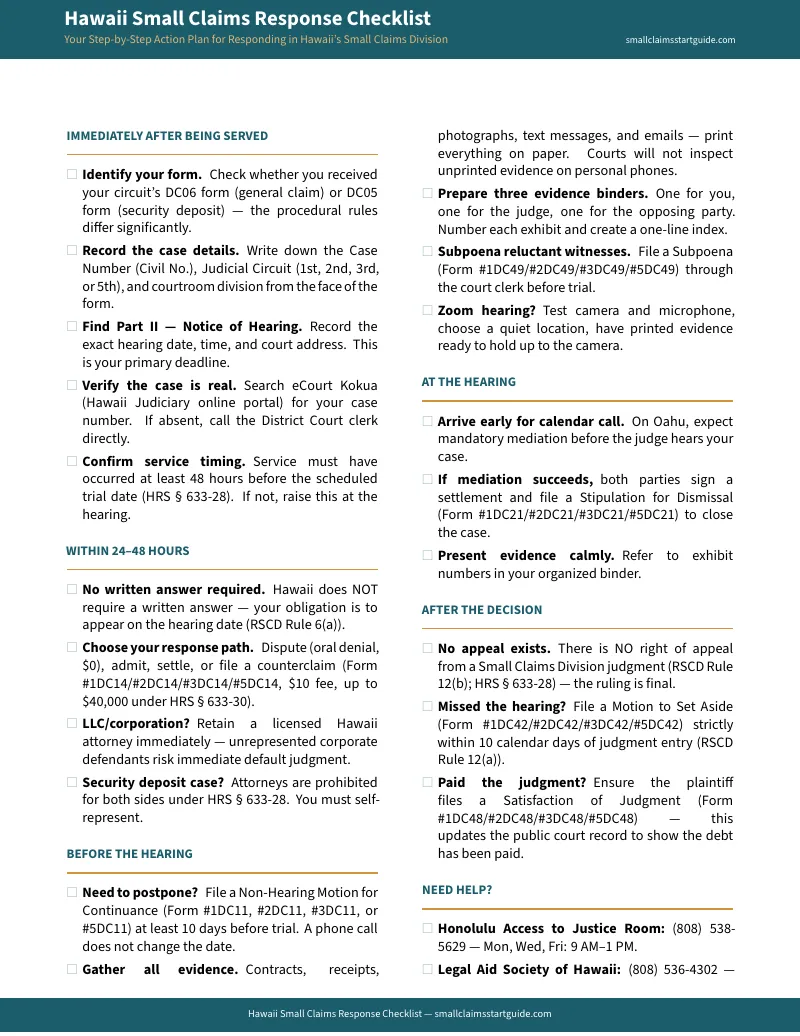
Download the free Hawaii Small Claims Response Checklist — a one-page summary of your appearance obligation, response options, evidence preparation steps, and key deadlines. If you want the full guide with step-by-step instructions, the attorney decision tree, printable worksheets, and the hearing-day preparation sheet, get the complete Hawaii Small Claims Response Guide for .
Frequently Asked Questions
What if the rules change after I buy?
We update the guide when the rules change. Email us any time, even years later, and we'll send you the current edition free.