
You Won Your Case. The Judge Ruled in Your Favor. Nobody Has Paid You.
If you are staring at a Hawaii District Court judgment wondering what happens next, you are not alone. The court does not collect for you. The clerk cannot tell you which forms to file. And the debtor who owes you money is counting on you to give up.
The Hawaii Judgment Collection Roadmap is a step-by-step enforcement system built specifically for self-represented judgment creditors in Hawaii's Small Claims Division. It takes the scattered forms, statutes and courthouse procedures across all four judicial circuits and puts them into a single, ordered sequence — so you know exactly what to file, where to file it, and when.
What Is Inside
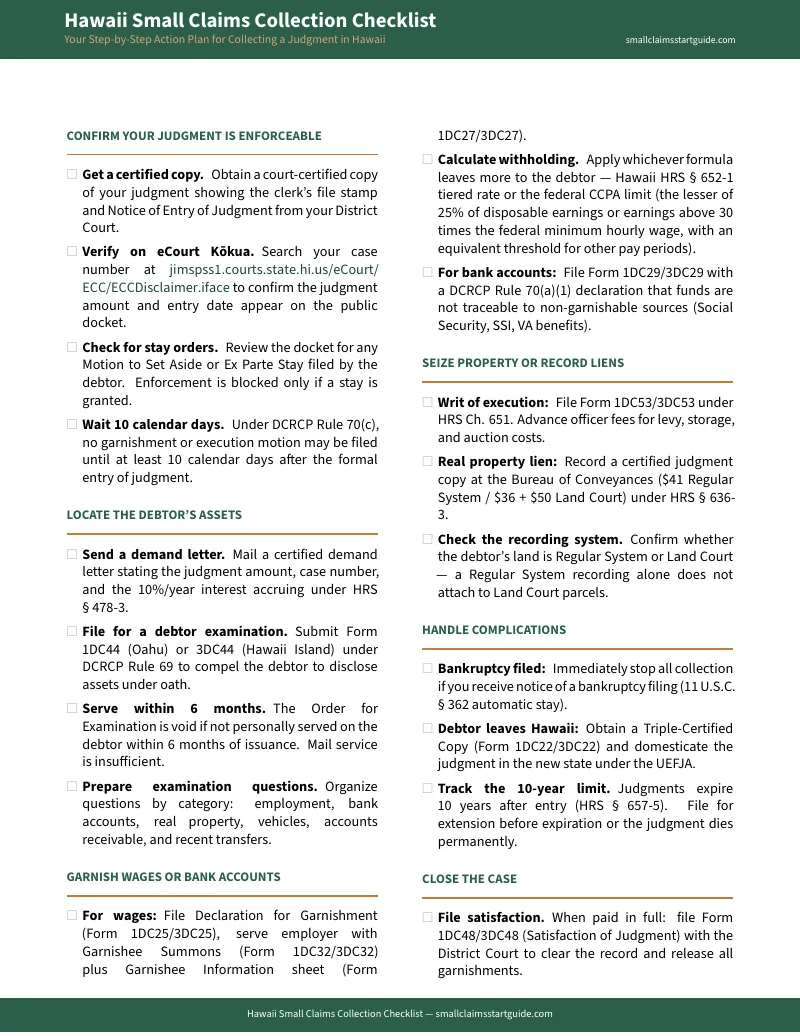
- Post-judgment timeline and waiting period calendar — so you do not file too early and get rejected at the clerk's window
- Circuit-by-circuit form matrix — the exact form numbers for Oahu (1DC), Maui (2DC), Big Island (3DC), and Kauai (5DC), because submitting the wrong circuit's form gets your paperwork sent back
- Debtor examination preparation guide — how to use the Ex Parte Motion for Examination of Judgment Debtor to compel the other side to disclose bank accounts, employment, and property under oath
- Wage garnishment calculation worksheet — Hawaii's tiered formula (5% of the first $100, 10% of the next $100, 20% of the rest) worked through with real numbers so you file the correct amount
- Bank account garnishment walkthrough — from the ex parte motion through the garnishee summons to collecting the funds, with the 120% hold rule explained
- Real property lien instructions — how to record your judgment with the Bureau of Conveyances to place a lien on the debtor's land or home
- Exemption reference — which income and assets Hawaii law protects from collection, including the $550,000 homestead exemption, so you know before you spend money on process service
- 10% statutory interest tracker — a balance ledger that calculates the interest accruing on your judgment under HRS § 478-3, so you collect every dollar you are owed
- Case closure checklist — filing the Satisfaction of Judgment, releasing garnishments, and clearing liens once you are paid in full
Who This Is For
- Individual creditors who won a judgment up to $5,000 for an unpaid loan, property damage, or service dispute
- Former tenants recovering a security deposit — uncapped in Hawaii's Small Claims Division under HRS § 633-27, so your award could be $1,500 or $6,500+
- Small-business owners chasing unpaid invoices or equipment claims, who need a repeatable process their staff can follow
- Anyone helping a judgment holder navigate the paperwork — family members, administrative assistants, or non-attorney employees
Why the Free Information Is Not Enough
The Hawaii State Judiciary website publishes every District Court form for free. But the forms are listed alphabetically alongside dozens of pre-trial documents — not in the order you need them. The site provides no sequenced collection workflow, no calculation worksheets, and no instructions for filling in the blanks.
Court clerks are legally prohibited from telling you which form to use or how to complete it. The official Small Claims brochure says it plainly: "Service Center staff and court clerks are NOT permitted to give legal advice."
National self-help books cover garnishment concepts but skip Hawaii's circuit-specific form numbers, the tiered wage garnishment formula, and the Bureau of Conveyances recording process. An out-of-state guide showing up in your search results could have you following Nevada or California rules — in a Hawaii courtroom.
The alternative is hiring a professional. But an attorney billing $250 to $450 per hour or a collection agency taking 25 to 50 percent of the recovery will consume most of what you are owed on a judgment under $5,000.
This guide fills the gap between free-but-scattered government forms and professional help that costs more than the judgment is worth.
Satisfaction Guarantee
Full refund, no time limit. If the guide does not help you move forward with your collection, email [email protected] and you will get every penny back.
Independent procedural guide. Not affiliated with, endorsed by, or connected to the Hawaii State Judiciary or District Courts. Does not constitute legal advice.
Start Collecting What You Are Owed
You did the hard part — you went to court and won. The guide shows you how to finish the job. Download the free checklist to see the full collection sequence at a glance, or get the complete guide for the forms, calculations, and step-by-step instructions you need to enforce your judgment across any of Hawaii's four judicial circuits.
Every week you wait, your debtor has more time to move assets, change banks, or leave the state. The 10% statutory interest is accruing in your favor — but only if you act on it.
Frequently Asked Questions
What if the rules change after I buy?
We update the guide when the rules change. Email us any time, even years later, and we'll send you the current edition free.