You know the court exists. You don't know which form to file first.
Your landlord kept your security deposit and the 14-day deadline under HRS § 521-44 has passed. Your contractor took a deposit and vanished. A client owes you for work you finished months ago. You have already searched "how to file small claims in Hawaii" and found the Judiciary's Small Claims brochure, a DocDraft article that lists the statutes, and a Nolo book that covers all fifty states in four hundred pages — none of which told you, start to finish, what to do and in what order.
You do not need fifty states. You need to know which form to file in a Hawaii District Court, what it costs, how to get the papers to the other side by certified mail, what happens at the mandatory pre-trial mediation, and what to bring to a hearing whose result is final and cannot be appealed. One wrong defendant name on the Statement of Claim, one botched service attempt, and your case gets dismissed before the judge hears a word.
The Hawaii District Court Filing Workflow
The Hawaii Small Claims Filing Guide takes the entire process — from checking whether your claim fits the court's limits through to enforcing a judgment — and puts it in one printable sequence with checklists, fillable worksheets, and a deadline calendar. Every step references the specific form, the statutory citation, and the timeline.
This is not a national overview that mentions Hawaii in a footnote. It is not a $150–$300 document preparation service that types your form but leaves you on your own at the hearing. And since TurboCourt's guided online filing shut down in June 2025, paper filing at the courthouse or by mail is the only option for most self-represented claimants — the guide walks through the physical filing process step by step.
What's Inside
Checking the Limit and the Clock
Hawaii's Small Claims Division handles general money claims up to $5,000 under HRS § 633-27. But residential security deposit claims are uncapped — a tenant owed a $6,500 deposit files in the same Small Claims Division that caps everything else at $5,000. The statute of limitations matters too: six years for a written or oral contract under HRS § 657-1, two years for property damage or personal injury under HRS § 657-7. The guide walks through each limit and shows you how to calculate your deadline from the date the dispute happened.
The Demand Letter — Because It Strengthens Your Case
Hawaii does not require a demand letter before filing in Small Claims Division, but sending one is strongly advisable. It documents that you asked for payment and were refused, it gives the other side a chance to settle without court, and it strengthens your position at the hearing. The guide includes a fillable demand-letter template with a mailing record and covers what to include, how to send it by certified mail, and how long to wait before filing.
Finding the Right Defendant — The DCCA Entity Search
Filing against a trade name or brand instead of the actual registered business entity is one of the most common reasons service fails or a judgment becomes uncollectible. The guide walks you through searching the Hawaii DCCA Business Registration Division (BREG) online database to identify the correct legal entity name, registered agent, and service address before you complete the court forms. Sole proprietorships, LLCs, partnerships, and corporations each require a different naming approach on the Statement of Claim.
The Statement of Claim and Notice — Field by Field
The Statement of Claim and Notice is the form that starts your case. The guide covers every field, with particular attention to the parts that trip people up: naming the defendant correctly, choosing the right judicial circuit (First Circuit on Oahu, Second on Maui/Molokai/Lanai, Third on Hawaii Island, Fifth on Kauai), and writing a clear factual summary of your claim. The filing fee is capped at $35 under HRS § 633-29. If you cannot afford the fee, the guide covers the fee waiver process.
Service of Process — Certified Mail and Other Methods
The most common service method is certified mail with return receipt requested. For general money claims, service must be within the judicial circuit. For residential security deposit claims, certified mail service with the addressee's signature is authorized anywhere in or outside Hawaii under HRS § 633-28(a)(3) — critical when suing a landlord who left the state. You can also serve in person if the defendant signs an acknowledgment, or have a non-party witness serve and provide a notarized affidavit. The guide covers each method, what to do when service fails, and how to file proof of service.
Pre-Trial Mediation — How It Works
Hawaii's Small Claims Division requires mediation before trial. At the pre-trial hearing, the judge directs both parties to attend mediation and sets a trial date. If mediation resolves the dispute, you file a Stipulation for Dismissal. If it does not, you proceed to trial on the scheduled date. The guide explains how to prepare for mediation, what to bring, and when it makes sense to negotiate.
Evidence Assembly — The Three-Copy Rule
Small claims hearings are short. Hawaii courts expect you to bring three identical collated sets of every exhibit — one for the judge, one for the opposing party, and one for yourself. The guide shows you how to assemble the three sets in chronological order: contracts, invoices, bank statements, text messages, photographs, repair estimates, and receipts. It covers how to print digital evidence and how to handle screenshots.
The Hearing — What Actually Happens
What the courtroom looks like, how the judge runs the proceeding, how to present your evidence clearly, and what happens if the other side does not show up (default judgment). Attorney representation rules depend on your claim type: attorneys are allowed in general money claims but strictly prohibited in residential security deposit disputes under HRS § 633-28(b). Hawaii small claims judgments are final — there is no right of appeal — which makes getting it right the first time essential.
After the Decision — Judgments Do Not Pay Themselves
Winning in court does not mean the defendant pays you. If they do not pay voluntarily, the guide covers post-judgment interest at 10% per year under HRS § 478-3, wage garnishment under HRS Chapter 652, bank account levies under HRS Chapter 651, real property liens recorded with the Bureau of Conveyances, and the 10-day set-aside window.
Security Deposit Disputes — The Special Rules
The guide includes a dedicated chapter for residential security deposit claims. These disputes operate under unique rules: no dollar cap, no attorney representation for either side, the 14-day accounting deadline under HRS § 521-44, and treble damages for willful withholding. The guide covers the statutory timeline, how to calculate your claim, how to document the unit condition, and how to serve a landlord who has left the state.
Printable Worksheets and Planning Tools
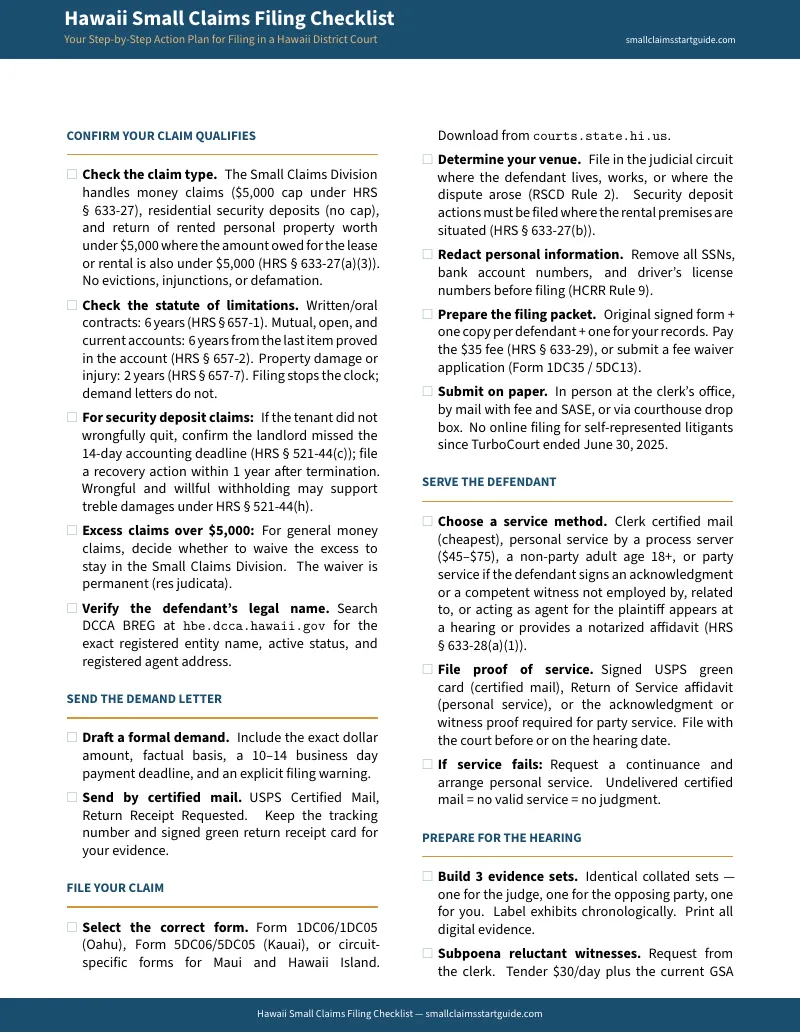
Seven fillable worksheets: demand letter planner, DCCA entity search worksheet, Statement of Claim filing checklist, service of process tracker, evidence organization matrix, security deposit 14-day timeline calculator, and hearing day preparation checklist. Plus a two-page, 25-item master checklist covering every step from demand letter to judgment enforcement. Print them, write on them, and check off each step as you go.
Who This Is For
- Tenants owed a security deposit. Hawaii law requires landlords to return a deposit within 14 days or provide an itemized accounting. Security deposit claims are uncapped in the Small Claims Division — the $5,000 limit does not apply. Attorneys are prohibited on both sides. Courts are strict: missing the 14-day deadline can forfeit the entire amount. The guide covers the statutory timeline, how to calculate treble damages for willful withholding, and how to serve a landlord who has left the state.
- Homeowners with a contractor dispute. The contractor took your deposit and disappeared, or the work is defective. The guide covers DCCA BREG entity lookups, naming the correct defendant, and presenting repair estimates as evidence.
- Small landlords owed rent or damage costs. Your former tenant left owing rent or caused damage beyond normal wear. The landlord's claim is subject to the $5,000 limit. The guide covers documenting damage with photographs and invoices and locating a former tenant for service.
- Sole traders and small businesses with unpaid invoices. A client stopped paying. The guide covers how businesses file in Small Claims Division and explains that under HRS § 633-28(a), court clerks cannot help corporations, partnerships, or sole proprietorships prepare their papers — you draft them yourself.
- Buyers refused a refund. You paid for something that never arrived or did not match the description. The guide covers finding a business's registered agent through the DCCA and choosing the correct judicial circuit.
- Anyone owed money in Hawaii who wants to handle it themselves. If your claim is $5,000 or less — or any amount for a security deposit — and you would rather spend an evening with a step-by-step guide than navigate scattered Judiciary pages across four judicial circuits, this is for you.
Why Not Just Use the Free Court Resources?
You should use them — and the guide tells you exactly when and where. The Hawaii State Judiciary at courts.state.hi.us publishes a Small Claims brochure, a Questions and Answers page, and downloadable PDF forms. The DCCA runs the business entity database. Courthouse Self-Help Centers in Honolulu, Kapolei, Wailuku, Hilo, Kona, and Lihue provide free legal information.
What these resources do not do is put the information in the order you need it. The Judiciary's brochure explains the rules but not the step-by-step sequence. The court forms are blank PDFs without line-by-line completion instructions. Court clerks can help with basic paper preparation under HRS § 633-28(a) but cannot give legal advice, frame your factual statement, or organize your evidence. And since TurboCourt shut down in June 2025, there is no guided online filing — you are on your own with paper forms, the courthouse filing counter, and the mail.
The guide does the organizational work: every form, every fee, every deadline, in the order you encounter them, with checklists and worksheets you can print and work through. It sits between the free information (which you still need) and a $150–$300 document preparation service (which types your form but does not prepare you for the courtroom).
What This Is Not
This guide explains the procedure. It does not give legal advice, predict outcomes, or tell you how to argue your case. It is not published by, affiliated with, or endorsed by the Hawaii State Judiciary, any District Court, or any government agency. If you need legal advice, contact a lawyer. If you need free help, the guide lists the Legal Aid Society of Hawaii, Volunteer Legal Services Hawaii, and Courthouse Self-Help Center resources.
Satisfaction Guarantee
Full refund, no time limit. If the guide is not what you expected, email [email protected] and we will refund you — no questions, no deadline.
Get Started
Download the free Hawaii Small Claims Filing Checklist — a two-page, 25-item summary of the limit, forms, fees, service steps, and deadlines. If you want the full guide with step-by-step instructions, fillable worksheets, and the deadline calendar, get the complete Hawaii Small Claims Filing Guide for .
Frequently Asked Questions
What if the rules change after I buy?
We update the guide when the rules change. Email us any time, even years later, and we'll send you the current edition free.