You've Been Served — and the Clock Is Already Running
A sheriff or process server just handed you a Statement of Claim. The papers say someone wants money from you — maybe a contractor, a former landlord or tenant, a customer, or a buyer from a car sale. You have 30 calendar days to file your answer with the Magistrate Court clerk. After that, the court can enter a default judgment for the full amount — up to $15,000 — without a hearing.
The problem is not that the information doesn't exist. Georgia's statutes are public. Court forms are on county websites — some of them, anyway. But the information is scattered across 159 county portals, state judicial pages, and static PDF brochures that assume you already know how the system works. You don't have time to become a courthouse researcher while a deadline is ticking.
The Georgia Magistrate Response System
This guide puts the entire response process in one place: from verifying your service date and calculating your exact deadline, through structuring your answer and deciding whether to counterclaim, to preparing your evidence for the hearing and knowing your options after the judge decides.
It is built exclusively for Georgia Magistrate Court defendants — not a 50-state overview, not a plaintiff's filing guide, not a generic legal template. Every statute cited is Georgia's. Every deadline is Georgia's. Every procedural step follows the Uniform Magistrate Court Rules that govern all 159 counties.
What You Get
- Service date verification and deadline calculation — a step-by-step method to confirm Day 0 from the sheriff's entry of service and count forward to your exact filing deadline, including weekend and holiday rollovers, plus a printable Response Deadline Calculator
- The four response paths explained — dispute the claim, admit it, negotiate a settlement, or file a counterclaim for up to $15,000. The guide explains when each option applies and what the paperwork looks like
- Answer structuring walkthrough — how to go paragraph by paragraph through the Statement of Claim and respond (admit, deny, or lack knowledge) so the clerk accepts your filing and the judge can follow your defense, plus The Answer Preparation Worksheet
- Counterclaim integration — if the plaintiff owes you money for defective work, unreturned deposits, or property damage, you can include your own claim in the same filing. The guide covers the $15,000 cap, the filing format, and how counterclaims interact with the hearing
- Default and cure procedures — what happens if you miss the 30-day window, how to open default during the 15-day cure period, and the court costs involved
- Evidence preparation for the hearing — which documents, photos, and records to organize, how to authenticate them under Georgia's rules of evidence, and what gets excluded as hearsay, plus The Evidence Organization Matrix and The Hearing Day Checklist
- Post-decision options — the 30-day appeal window for a de novo trial in State or Superior Court, cost bond requirements, and what enforcement looks like if a judgment goes against you, plus The Post-Decision Action Log
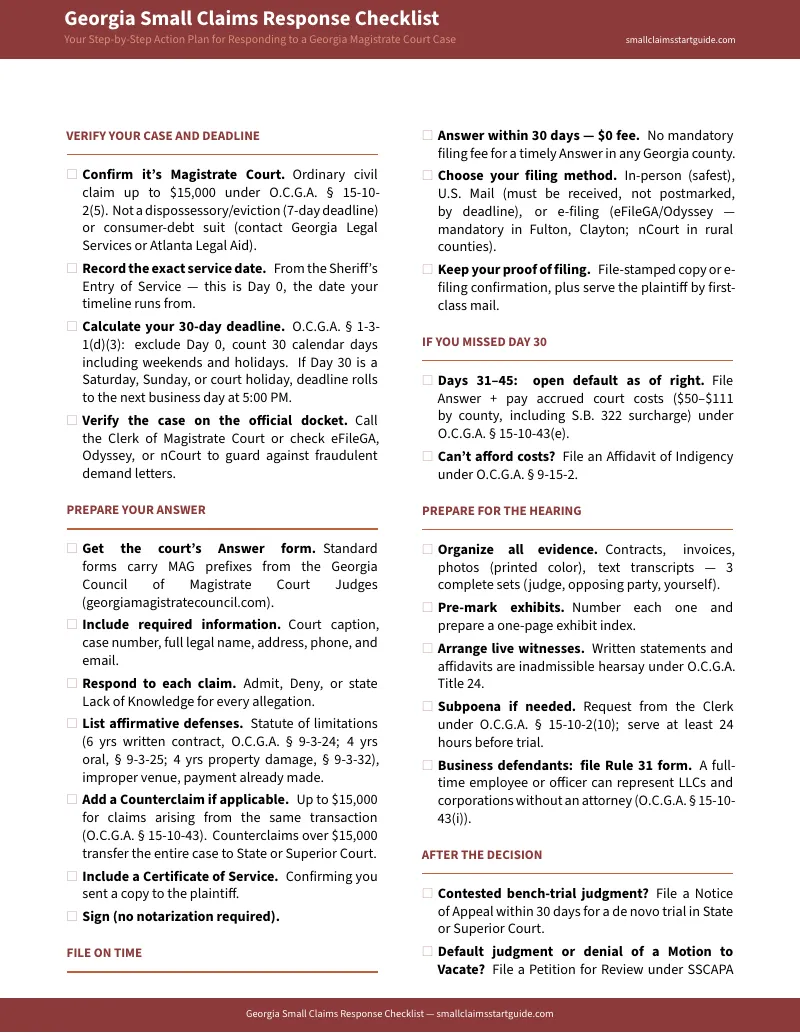
Plus the Response Checklist
The free checklist gives you the deadline, the four response options, and the key steps on two pages — a quick reference while you work through the full guide.
Who This Is For
- Homeowners sued by a contractor or tradesperson over a renovation, repair, or roofing dispute
- Former tenants or landlords in a security deposit or move-out damage dispute (not evictions — those have a separate 7-day deadline)
- Small business owners sued by a customer or vendor over a contract or service dispute
- Private car buyers or sellers in a dispute over undisclosed defects, title issues, or purchase price recovery
This guide is not for eviction (dispossessory) cases or consumer debt lawsuits from lenders, debt buyers, or collection agencies. Those require different procedures and different legal protections. The guide directs those readers to GeorgiaLegalAid.org and the State Bar of Georgia for free help.
Why Not Just Use the Free Court Website?
Court websites publish the rules, but they don't organize the defense for you. Worth County posts the answer form — without line-by-line instructions. Clayton County's Magistrate Court page returns a broken link. Some counties offer e-filing through Odyssey/eFileGA; others require paper. The Uniform Rules say what must happen; they don't say how to actually do it from your phone on a Thursday night.
Court clerks are helpful with filing procedures, but Georgia law prohibits them from advising you on how to phrase your defenses, evaluating your case, or helping you draft your answer. The national alternatives — Nolo's 480-page, 50-state overview, or a $39-per-month form subscription — either bury the Georgia-specific procedures in hundreds of irrelevant pages or sell you a blank template with no context.
This guide does one thing: it takes the response process for Georgia Magistrate Court and puts it in order, with the statutes cited, the deadlines calculated, and the filing steps explained for someone who has never been inside a courthouse.
Full Refund, No Time Limit
If the guide doesn't help, email [email protected] for a full refund. No time limit, no questions.
Important: Small Claims Start Guide is an independent commercial publisher. This guide is not affiliated with, endorsed by, or speaking for any court, government agency, or legal aid organization. It provides procedural navigation only — not legal advice, representation, or outcome predictions.
Download the free checklist to see the response steps at a glance, or get the complete guide with the full walkthrough, answer structuring, evidence preparation, and post-decision options.