You know the court exists. You don't know which form to file first.
Your contractor took your deposit and stopped answering. Your landlord kept your security deposit and sent you a list of deductions that makes no sense. A client owes you for work you finished months ago. You have already searched "how to file small claims in Georgia" and found the Council of Magistrate Court Judges' website, your county's clerk page, and a Reddit thread from 2017 — none of which told you, start to finish, what to do and in what order.
You do not need a 400-page national legal reference. You need to know which form to file in your Georgia Magistrate Court, what it costs, how to get the papers served on the other side, what extra documents the clerk expects, and what to bring to a hearing that lasts fifteen minutes. One wrong entity name on the Statement of Claim, one missing military affidavit, and the clerk sends you home before the judge ever sees your case.
The Georgia Magistrate Court Filing Workflow
The Georgia Small Claims Filing Guide takes the entire process — from checking whether your claim fits the court's limits through to enforcing a judgment — and puts it in one printable sequence with checklists, fillable worksheets, and a deadline calendar. Every step references the specific form, a sample of county filing fees, and the timeline.
This is not a national overview that mentions Georgia in a footnote and it is not a $99–$299 filing service that fills in your form but leaves you on your own at the hearing. It is a procedural workflow: what to do, in what order, by when.
What's Inside
Checking the Limit and the Clock
Georgia Magistrate Court handles claims up to $25,000 for cases filed on or after 1 July 2026 (HB 999 / O.C.G.A. § 15-10-2), excluding interest and court costs. But the dollar limit is only half the question — if your statute of limitations has expired, the claim is dead before you file. Six years for a written contract, four years for an oral agreement or open account, four years for property damage, four years for a sale of goods. The guide walks through every limit and shows you how to calculate your deadline from the date the dispute happened.
The Demand Letter — Because Judges Ask About It
Georgia does not legally require a demand letter before filing, but sending one is strongly advisable. It proves you asked for payment and were refused, which strengthens your position at the hearing and can sometimes resolve the dispute without filing at all. The guide covers what the letter needs to say, how to send it by certified mail so you have proof of delivery, and how long to wait before filing.
The Statement of Claim — Field by Field
The Statement of Claim is the form that starts your case. The part that trips people up is not the form itself — it is naming the defendant correctly. A person, a DBA, an LLC, and a corporation each require a different approach, and a wrong name can make your judgment unenforceable even if you win. The guide covers entity verification through the Georgia Secretary of State's business search, venue selection (defendant's county of residence, registered agent location, or where the business operates), and writing a clear factual summary. Filing fees vary by county — from $60 in Fulton County to $120 or more in smaller counties — and service fees add another $50 or so per defendant.
Serving the Defendant — Sheriff, Marshal, or Appointed Server
You cannot serve the papers yourself. In Georgia, the court typically arranges service through the county sheriff or marshal after you pay the service fee. The guide covers personal service by the sheriff or marshal, out-of-county Second Original Summons, what to do when a return comes back unserved, and when to ask the court to appoint a private process server. The defendant has 30 days to respond after service, and you can request a default judgment if they fail to answer after Day 45.
The Military Affidavit and Business Agent Designation
Georgia Magistrate Court requires a Servicemembers Civil Relief Act (SCRA) affidavit confirming whether the defendant is on active military duty — miss this and the clerk rejects your filing. If you are suing a business entity, you may also need a Designation of Agent form under O.C.G.A. § 15-10-43(i). The guide explains when each document is required, how to complete them, and where to verify military status through the Department of Defense database.
E-Filing Portals — Finding the Right One for Your County
Georgia does not have one statewide e-filing system for Magistrate Courts. Some counties use Odyssey eFileGA, others use PeachCourt, and some accept only paper filings at the clerk's window. The guide names the three channels, gives sample counties for each, and tells you to confirm the portal with your clerk before you upload or pay.
Evidence Binder Assembly — Three Copies, Chronological Order
Magistrate Court hearings run ten to fifteen minutes. You will not have time to dig through a folder looking for the right receipt. The guide shows you how to assemble three matching evidence sets — one for the judge, one for the defendant, and one for you — with contracts, invoices, text messages, photographs, and repair estimates in chronological order, ready to reference when the judge asks a question.
The Hearing — What Actually Happens
What the courtroom looks like, how the judge runs the proceeding, how to present your evidence clearly without rambling, and what happens if the other side does not show up. Georgia Magistrate Courts also offer mediation — the guide explains how it works and when it might lead to a faster resolution.
After the Decision — Judgments Do Not Pay Themselves
Winning in court does not mean the defendant writes you a cheque. After the appeal window closes (a Petition for Review to Superior Court within 30 days), you may need to enforce the judgment yourself. The guide covers fi. fa. liens recorded with the county clerk, wage and bank garnishments, and post-judgment discovery to find assets the defendant has not disclosed.
Printable Checklists, Fillable Worksheets, and Deadline Calendar
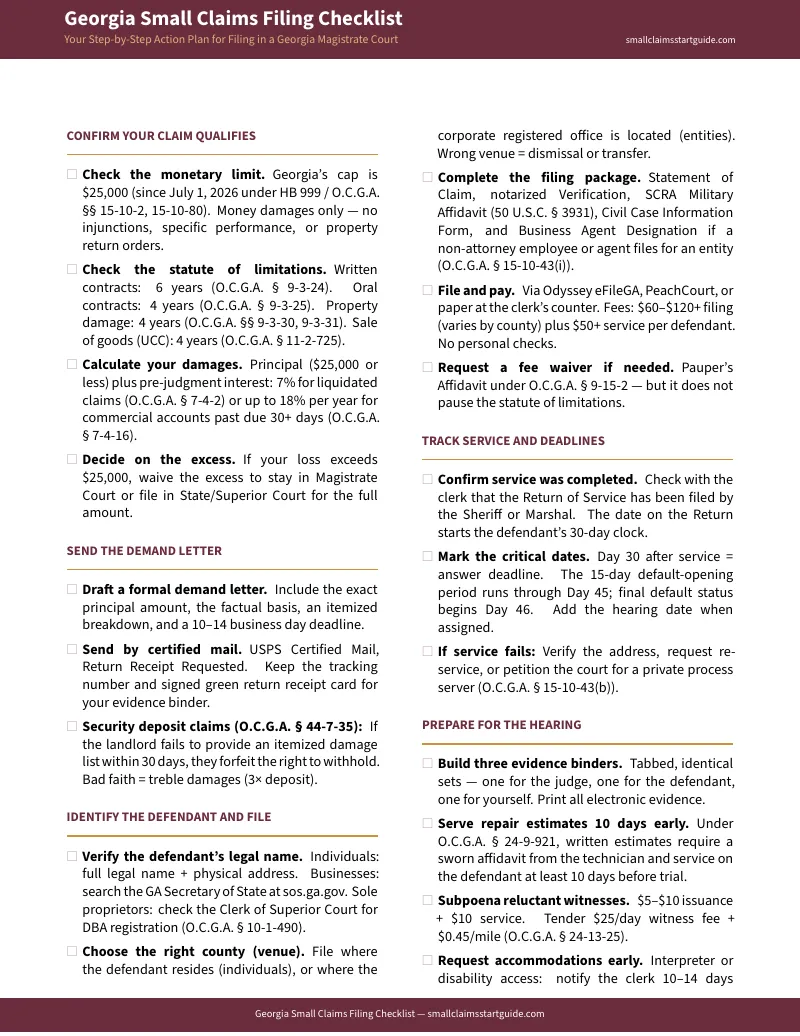
A two-page master checklist (25 items) plus seven fillable one- and two-page worksheets: pre-filing readiness, defendant and venue, mandatory documents, demand letter with mailing record, service tracking calendar, service diligence log, and courtroom evidence binder index. Print them, write on them, and check off each step as you go.
Who This Is For
- Tenants owed a security deposit. Georgia law requires landlords to return a security deposit within one month of the lease ending or provide an itemised statement of deductions. If the landlord withheld the deposit in bad faith, the court may award treble damages — up to three times the amount wrongfully withheld. The guide covers the statutory timeline and how to calculate your claim.
- Homeowners with a contractor dispute. The contractor took your deposit and disappeared, or the work is defective. The guide covers Secretary of State entity lookups, naming the correct defendant, and presenting repair estimates as evidence.
- Small landlords owed rent or damage costs. Your former tenant left owing rent or caused damage beyond normal wear. The guide covers locating a former tenant for service and documenting damage with photographs and invoices.
- Sole traders and small businesses with unpaid invoices. A client stopped paying. The guide covers how businesses file in Magistrate Court, the agent designation requirement, and presenting an invoice trail as evidence.
- Buyers refused a refund. You paid for something that never arrived or did not match the description. The guide covers finding a business's registered agent through the Secretary of State and establishing the correct venue.
- Anyone owed money in Georgia who wants to handle it themselves. If your claim is $25,000 or less and you would rather spend an evening with a step-by-step guide than several hours researching across a dozen court websites, this is for you.
Why Not Just Use the Free Court Resources?
You should use them — and the guide tells you exactly when and where. The Council of Magistrate Court Judges at georgiamagistratecouncil.com publishes free standardised fillable PDF forms and an interactive Forms Generator. Individual county clerk websites list local fees and hours. GeorgiaLegalAid.org provides referrals if you qualify for free legal assistance.
What these resources do not do is put the information in the order you need it. The Council's site gives you forms but not the context for filling them out. Your county clerk can confirm the filing fee but cannot tell you which entity to name, how to draft the factual summary, or whether your evidence is organised well enough. The e-filing portal lets you upload documents but does not explain which ones you need or in what order.
The guide does the organisational work: every form, every fee, every deadline, in the order you encounter them, with a checklist you can print and work through. It sits between the free information (which you still need) and a $99–$299 filing service (which fills in your form but does not prepare you for the courtroom).
What This Is Not
This guide explains the procedure. It does not give legal advice, predict outcomes, or tell you how to argue your case. It is not published by, affiliated with, or endorsed by the Judicial Council of Georgia, the Council of Magistrate Court Judges, any county Magistrate Court, or any government agency. If you need legal advice, contact a lawyer. If you need free help, the guide lists Georgia Legal Aid and Georgia Legal Services Program resources.
Satisfaction Guarantee
Full refund, no time limit. If the guide is not what you expected, email [email protected] and we will refund you — no questions, no deadline.
Get Started
Download the free Georgia Small Claims Filing Checklist — a two-page, 25-item summary of the limit, forms, fees, service steps, and deadlines. If you want the full guide with step-by-step instructions, fillable worksheets, and the deadline calendar, get the complete Georgia Small Claims Filing Guide for .