You won. Now you need to get paid.
The judge signed your judgment. The case is over. But the money is not in your account — and nobody at the courthouse is going to put it there.
Florida courts enter judgments. They do not enforce them. The Clerk cannot tell you what to do next. The Sheriff will not track down the debtor's assets. Legal aid organizations focus on defendants, not creditors. And the attorneys who do handle collections want a retainer or a third to half of whatever they recover — which makes no sense on a judgment under $8,000.
So you are on your own. And the process involves four separate agencies, dozens of forms, and a set of rules that can cost you hundreds of dollars in nonrefundable fees if you take the wrong step first.
The Florida Judgment Collection Roadmap
This guide replaces the confusion with a single enforcement sequence — every tool, every form, every fee, in the order that protects your money.
Instead of guessing whether to start with garnishment or a lien, you follow the same progression that experienced collections attorneys use: establish priority first, discover assets second, then choose the enforcement tool that matches what the debtor actually has.
That sequence matters because the wrong starting point wastes real money. A bank garnishment filed before you know which bank the debtor uses costs $188 in clerk fees and $40 in sheriff service fees — and a zero-balance answer means you lose all of it. A vehicle levy requires a $1,500 nonrefundable deposit before the Sheriff will lift a finger. The guide starts you with the $20 Sunbiz personal property lien and works up from there.
What You Get
- Enforcement timing walkthrough — the mandatory waiting periods (15-day motion window, 30-day appeal deadline) and exactly when each enforcement tool becomes available, so you never file prematurely and hand the debtor grounds to vacate
- Asset discovery with Form 7.343 — how to serve the Fact Information Sheet, what the 45-day deadline means, and how to file a Motion to Compel or obtain a Writ of Bodily Attachment when the debtor ignores it — using the correct form for individuals (7.343a) versus business entities (7.343b)
- Bank garnishment, step by step — from filing the Motion for Writ of Garnishment through the Clerk, to serving the bank through the Sheriff, to handling the garnishee's answer, to claiming the funds — including what to do when the bank reports a zero balance
- Wage garnishment and the Head of Household trap — how wage garnishment works under Florida Chapter 77, why the Head of Household exemption under Fla. Stat. § 222.11 can dissolve the entire writ, and how to evaluate whether wage garnishment is worth pursuing before you spend the fees
- Sheriff levies on vehicles and property — what the Sheriff requires before executing (Instructions for Levy, proof of ownership, advance deposits of $1,000–$1,500), the public sale process, and the realistic recovery you can expect after fees
- Judgment liens that outlast the debtor's excuses — how to file a Judgment Lien Certificate on Sunbiz for a statewide personal property lien ($20), how to record a real property lien in the county Official Records, the 5-year duration and renewal rules, and why liens are your best low-cost first move
- Florida exemptions mapped — every major asset the debtor can legally shield from collection, including the unlimited homestead exemption, the Head of Household wage protection, and the retirement account exclusions, so you know what is actually reachable before spending money to seize it
- Interest calculation with worked example — how to apply the CFO’s quarterly statutory post-judgment interest rates (2026: Q1 8.44%, Q2 8.25%, Q3 8.06%, Q4 7.87%) to your judgment balance, with a step-by-step calculation so you collect every dollar owed
Who This Is For
You have a final judgment from a Florida County Court small claims case — up to $8,000 — and the other side has not paid. Maybe they are ignoring you entirely. Maybe they paid part of it and stopped. Maybe you have no idea what they own or where their money is.
You do not need a lawyer. Every enforcement tool in this guide uses standard forms from the Clerk of Court, the Sheriff, or the Florida Department of State. The guide shows you which form, which office, and which fee — in order.
Why Not Just Use the Free Court Forms?
The forms are free. What is not free is the knowledge of which form to file, at which office, in what order, with what deposit.
Florida Courts Help provides blank PDF downloads of Form 1.977, Form 1.907, and the other enforcement forms. But the site offers no sequencing, no explanation of the Sheriff's advance deposit requirements, no Sunbiz filing walkthrough, and no guidance on exemptions that could make your entire enforcement attempt pointless.
The result is predictable: creditors file garnishments before running asset discovery, serve writs on the wrong entity, skip the Sunbiz lien that would have given them priority, or attempt to levy on a homestead-protected residence. Each mistake costs real money — $188 here, $1,500 there — and none of it is refundable.
The guide puts every step in the right order so the forms actually work.
Satisfaction Guarantee
Full refund, no time limit. If the guide does not help you move forward with collecting your judgment, email [email protected] and we will refund your purchase — no questions, no deadline.
Start Collecting What You Are Owed
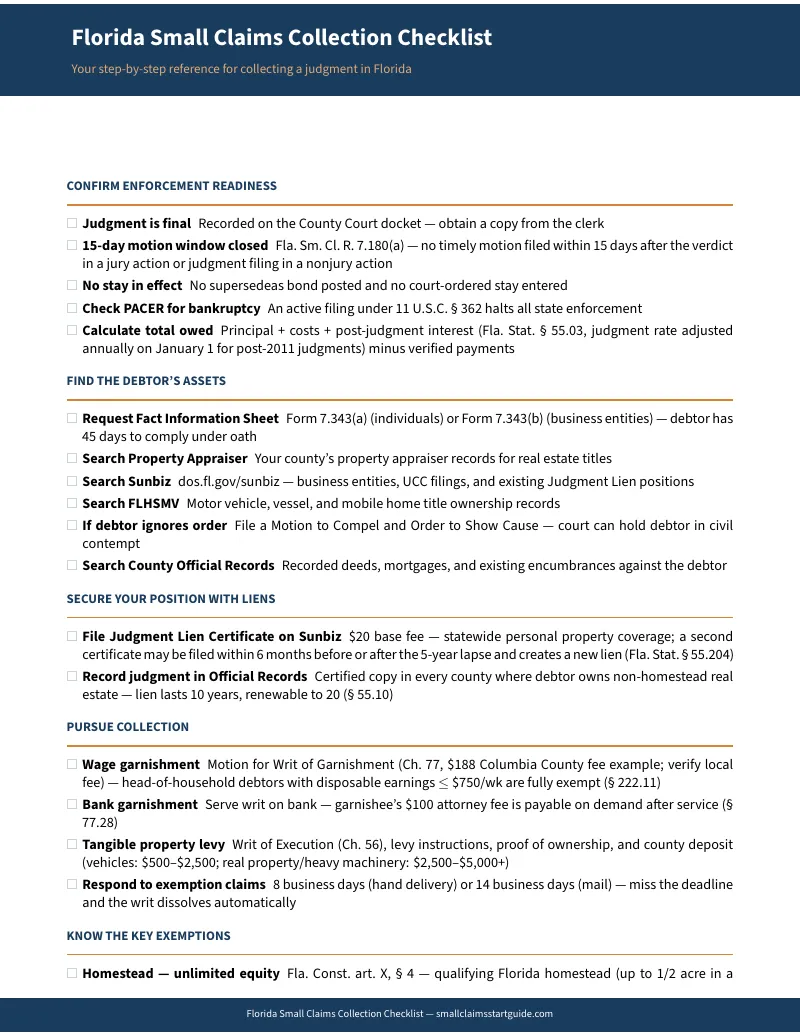
The free checklist gives you the enforcement overview — the waiting periods, the main tools, the key exemptions. It is a solid starting point.
The full guide gives you the execution: every form identified, every fee listed, every agency mapped, every step sequenced. It is the difference between knowing the tools exist and knowing how to use them.
Download includes the 49-page guide PDF, the collection checklist, and 5 printable worksheets (asset discovery tracker, garnishment timeline, interest ledger, enforcement cost tracker, and lien renewal calendar). Yours to keep permanently — .
Frequently Asked Questions
What if the rules change after I buy?
We update the guide when the rules change. Email us any time, even years later, and we'll send you the current edition free.