You know the court exists. You don't know which county to file in.
Your contractor took your deposit and vanished. Your landlord is ignoring every message about the security deposit. A client owes you months of invoices and has gone silent. You searched "how to file small claims in Florida" and found out that Florida has 67 counties, each with its own clerk's packet, its own local forms, and its own fee schedule. The state's E-Filing Portal is designed for attorneys, not for someone filing their first claim. The court's website gives you rules by topic. It does not give you the rules in the order you need to follow them.
You do not need a legal textbook. You need to know which county court to file in, which forms to use, how much it all costs, how to get the defendant served, and what to bring to a pretrial conference that most first-time filers confuse with the actual trial. One wrong entity name on the Statement of Claim, one missed service deadline, and the judge dismisses your case before you open your mouth.
The Florida Filing Workflow
The Florida Small Claims Filing Guide takes the entire County Court small claims process — from checking whether your claim fits the $8,000 limit through to enforcing the judgment after you win — and puts it in a single printable sequence. Every step names the statute or rule, the form, the fee, and the deadline. No guesswork, no tab-juggling across 67 county websites, no wondering what comes next.
This is not a 400-page legal reference and it is not a $50–$200 filing service that submits your paperwork but leaves you on your own at the hearing. It is a procedural workflow that walks you through what to do, in what order, by when.
What's Inside
How Florida's Small Claims Division Works
Florida's County Court handles small claims up to $8,000 under the Florida Small Claims Rules and Fla. Stat. § 34.01. The guide starts by confirming your case belongs on the small claims track (not county civil, not eviction), explaining the claim-splitting prohibition, and clarifying what the clerk can and cannot help you with — because deputy clerks are legally prohibited from giving advice, and most first-time filers do not know that.
Filing Fees — The Full Cost, Not Just the Base
Filing fees are tiered by claim size: $55 for claims up to $500, $80 for $501–$2,500, and $175 for $2,501–$8,000. But those are just the court filing fees. Add $10 per summons, $40–$50 for Sheriff service per defendant, and page-by-page copy charges, and a single claim can cost over $350 before you reach the courtroom. Tech filing platforms that charge $40–$125 above court fees rarely mention that fee waivers exist. The guide breaks down every cost and walks through the Application for Determination of Civil Indigent Status.
Statutes of Limitations — The Deadlines That Kill Your Claim
Every type of claim has a mandatory filing deadline. Five years for written contracts. Four years for oral contracts, property damage, and negligence — with the negligence period modified by HB 837 for causes of action arising after March 2023. Sending a demand letter does not pause the clock. The guide walks through every deadline by claim type and shows you how to calculate yours from the date the dispute happened.
The Demand Letter
Florida does not legally require a demand letter before most small claims filings, but judges consistently look for one — especially in contractor and security deposit disputes. Sending a demand by certified mail creates a documented paper trail and often resolves the matter without filing. The guide covers what the letter needs to say, how to send it with proof of delivery, and how long to wait.
Identifying the Defendant on Sunbiz
Naming the wrong defendant is the single most common reason Florida small claims judgments become unenforceable. Suing a trade name when the defendant operates as an LLC, or listing a business owner's personal name when the contract was with their corporation, makes the judgment worthless even if you win. The guide walks through the Florida Division of Corporations (Sunbiz) lookup step by step — finding the correct legal entity name, the registered agent for service, and distinguishing active corporations from dissolved entities and fictitious names.
Filing the Statement of Claim — E-Filing Portal or In Person
The Statement of Claim (Form 7.330) starts your case. The E-Filing Portal (myflcourtaccess.com) accepts statewide electronic filing, but first-time users frequently hit rejections for missing the Civil Cover Sheet (Form 1.997), failing to redact confidential information, or selecting the wrong document category. The guide covers both the electronic and paper filing routes, every required form and attachment, and the Form 2.601 email service exemption for filers who do not want court correspondence by email.
Serving the Defendant — Methods, Costs, and the Return of Service
You cannot hand the papers to the other side yourself. Service must go through the county Sheriff, a certified process server, or (in limited situations) certified mail. Improper service under Florida Small Claims Rule 7.070 is the leading cause of case delays. The guide covers the statutory service hierarchy for individuals and business entities, what to do when the defendant avoids service, and the critical step most filers miss: filing the Return of Service with the clerk before the hearing date.
The Pretrial Conference — It Is Not the Trial
Florida's mandatory Pretrial Conference catches first-time filers off guard. They arrive with witnesses, evidence binders, and opening statements — but the pretrial is primarily for case management and mandatory mediation. Witnesses should not attend. The guide explains what happens at the pretrial, how mediation works, how to negotiate a settlement agreement, and what happens if the case moves to trial.
Preparing for Trial
If the pretrial conference does not resolve the case, a trial date is set. The guide covers exhibit preparation and pre-exchange, subpoenas for compelling witnesses, courtroom procedure, business representation under Rule 7.050(a)(2), and what happens if the defendant does not show up.
After the Judgment
Winning does not mean the defendant writes you a cheque. If the judgment goes unpaid, you may need to enforce it yourself. The guide covers the Fact Information Sheet (Form 7.343) for making the debtor disclose assets, judgment liens, writs of garnishment for bank accounts, and writs of execution for non-exempt personal property — along with Florida's homestead and personal-property exemptions that limit what you can reach.
Who This Is For
- Tenants owed a security deposit. Your landlord had 15 to 60 days to return your deposit or send an itemised statement of deductions under Fla. Stat. § 83.49. If they failed to follow the statutory notice procedures, you may be entitled to the full deposit. The guide covers the timeline and how to calculate your claim.
- Homeowners with a contractor dispute. The contractor took your money and disappeared, or the work is defective. The guide covers entity verification on Sunbiz, naming the correct business on the Statement of Claim, and presenting repair estimates as evidence.
- Small landlords owed rent or damage costs. Your former tenant left owing rent or caused damage beyond normal wear. The guide covers how to distinguish a money claim from an eviction proceeding and how to document damage with photographs and invoices.
- Sole traders and freelancers with unpaid invoices. A client owes you for completed work. The guide covers business representation at trial under Rule 7.050(a)(2), filing as a business entity, and presenting an invoice trail.
- Buyers refused a refund. You paid for something that never arrived or did not match the description. The guide covers identifying the business's registered agent through Sunbiz and establishing venue in the correct county.
- Anyone owed money in Florida who wants to handle it themselves. If your claim is $8,000 or less and you would rather spend an evening with a step-by-step guide than an afternoon navigating county clerk websites and calling the court, this is for you.
Why Not Just Use the Free Court Resources?
You should use them — and the guide tells you exactly when and where. County clerk websites publish blank forms. The E-Filing Portal is open to self-represented litigants for free. FloridaLawHelp.org and Legal Services of Greater Miami offer free guidance to qualifying low-income individuals. County court self-help centres offer consultations.
What none of those resources do is put the information in the order you need it. The clerk's packets are organised by topic — one page for fees, another for service, another for the hearing — not by step. The forms are blank with no instructions on how to complete them. Tech filing platforms automate the paperwork for $40–$125 above court fees, but they do not prepare you for the courtroom, and they rarely mention that fee waivers and indigent status applications exist.
The guide does the organisational work: every form, every fee, every deadline, in the order you encounter them, with a checklist you can print and work through. It sits between the free information (which you still need) and a filing service (which submits your paperwork but does not prepare you for the hearing).
What This Is Not
This guide explains the procedure. It does not give legal advice, predict outcomes, or tell you how to argue your case. It is not published by, affiliated with, or endorsed by any Florida court, the Florida Court Clerks & Comptrollers, the Florida Bar, or any government agency. If you need legal advice, contact a lawyer. If you need free help, the guide lists the resources available through FloridaLawHelp.org, Legal Services of Greater Miami, Bay Area Legal Services, and county court self-help centres.
Satisfaction Guarantee
Full refund, no time limit. If the guide is not what you expected, email [email protected] and we will refund you — no questions, no deadline.
Get Started
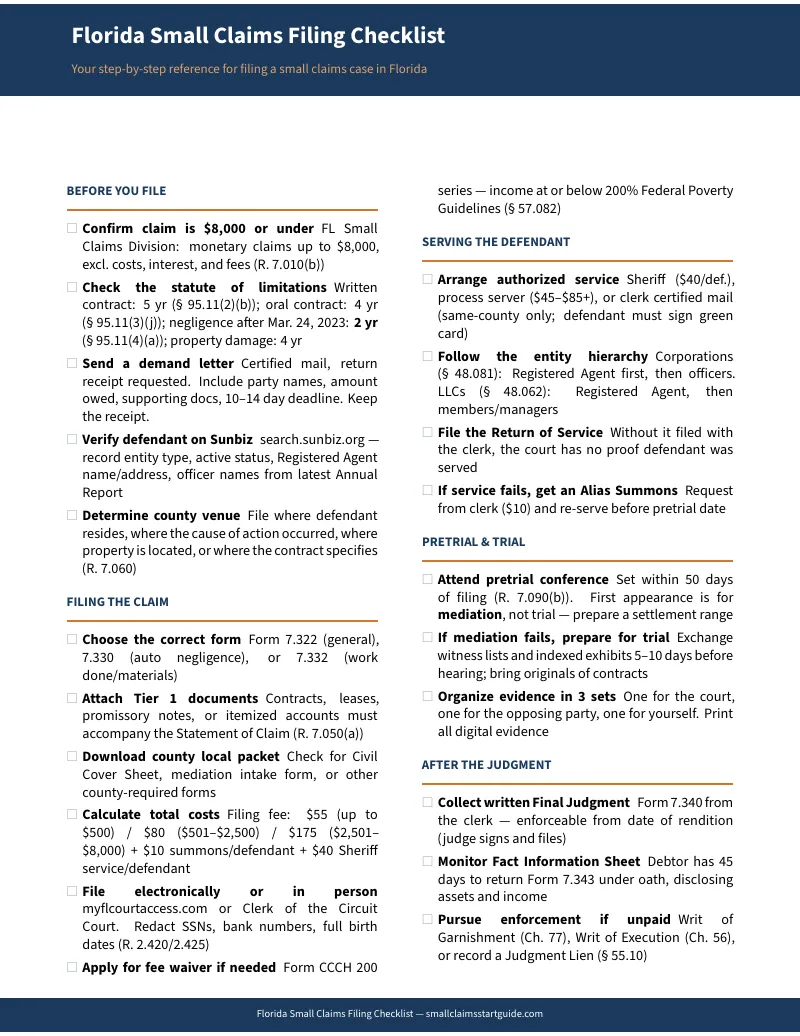
Download the free Florida Small Claims Filing Checklist — a printable summary of the limit, forms, fees, service steps, and deadlines. If you want the full guide with step-by-step instructions plus 6 fillable standalone tools — fee worksheet, Sunbiz lookup form, service tracking log, pretrial and trial checklists, deadline calendar, and demand letter template — get the complete Florida Small Claims Filing Guide for .