You won the case. The court won't collect the money.
The judge entered a number on the docket. You expected the debtor to pay. They didn't. You called Room 120 at Court Building B and were told the court doesn't collect judgments — that's your job. Now you're staring at blank PDF forms on the D.C. Courts website, trying to figure out which one to file, what fee to bring, and whether you're even allowed to start yet.
Here's what nobody told you after the hearing: a D.C. small claims judgment is a license to use the court's enforcement machinery, not an automatic payment. The 30-day stay, the writ selection, the wage exemption math, the service rules — every step has a specific procedure, and getting any of it wrong means a wasted filing fee and a trip back to the courthouse.
The D.C. Judgment Enforcement System — Every Tool, Every Form, Every Step
This isn't a generic overview of how judgments work. It's a complete procedural walkthrough built specifically for the Small Claims and Conciliation Branch of the D.C. Superior Court — the forms filed at Room 120, the fees set by Civil Rule 202, the exemption floors calculated under D.C. Code § 16-572, and the service rules that apply in the District.
Inside, you'll find:
- A clear enforcement sequence — which tool to use first, which to use when the debtor has no employer, and when to shift from garnishment to liens. No more guessing which form to pull from the court's website.
- Debtor examination walkthrough — how to file the motion for an oral examination under D.C. Code § 16-3908, what questions to ask under oath, and what the court does when the debtor doesn't show up.
- Wage garnishment with the exemption math done for you — D.C.'s wage shield is one of the strongest in the country. The guide explains the 40× minimum wage floor, shows you how to calculate the garnishable amount, and walks you through the Writ of Attachment on Wages from filing to employer service.
- Bank account attachment step by step — which form is for wages and which is for bank accounts (the names are confusing), how to serve the garnishee bank, and how to respond when the debtor claims an exemption.
- Property seizure through the U.S. Marshals — when a Writ of Fieri Facias makes sense, how to request Marshals execution (D.C. has no sheriff system), and what personal property is exempt from seizure.
- Real property liens via the Recorder of Deeds — how to record an abstract of judgment so your claim attaches to anything the debtor owns in the District, and what it means for eventual collection.
- A filing fee ledger — every fee at every step ($10 writ fees, $5 process server appointments, $30 Recorder of Deeds recording), so you know the cost before you file and can add it to your recovery total.
- Satisfaction of judgment instructions — how to close the case properly once you've been paid, including releasing any recorded liens.
Who This Is For
You're an individual or sole proprietor who won a monetary judgment (up to $10,000) in the D.C. Superior Court Small Claims Branch. The 30-day waiting period is almost up — or already past — and you haven't been paid. You want to know exactly what paperwork to file, where to file it, what it costs, and what happens after you do.
You might be a freelancer whose client never paid the invoice, a landlord whose former tenant owes for damages, or a consumer who won a dispute with a contractor. The common thread: you did the hard part (winning the case), and now you need the procedural roadmap for the part nobody explained.
Why Not Just Use the Free Court Forms?
The court's forms are free, and this guide links to every one of them. The forms are not the problem. The problem is that a blank Writ of Attachment on Wages doesn't tell you whether the debtor's income is above the garnishment floor. The court's information handbook doesn't explain what to do when the debtor ignores your oral examination subpoena. And the fee schedule doesn't show you how to add your enforcement costs to the judgment total.
National books like Nolo's Everybody's Guide to Small Claims Court explain general concepts but skip the D.C.-specific details — which room to file in, which writ to use for bank accounts versus wages, how the Marshals handle property seizure in the District. This guide covers what they don't.
What You Get
Your download includes six files:
- The full guide (PDF) — 13 chapters covering the complete enforcement process, from the 30-day automatic stay through satisfaction of judgment, with every D.C. form, fee, deadline, and court contact referenced in context.
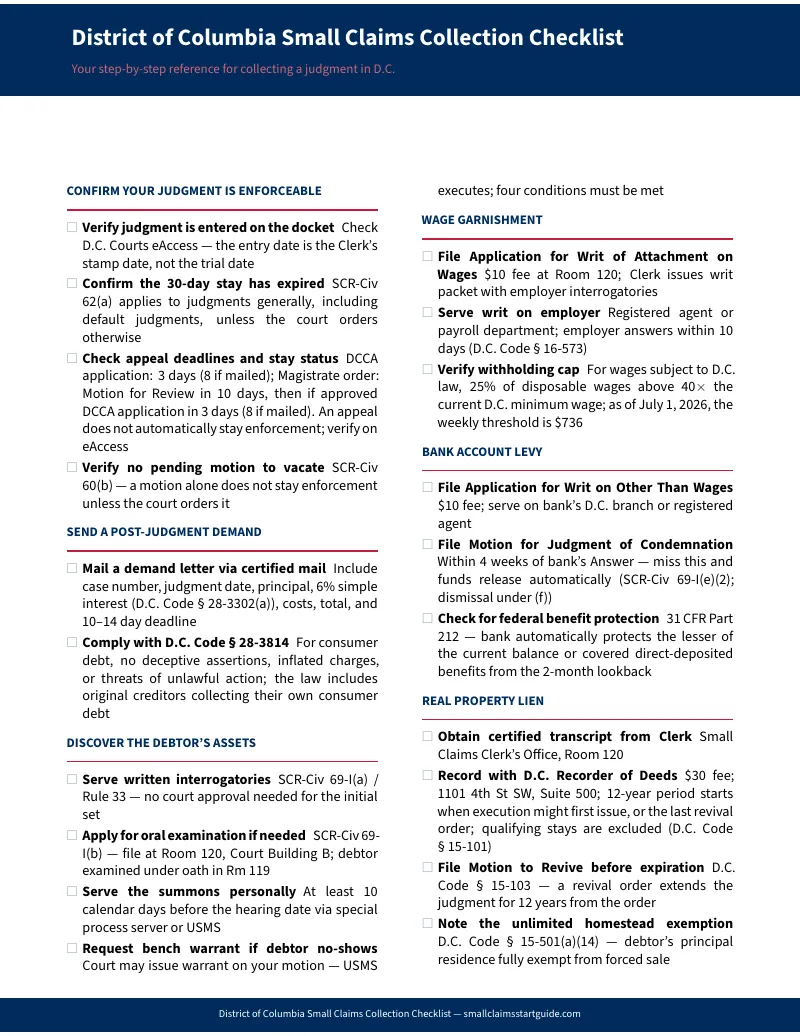
- Enforcement checklist (PDF) — a printable one-page sequence of every step, so you can track your progress and see what comes next at a glance.
- Enforcement filing matrix (PDF) — one table mapping each enforcement tool to its form, fee, filing location, and service requirements, plus a filing packet checklist to complete before you go to Room 120.
- Oral examination prep worksheet (PDF) — the questions to ask the debtor under oath, organized by asset category (employment, banking, real property, vehicles), with space to record answers at the hearing.
- Payment and interest tracking ledger (PDF) — records every payment in D.C.'s statutory application order (costs, then interest at 6%, then principal) and tracks running balances.
- Satisfaction and lien release protocol (PDF) — the step-by-step closeout sequence for filing the Satisfaction of Judgment with the court and releasing any recorded liens with the Recorder of Deeds.
Try the Free Checklist First
Not sure you need the full guide? Download the free enforcement checklist. It covers the key steps, forms, and exemption thresholds so you can see whether this process is something you want to handle yourself. If you decide to go deeper, the full guide is waiting — and the checklist you already have stays useful as your progress tracker.
Full refund, no time limit. If the guide doesn't help, email [email protected] and we'll refund every penny.
Frequently Asked Questions
What if the rules change after I buy?
We update the guide when the rules change. Email us any time, even years later, and we'll send you the current edition free.