
You Won. Now Collect.
The judge ruled in your favor. You walked out of the Arizona Justice Court with a signed judgment — and then nothing happened. No phone call from the court. No letter telling the other side to pay. No one depositing money into your account.
That is because Arizona courts do not collect for you. The judgment is a legal authorization — a license to use enforcement tools like garnishments, bank levies, property seizures, and liens. But it is your job to figure out which tools to use, file the right forms in the right precinct, serve them through the right officer, and track every dollar until the case is closed.
Most people get stuck right here. They call the clerk's office and hear: "We can't give legal advice." They search online and find 30 separate form packets across two different garnishment series, conflicting county web pages, and dense statutory language that reads like it was written for attorneys — not for someone who just wants to collect what a judge already said they are owed.
The Judgment Enforcement Roadmap
This guide replaces that confusion with a single, structured path from the day the judgment is entered to the day you file the Satisfaction of Judgment and close the case. We call it the Judgment Enforcement Roadmap — a sequenced workflow that tells you which tool to use first, which forms to file, how to serve them, and how to avoid the filing-fee traps that catch most self-represented creditors.
It covers every enforcement mechanism available under Arizona law for small claims judgments, organized in the order you will actually need them.
What's Inside
- Demand letter framework — the factual, non-threatening letter that gives the debtor a final chance to pay before you file formal enforcement papers, and satisfies the written-demand requirement for earnings garnishments
- Judgment Debtor Examination module — how to petition the court to compel the debtor to appear under oath and disclose bank accounts, employers, vehicles, and property, with a 20-question examination script so you walk in prepared
- Wage garnishment walkthrough — filing the Application for Writ of Garnishment (AOCCVGE series), serving it on the employer, and understanding the Proposition 209 cap: only 10% of disposable earnings are garnishable, with hardship provisions that could reduce it to 5%
- Bank account levy instructions — the Non-Earnings Garnishment (AOCCVGN series) served on the debtor's bank, plus the critical $5,000 single-institution exemption that determines whether a levy is worth filing
- Writ of Execution for personal property — when and how to direct a precinct constable to seize non-exempt personal property, including vehicles (exempt up to $15,000 in equity, or $25,000 for debtors with physical disabilities)
- Real property judgment lien — the exact sequence to record a lien through the County Recorder: Transcript of Judgment from the Justice Court, filing with the Clerk of Superior Court, then recording the certified copy — with the $400,000 homestead exemption that determines whether the lien has any practical value
- MVD driver's license suspension — submitting a Non-Satisfaction Notice to the Arizona Motor Vehicle Division for auto-accident judgments under A.R.S. § 28-4071
- Post-judgment interest calculator — how to compute accruing interest under A.R.S. § 44-1201 (the lesser of 10% per annum or prime rate plus 1%) and add recoverable court costs to your running ledger
- Renewal and expiration rules — Arizona judgments last 10 years, renewable within the 90-day window before expiration, so a debtor who is judgment-proof today does not escape permanently
- Satisfaction of Judgment compliance — the mandatory filing within 30 days of full payment that protects you from court sanctions
- 8 printable worksheets — enforcement decision worksheet, debtor exam question checklist, interest calculator, garnishment tracking log, lien and filing tracker, satisfaction checklist, multi-county form cross-reference, and constable service instruction sheets
Who This Is For
- Arizona residents who won a small claims judgment (Justice Court, Small Claims Division) and have not been paid
- Landlords, freelancers, contractors, and small business owners holding an unpaid judgment for a security deposit, unpaid invoice, or property damage
- Creditors who sent a demand letter that was ignored and now need to use formal enforcement tools
- Anyone holding a judgment nearing the 10-year mark who needs to renew before it expires
Why Free Court Resources Are Not Enough
Arizona's official court system publishes the forms — and the forms are free. Nobody disputes that. What the court does not publish is a sequenced enforcement plan.
The Arizona Judicial Branch maintains over 30 separate PDF forms across the earnings garnishment series (AOCCVGE1F through AOCCVGE23F) and the non-earnings garnishment series (AOCCVGN1F through AOCCVGN8F). Each packet uses dense statutory language and assumes you already know which tool applies to your situation. Maricopa County uses local motion templates for debtor examinations. Pima County uses its own form numbering system (JP404, JP407, JP600, JP601). Rural precincts in Mohave, Coconino, and Yavapai may direct you to statewide AOC forms — or hand you a paper packet in person.
Worse, some official county pages still contain stale guidance. Pima County's collection page has published a 5-year judgment expiration figure that contradicts the 10-year statutory timeframe under A.R.S. § 12-1551. File based on that outdated information and you risk premature panic or missed renewal deadlines.
This guide maps the statewide AOC form codes to county-specific precinct codes, flags the exemption thresholds you need to check before paying any filing fee, and walks you through service requirements that differ between the complaint stage and the enforcement stage. One wrong service method — certified mail instead of personal service by a process server or constable — invalidates the entire filing.
The Proposition 209 Reality Check
Arizona voters approved Proposition 209 in November 2022, dramatically expanding debtor protections. If you are using enforcement guides or form instructions written before December 2022, the exemption numbers are wrong.
The guide incorporates every current threshold — the 10% wage garnishment ceiling, the $5,000 bank account exemption, the $400,000 homestead exemption, and the updated vehicle equity exemptions — so you can audit an asset before spending money to pursue it. A single garnishment filing that targets an exempt bank account wastes between $28 and $43 in non-refundable court fees with zero recovery.
Satisfaction Guarantee
If the guide does not meet your expectations, email [email protected] for a full refund — no time limit, no questions.
Get the Free Checklist — or the Complete Guide
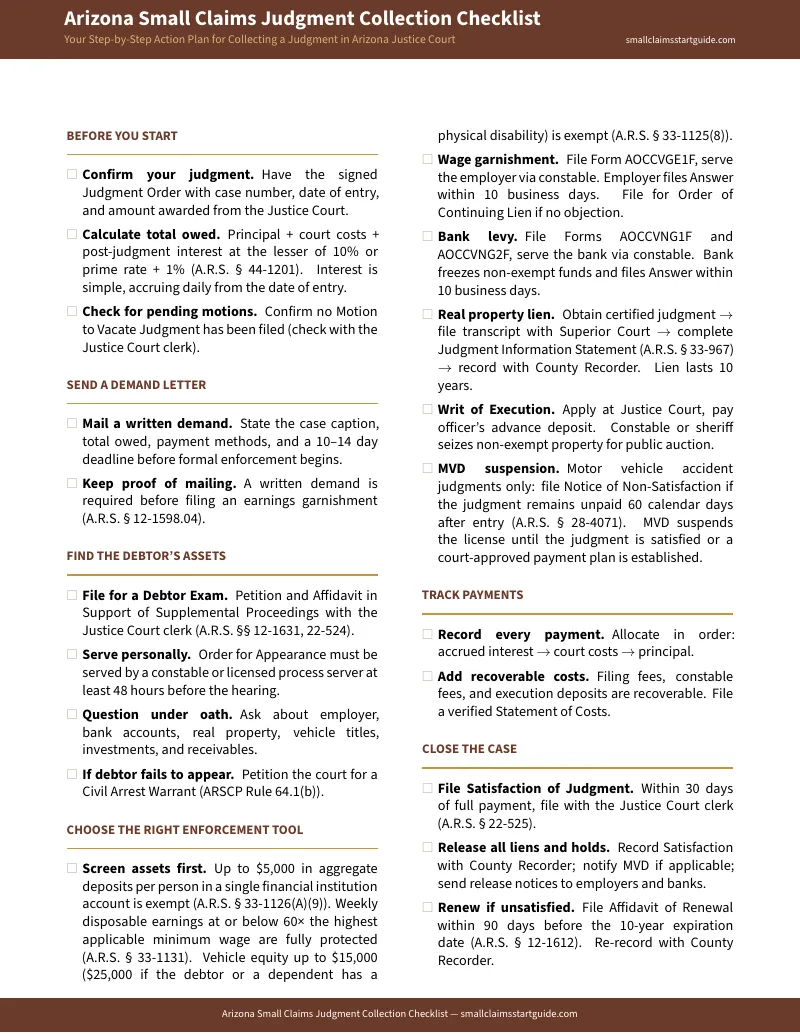
Download the Arizona Small Claims Collection Checklist for a quick-reference overview of the enforcement tools, key form numbers, and Proposition 209 exemption thresholds. If you need the full step-by-step workflow — every form, every fee, every service requirement, every exemption calculation — the complete guide has it all for .
Frequently Asked Questions
What if the rules change after I buy?
We update the guide when the rules change. Email us any time, even years later, and we'll send you the current edition free.