You know the court exists. You don't know which forms to file first.
Your contractor took your deposit and disappeared. Your landlord is sitting on your security deposit well past the statutory deadline and will not answer a single message. A client in Fairbanks owes you months of invoices and has gone quiet. You looked up "how to file small claims in Alaska" and found the Alaska Court System's website — except the information is spread across the SC-100 Handbook (40 pages organised by rule, not by step), a separate forms index, a separate fee schedule, and the District Court Rules of Civil Procedure. The court's resources answer every question about small claims procedure. They do not tell you what to do first, what to do second, and what to do third.
You do not need a legal textbook. You need to know whether your claim fits the $10,000 limit and the statute of limitations, which forms to file and what they cost, how to get the papers to the other side in a state where there is no Sheriff service and certified mail to Bush communities can take weeks, and what to bring to a hearing that lasts 15 to 30 minutes. One wrong defendant name on Form SC-1, one unfiled Affidavit of Service, and the judge continues your case before you open your mouth.
The Alaska Filing Sequence
The Alaska Small Claims Filing Guide takes the entire District Court small claims process — from checking whether your claim fits the $10,000 limit through to post-judgment options — and puts it in a single printable sequence. Every step names the statute or rule, the form, the fee, and the deadline. No tab-juggling between the SC-100 Handbook, the forms index, and the court rules. No guessing what comes next.
This is not a 40-page handbook organised by rule number and it is not a $99–$299 filing service that automates your paperwork but leaves you on your own at the hearing. It is a procedural workflow that walks you through what to do, in what order, by when — with standalone tools you print and fill in at each stage.
What's Inside
How Alaska's Small Claims Track Works
Alaska District Court runs two parallel civil tracks: formal procedure under Part I of the District Court Rules, and small claims under Part II (Rules 8–25). The guide starts by confirming your case belongs on the small claims track, explaining the $10,000 ceiling under AS 22.15.040, the consent mechanism that lets a defendant demand formal procedure, and what the clerk can and cannot help you with — because court clerks are legally prohibited from giving legal advice, and most first-time filers do not know that.
Filing Fees — The Full Cost, Not Just the Base
Filing fees under Administrative Rule 9 are $50 for claims of $2,500 or less and $100 for claims above $2,500. But those are just the court fees. Court-arranged certified mail adds $5 plus actual postage. Licensed private process servers charge $60 to $150. State Trooper service costs approximately $30. Document copies, certifications, and post-judgment costs add more. Filing platforms that charge $99–$299 above court fees rarely mention that fee waivers exist. The guide breaks down every cost and walks through Form TF-920 for filers who cannot afford to pay.
Statutes of Limitations — The Deadlines That Kill Your Claim
Every type of claim has a mandatory filing deadline. Three years for written contracts under AS 09.10.053. Six years for property damage under AS 09.10.050. Two years for personal injury under AS 09.10.070. A demand letter does not pause the clock. The guide walks through every deadline by claim type and shows you how to calculate yours from the date the dispute arose.
The Demand Letter
Alaska does not legally require a demand letter before most filings, but judges expect to see one — especially in contractor disputes and security deposit cases. For security deposit claims under AS 34.03.070, the demand triggers a statutory response window. The guide covers what the letter needs to say, how to send it by certified mail with return receipt, and how long to wait before filing.
Filing Form SC-1 — At the Counter or Through TrueFiling
Form SC-1 (Small Claims Complaint) starts your case. You state the facts, the dollar amount, and the defendant's exact legal name. TrueFiling, the court's e-filing portal, is available to self-represented filers under Administrative Bulletin 92 — but first-time users frequently hit technical rejections. The guide covers both the electronic and paper filing routes, every required form, and the common mistakes that cause the clerk to reject a filing.
Serving the Defendant — Certified Mail, State Troopers, or Process Server
Alaska has no county sheriff service for civil process. Service goes through certified mail with restricted delivery, the Department of Public Safety via State Troopers (approximately $30), or a licensed private process server. In rural and Bush communities — Bethel, Nome, Dillingham, Utqiaġvik — USPS delivery can take weeks and there may be no process server within hundreds of miles. Whichever method you use, you must file Form SC-4 (Affidavit of Service) with the court. Miss this step and the hearing does not go forward. The guide covers each service method, the 20-day pre-hearing deadline, and what to do when the defendant avoids service.
Preparing Evidence for a 15-to-30-Minute Hearing
Small claims hearings are brief. Judges and Magistrates allocate 15 to 30 minutes to hear both sides. Arriving with unsorted photos, unitemised receipts, and no chronological narrative is the fastest way to lose a winnable case on presentation alone. The guide covers exhibit organisation, the evidence index sheet, how to present a contract or receipt trail, and what the courtroom procedure actually looks like.
After the Judgment
Winning does not mean the defendant pays. If the judgment goes unpaid, enforcement tools include wage garnishment under AS 09.40.085, bank levies, and judgment liens. The guide defines where its scope ends — the initial judgment — and points you to the resources for post-judgment collection.
Who This Is For
- Tenants owed a security deposit. Your landlord has 14 days to return your full deposit if no deductions are claimed, or 30 days to send an itemised statement of deductions under AS 34.03.070. If they failed to meet either deadline, you may be entitled to up to double the wrongfully withheld amount. The guide covers the statutory timeline and how to calculate your claim.
- Homeowners with a contractor dispute. The contractor took your deposit and disappeared, or the work is defective. The guide covers how to verify their business registration through the Division of Corporations, Business and Professional Licensing, name the correct entity on Form SC-1, and present repair estimates as evidence.
- Small landlords owed rent or damage costs. Your former tenant left owing rent or caused damage beyond normal wear. The guide covers how to distinguish a money claim from an eviction proceeding under the Forcible Entry and Detainer statutes, and how to document damage with photographs and invoices.
- Sole traders and small businesses with unpaid invoices. A client owes you for completed work. The guide covers entity naming for sole proprietorships, LLCs, and DBAs, the three-year contract statute of limitations, and presenting an invoice trail as evidence.
- Buyers refused a refund. You paid for something that never arrived or did not match the description. The guide covers the demand letter, identifying the seller's registered business name, and establishing venue in the correct District Court location.
- Anyone owed money in Alaska who wants to handle it themselves. If your claim is $10,000 or less and you would rather spend an evening with a step-by-step guide than an afternoon navigating the SC-100 Handbook and calling clerks who are prohibited from advising you, this is for you.
Why Not Just Use the Free Court Resources?
You should use them — and the guide tells you exactly when and where. The Alaska Court System publishes the SC-100 Handbook, blank forms, and the TrueFiling portal. Court clerks accept filings and answer basic administrative questions. The Alaska Legal Services Corporation and AlaskaLawHelp.org offer free guidance to qualifying low-income individuals.
What none of those resources do is put the information in the order you need it. The SC-100 Handbook is 40 pages organised by rule. The forms index lists form numbers without explaining the filing sequence. The fee schedule is on a separate page. TrueFiling instructions live on yet another page. Filing platforms like Squabble automate the paperwork for $99–$299, but they do not prepare you for the courtroom, and they do not mention that Form TF-920 fee waivers exist.
The guide does the organisational work: every form, every fee, every deadline, in the order you encounter them, with a checklist you can print and work through. It sits between the free information (which you still need) and a filing service (which submits your paperwork but does not prepare you for the hearing).
What This Is Not
This guide explains the procedure. It does not give legal advice, predict outcomes, or tell you how to argue your case. It is not published by, affiliated with, or endorsed by the Alaska Court System, the Alaska Bar Association, the Alaska Department of Law, or any government agency. If you need legal advice, contact a lawyer through the Alaska Bar Association Lawyer Referral Service. If you need free help, the guide lists the resources available through the Alaska Legal Services Corporation and AlaskaLawHelp.org.
Satisfaction Guarantee
Full refund, no time limit. If the guide is not what you expected, email [email protected] and we will refund you — no questions, no deadline.
Get Started
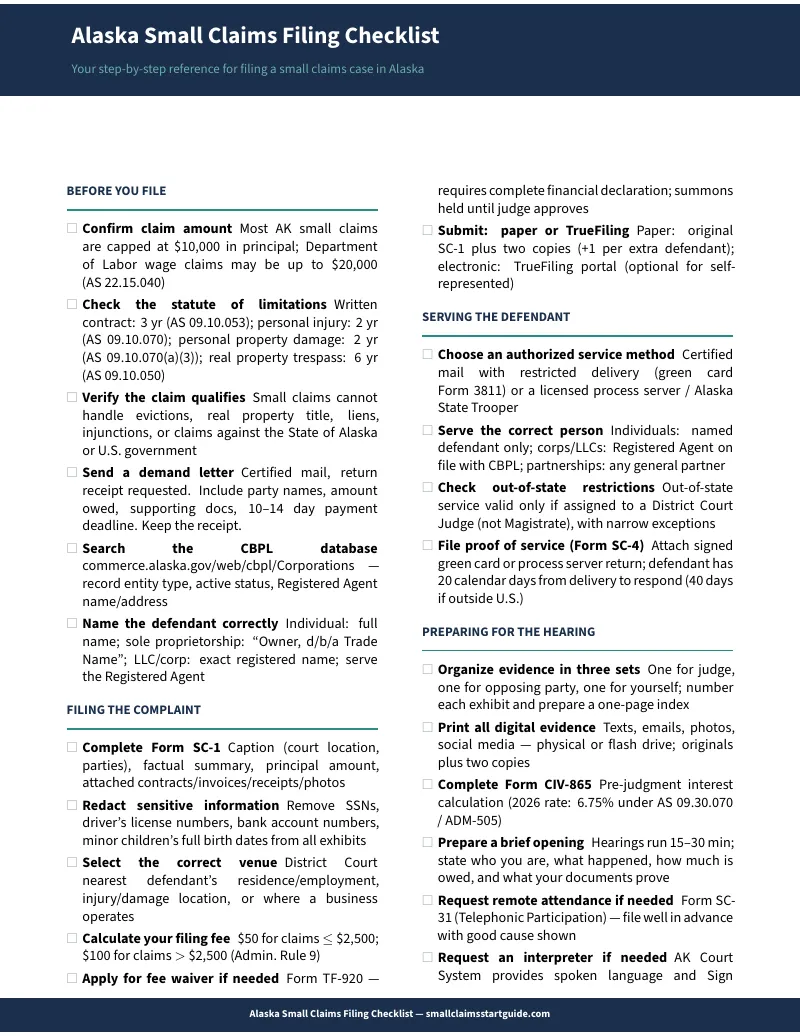
Download the free Alaska Small Claims Filing Checklist — a printable summary of the limit, forms, fees, service steps, and deadlines. If you want the full guide with step-by-step instructions plus fillable standalone tools — deadline calendar, service tracking log, evidence organizer, pre-filing decision worksheet, interest calculator, and demand letter planner — get the complete Alaska Small Claims Filing Guide for .
Frequently Asked Questions
What if the rules change after I buy?
We update the guide when the rules change. Email us any time, even years later, and we'll send you the current edition free.