You won the judgment. Nobody told you that collecting it is a separate process — in a different court.
The hearing is over. The judge ruled in your favour. You expected the money to follow. Instead, the Alberta Court of Justice handed you a piece of paper and sent you home. No one explained that the court that heard your case cannot enforce its own judgments — that you need to transfer the file to the Court of King's Bench, register documents at the Personal Property Registry, locate the debtor's assets yourself, and instruct a private enforcement agency if you want anything seized.
You could hire a paralegal to handle it — $375 just to prepare the Writ, $525 if you add a garnishment, $185 an hour for anything else. If the debtor owns assets worth seizing, a licensed bailiff needs $950 to $1,250 upfront before they pick up the phone. For a $4,000 judgment, those numbers can eat the recovery before it starts.
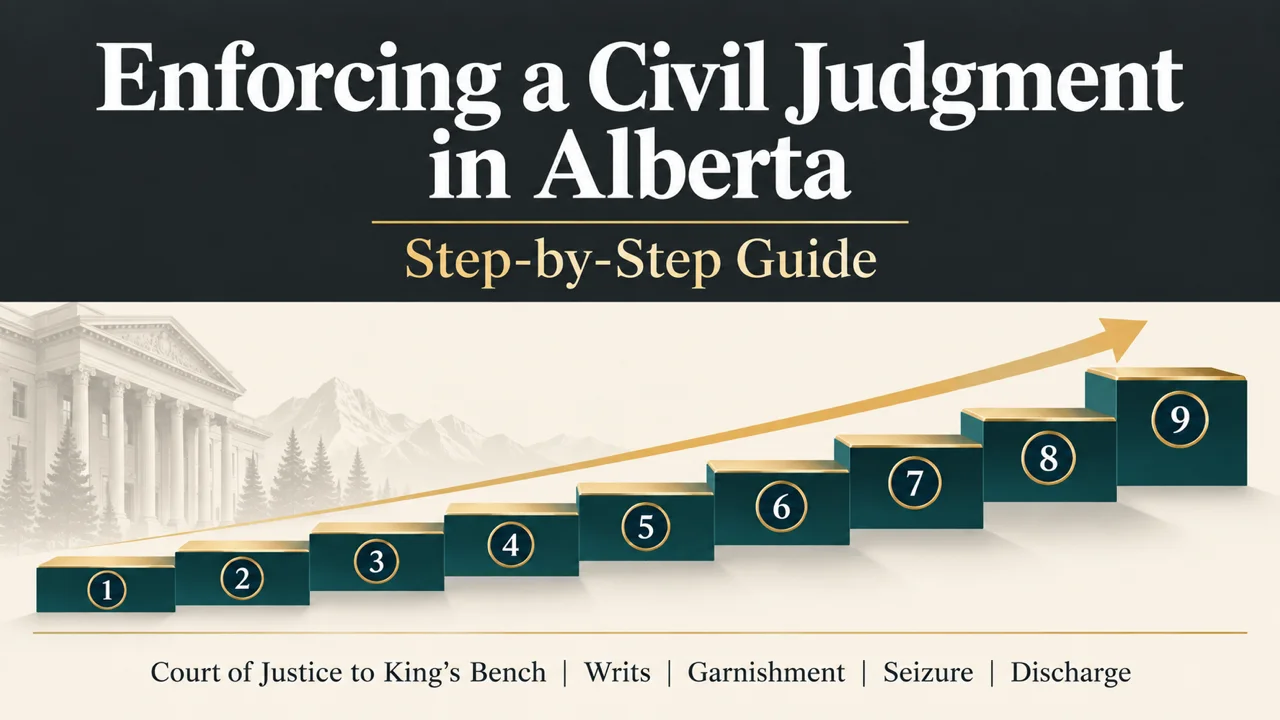
The Enforcement Execution Roadmap — from unpaid judgment to money collected
This guide puts every Alberta judgment enforcement tool in order: when to use each one, what forms to file, where to file them, how much each step costs, and what to do if the debtor resists. It follows a nine-stage sequence from the Certificate of Judgment through to the final discharge — the same sequence a lawyer would follow, with every procedural step laid out so you can follow it without hiring one.
It covers the Alberta Court of Justice, the Court of King's Bench, the Personal Property Registry, Alberta Land Titles, and licensed Civil Enforcement Agencies. You do not need to call any of them to figure out which form comes next.
What's inside
- Court-to-court transfer walkthrough — how to obtain a Certificate of Judgment from the Court of Justice and register it in the Court of King's Bench, step by step. This is where most self-represented creditors stall — the court's own booklet describes the transfer in one paragraph.
- Writ of Enforcement instructions (Form REG3342) — how to issue the writ, register it at the Personal Property Registry to establish priority over the debtor's personal property, and register it against land titles at the Land Titles Office so you can participate in sale proceeds.
- Asset discovery framework — two statutory tools for finding out what the debtor owns or earns: Individual and Corporate Financial Statements (Forms 13/14) that the debtor must complete under penalty, and Examinations in Aid of Enforcement where you question the debtor under oath. The guide covers how to serve the forms, what questions to ask, and what to do with the answers.
- Bank account garnishment — completing a Garnishee Summons (Form 11) against a financial institution, the 60-day effectiveness window, what to do when the bank disputes, and how to re-serve when the first summons expires.
- Wage garnishment and exemption worksheets — serving a Garnishee Summons on the debtor's employer for continuous deductions (up to one year), plus Alberta's statutory wage exemption calculations. The guide includes a step-by-step worksheet so you know exactly how much can be deducted before you serve.
- Property seizure decision guide — when and how to instruct a licensed Civil Enforcement Agency, the upfront deposits they require, what personal property is exempt under Alberta law, and how to evaluate whether seizure makes financial sense for the size of your judgment.
- Interest and cost tracking ledger — calculating post-judgment interest under the Judgment Interest Act, logging every recoverable disbursement (filing fees, registry charges, service costs), and tracking partial payments. Most of these costs get added to the judgment debt — the guide shows you which ones and how to claim them.
- Renewal and discharge procedure — keeping your Personal Property Registry registration current (it must be renewed), maintaining the judgment's ten-year enforceability, and filing the mandatory discharge documents once the debtor has paid in full. Missing the discharge step can expose you to a wrongful-encumbrance claim.
Who this guide is for
- Individuals who won a judgment for an unpaid loan, contractor deposit, property damage, or security deposit — and the other side has not paid
- Landlords with a monetary order from the Residential Tenancy Dispute Resolution Service (RTDRS) who need to enforce it through the courts
- Sole traders and small businesses with a judgment on an unpaid invoice or service contract
- Office managers, bookkeepers, or paralegals tasked with managing enforcement on behalf of a business owner or landlord
If you have a monetary judgment from an Alberta court or tribunal and need a clear, step-by-step path to collecting it, this guide covers every enforcement tool the law provides — in order, with forms, fees, and deadlines.
Why the court's free information isn't enough
The Alberta Courts booklet "Getting and Enforcing Your Judgment in Alberta" is free and accurate. The guide links to it. But it is a high-level overview: it explains that garnishment exists without showing you how to complete the Garnishee Summons, mentions the Personal Property Registry without walking you through the registration, and describes exemptions without providing a calculation worksheet.
Free legal education sites like CPLEA and LawCentral Alberta publish helpful overviews of enforcement concepts. Community legal clinics — Student Legal Services, Calgary Legal Guidance, Edmonton Community Legal Centre — offer short advice sessions for people who meet income thresholds. Neither produces a start-to-finish enforcement workflow with form instructions, fee schedules, and accounting tools in one place.
Hiring a paralegal or civil court agency fills the gap — at $185 an hour. For a $3,000 to $10,000 judgment, professional fees can consume a significant portion of the recovery. This guide gives you the execution roadmap so you can handle straightforward enforcement yourself, and helps you evaluate whether professional help makes financial sense for the steps that need it.
Your purchase is protected
Full refund, no time limit. If the guide isn't what you expected, email [email protected] and you'll get your money back. No forms, no waiting period.
Get started now
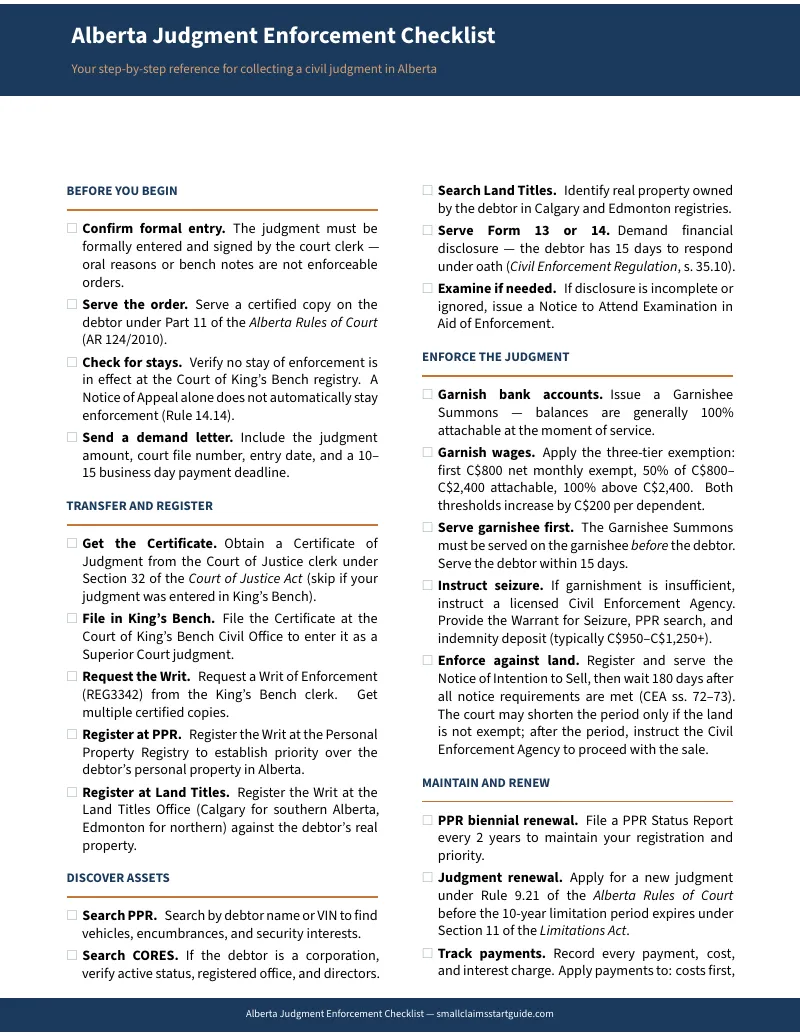
Download the free Alberta Judgment Enforcement Collection Checklist to see the enforcement options, key forms and deadlines at a glance. When you're ready for the full step-by-step walkthrough — every form, every fee, every enforcement tool in order — get the complete guide for and start collecting tonight.
Frequently Asked Questions
What if the rules change after I buy?
We update the guide when the rules change. Email us any time, even years later, and we'll send you the current edition free.