You Have 14 Days. The Clock Started When They Handed You the Papers.
Someone has filed a minor case claim against you in the Magistrates Court of Western Australia. You are holding a Form 4 or Form 6, a date stamp, and a growing sense that doing nothing is going to cost you the entire amount. You are right about that — miss the response window, and the claimant can apply for a default judgment. The court awards them what they asked for, plus costs, without a hearing. No phone call, no second chance.
You do not need a lawyer. In fact, the minor case rules restrict lawyers from appearing without the Magistrate's permission. What you need is the procedural sequence — what to file, where to file it, and when — before that 14-day window closes.
The Minor Case Defence System
This guide takes every step a respondent faces in a WA minor case — from decoding the claim form to walking into the hearing room — and puts it in order, with the specific forms, deadlines, and portal workflows you need at each stage. It covers what registry staff are legally prohibited from telling you: which response box to check, how to frame a defence, how to file a counterclaim, and how to organise your evidence so the Magistrate can follow it.
What's Inside
- Court paper decoder — a guided walkthrough of Form 4 and Form 6 that shows you what each section means, how to identify the claim type, the amount, and the case number, and how to spot claims that belong in a different forum entirely (building disputes, residential tenancies, debt-collection lawsuits).
- Deadline calculator and tracking log — worked examples for calculating your exact response date: 14 days if served within WA, 21 days if served interstate. Covers service by post, personal service, and substituted service, and tracks whether the claimant served you correctly.
- Form 15A response walkthrough — field-by-field instructions for each of the five response routes: full defence, partial defence, admission with instalment offer, counterclaim, and the hybrid options. Explains what goes in Part H (your defence) so it reads like a statement, not a rant.
- eCourts Portal filing guide — account setup, document upload requirements, naming conventions the portal accepts, and the steps for lodging your Form 15A electronically. Covers the Form 69 exemption for defendants who cannot use the portal.
- Default judgment: prevention and recovery — how to check whether default has been entered on the eCourts Portal, how to lodge an urgent late response if it has not, and the Form 23 application to set aside a default judgment if it has.
- Status conference preparation — what happens at a pre-trial conference, the settlement worksheet for knowing your walk-away number, how to structure your summary notes, and the rules about who can attend.
- Evidence bundle and hearing guide — how to index documents for a Magistrate who hears dozens of cases a week, digital filing conventions for the eCourts Portal, the rules on witnesses, and courtroom conduct for the private hearing.
- Post-decision options — cost orders, the 21-day appeal window, applications to set aside a judgment given in your absence, and referral pathways to enforcement guides and free legal help.
- Seven printable worksheets — deadline calculator, response decision matrix, defence drafting worksheet, evidence index sheet, status conference preparation, hearing-day checklist, and agency communication log. Print them, fill them in, keep them with your court file.
Who This Guide Is For
- Homeowners served by a contractor over a building dispute under $10,000
- Former tenants or landlords served over unpaid rent, bond, or property damage
- Small business owners served by a customer or supplier
- Private sellers sued over a car, furniture, or other goods
- Anyone in Western Australia who has received a minor case claim form and does not know what to do next
Why the Free Checklist Is Not Enough
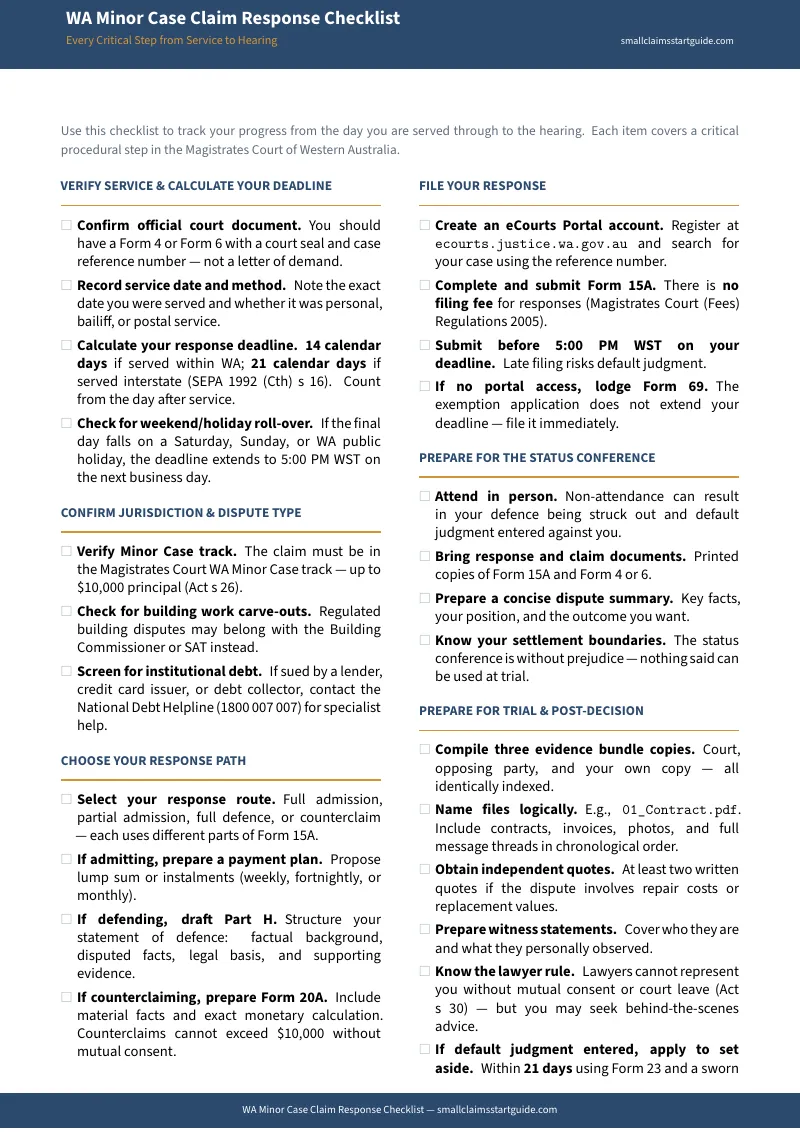
The free checklist gives you the sequence — the steps in order, the forms by name, the key deadlines. That is enough to get oriented and start counting days.
But it does not tell you how to draft a defence statement that a Magistrate will actually read. It does not walk you through deciding between defending, admitting, or counterclaiming when your situation falls in a grey area. It does not give you the evidence-indexing conventions the eCourts Portal expects, the document-naming rules that keep your bundle from being rejected, or the settlement worksheet you need before the status conference.
The Magistrates Court publishes every form and fact sheet for free. Legal Aid WA publishes information sheets for certain dispute types. But none of them connect the dots into a single response workflow — and none of them give you the worksheets, logs, and walkthroughs that turn a stack of court papers into a clear plan you can follow at a desk.
This guide is the instructions the court cannot give you.
Satisfaction Guarantee
If the guide does not deliver what you expected, email [email protected] for a full refund — no time limit, no questions, no hoops.
Respond Before the Deadline Closes
Every day you wait is a day closer to a default judgment — the claimant does not need to warn you, and the court does not send a reminder. The minor case stream is designed for people to handle without a lawyer, but it still enforces strict deadlines, specific forms, and procedural rules that cost you the case if you get them wrong.
Download the free checklist to see the response steps at a glance, or get the full guide for to take control of your response today.