
You won your case. The court won't collect it for you.
The Magistrate signed your judgment. You thought the hard part was over. Then weeks passed — no payment, no contact, no explanation. You called the court registry and heard the words nobody warns you about: "We don't collect debts. You need to file an enforcement application."
Now you are staring at a list of forms you have never seen — CJE Form 6, CJE Form 24, Earnings Appropriation Orders, Debt Appropriation Orders, Property (Seizure and Sale) Orders — and the court's fact sheets describe each one in isolation, without telling you which to use, in what order, or what happens when the debtor ignores the first one.
The Enforcement Roadmap System
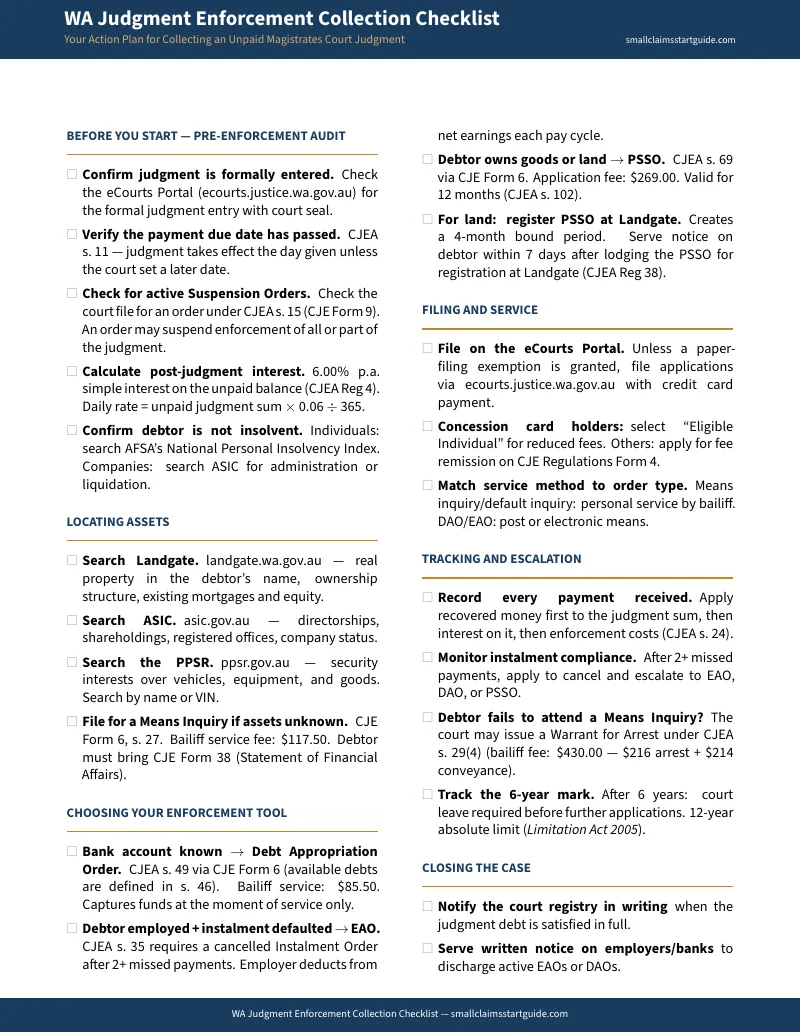
The Enforcing a Magistrates Court Judgment in Western Australia guide replaces that confusion with one linear workflow. Instead of reading eight separate fact sheets and hoping you picked the right form, you follow a structured sequence: confirm your judgment is enforceable, discover the debtor's assets, choose the enforcement tool that matches what you found, file through the eCourts Portal, track service and payments, and close the case when the debt is paid.
Every step names the exact form, the current filing fee, and what happens after you lodge it. No guessing, no jumping between documents, no discovering halfway through that you filed the wrong application.
What's Inside
- Pre-Enforcement Audit Worksheet — confirms your judgment is ready for collection before you spend a cent on court fees. Checks for stay orders, calculates post-judgment interest at 6% per annum, and flags the 6-year leave requirement under CJEA section 12.
- Means Inquiry Preparation Guide — walks you through CJE Form 6, personal service rules, examination questions to ask under oath, and what to do when the bailiff returns a Notice of Non-Service.
- Enforcement Tool Decision Map — matches the debtor's situation (individual or company, known bank account or unknown assets, employed or self-employed) to the correct enforcement order and form number.
- Earnings Appropriation Order Steps — covers the prerequisites (a cancelled instalment order), the application process, and the statutory deductions the debtor's employer must follow.
- Debt Appropriation Order Steps — shows how to garnish a debtor's bank account or intercept money owed by a third party, with the filing procedure for CJE Form 6 selecting the debt appropriation tick box.
- Property (Seizure and Sale) Order Steps — explains when the bailiff can seize personal property and real estate, the exempt property categories, and how to calculate whether the seizure is worth the bailiff's fees.
- Payment Tracking Ledger — a structured worksheet for recording principal, interest, court fees, bailiff fees, partial payments, and the running balance owed. Tells you when the debt is satisfied and how to file the formal record of payment.
- eCourts Portal Filing Walkthrough — step-by-step screenshots and form-field instructions so you file each application correctly the first time.
Who It's For
- Anyone in Western Australia with an unpaid Magistrates Court judgment — whether your case involved a tenancy bond dispute, a motor vehicle claim, an unpaid invoice, or a dividing fence contribution.
- Sole traders and small business owners chasing a debtor who owes up to $10,000 (minor case) or $75,000 (general procedure) and cannot justify hiring a solicitor at $350–$650 per hour.
- People who have already tried waiting and sending demand letters, and need to escalate to formal enforcement through the court.
Why Not Just Use the Free Court Fact Sheets?
The Magistrates Court of Western Australia publishes individual fact sheets for each enforcement order — and every one of them is free. You should read them. But each sheet describes one tool in isolation. None of them tells you which order to apply for based on your situation, what to do when one tool fails, or how the tools connect into a sequence. When the bailiff returns a Notice of Non-Service, the fact sheet does not explain your next step. When the debtor's instalment payments stop, the fact sheet on instalment orders does not point you to the Default Inquiry process.
What costs people money is not the absence of information — it is the absence of a workflow. Filing the wrong form wastes your application fee. Missing a service deadline resets the clock. Skipping the insolvency check means your enforcement order is void. The guide puts the steps in the right order so each filing builds on the last.
Your Purchase Is Protected
Full refund, no time limit. If the guide does not help you, email [email protected] and we will refund you — no questions, no deadline.
Get Started
Download the free WA Judgment Enforcement Collection Checklist to see the enforcement steps at a glance. When you are ready for the full procedural workflow — every form, every fee, every step — get the complete guide for .