You know you're owed money. You just don't know what to file, where to file it, or what happens after you do.
The contractor took your deposit and vanished. The retailer refused the refund. The tenant skipped without paying. You've sent texts, left voicemails, maybe even written a letter — and nothing.
You know VCAT exists. You've been on the website. And you've spent an evening clicking through dozens of pages trying to piece together what you actually need to do — which form, which fee, which list, how to serve the papers, what "Points of Claim" means, and whether your dispute even belongs at VCAT in the first place.
The information is all there. It's just scattered across 30+ pages with no clear order and no way to print a single checklist that walks you from "I'm owed money" to "I'm sitting in the hearing with my evidence organised."
The VCAT Civil Claim Filing System
This guide turns VCAT's fragmented online information into a single, printable execution plan. Every step is in order, every form is named, every fee is current, and every deadline is mapped — from checking whether your dispute fits the Civil Claims List through to the hearing itself.
It is not legal advice. It does not predict whether you will win. It does not replace the free help available from Consumer Action Law Centre, Consumer Affairs Victoria, or community legal centres. What it does is put every procedural step in one place so you are not guessing what comes next.
What's Inside
- Forum Fit Triage Checklist — before you pay the filing fee, verify that your dispute belongs in VCAT's Civil Claims List and not the Magistrates' Court, the Building and Plumbing Commission (for domestic building), or another pathway. Catches the mistakes that waste $202.10 before you make them.
- Letter of Demand Template — fill in party details, transaction facts, the monetary breakdown, and a 14-calendar-day payment deadline, then send it as your formal pre-action notice.
- Entity Verification Checklist — ASIC Connect and ABN Lookup steps so you name the legal entity, not the trading name on the invoice.
- Points of Claim Worksheet — an offline drafting sheet that breaks your dispute into the numbered paragraphs VCAT members expect: the agreement, the terms, the breach, and the remedy. Draft it on paper first, then paste into the portal without the formatting anxiety.
- myVCAT Portal Walkthrough — step-by-step guidance through account registration, the Civil Claims List selection, uploading attachments, and paying the fee (including how to apply for concession or hardship waiver).
- Service Tracking Log — a printable record for documenting how and when you served the application on the respondent, making the Affidavit of Service straightforward instead of a last-minute scramble.
- Directions-to-Hearing Calendar — the Timetable Order VCAT issues after filing (typically 16–20 weeks later) sets strict windows for exchanging evidence and paying hearing fees. The calendar maps every milestone so nothing catches you off guard.
- Hearing Bundle Index — a paginated cover sheet for organising contracts, emails, photos, invoices, and text messages into a bundle that a tribunal member can follow without asking you to re-sort mid-hearing.
- Interest Calculation Worksheet — work the 10.0% statutory penalty rate (where it applies) into a pleaded daily figure before you file.
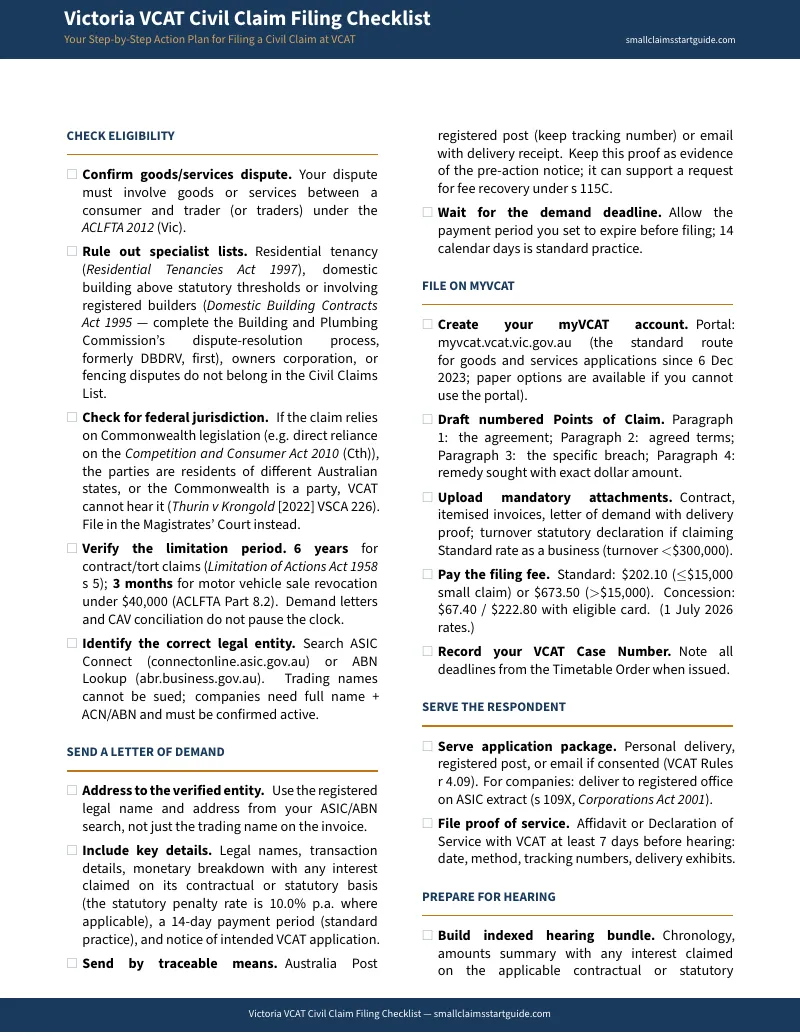
- Quick-Reference Checklist — a 2-page printable covering the monetary limit, all current fees, key deadlines, and the service steps. Pin it to the fridge.
Who This Is For
- Homeowners chasing a contractor who took a deposit and did not finish the work (non-building disputes — domestic building goes through the Building and Plumbing Commission first, and the guide tells you if that's you)
- Sole traders and freelancers with an unpaid invoice under the Civil Claims List
- Tenants or landlords owed a bond or rent (where the dispute is not in the Residential Tenancies List)
- Consumers refused a refund for defective goods or services
- Anyone in Victoria who has already sent a demand and is ready to file — but needs the steps in order
Why Not Just Use the Free Information?
You should use the free information. The official VCAT website, Consumer Action Law Centre, and Consumer Affairs Victoria all publish accurate, current procedural guidance — and the guide links directly to every one of them.
The gap is not accuracy. It is organisation. VCAT's own site spreads the application process across separate pages for fees, forms, portal access, service rules, evidence preparation, and hearing procedure. There is no single printable workflow that puts your steps in order. There is no offline draft worksheet for structuring Points of Claim before you touch the portal. There is no service tracking log or directions calendar you can fill in as deadlines arrive.
The guide does not contain secret information. It consolidates what is already free into a format you can execute without 30 browser tabs open.
What This Guide Does Not Do
- It does not give legal advice or tell you whether your claim will succeed
- It does not speak for VCAT, the Magistrates' Court, or any government body
- It does not replace a lawyer for complex disputes, urgent injunctions, or insolvency matters
- It does not cover responding to a claim (see our companion VCAT Response Guide) or enforcing an unpaid order (see the VCAT Order Enforcement Guide)
Full Refund, No Time Limit
If the guide is not what you expected, email [email protected] for a full refund. No time limit, no questions.
Start With the Free Checklist
Not sure yet? Download the free Victoria VCAT Civil Claim Filing Checklist — a 2-page printable covering the monetary limit, current fees, the myVCAT portal steps, and links to free legal help. If you need the full step-by-step system with worksheets, the calendar, and the evidence index, the complete guide is here when you are ready.