You Have 21 Days. The Court's Blank Forms Won't Help You Count Them.
You have been served with a claim in the Magistrates Court of Tasmania. The papers say you owe someone money — up to $15,000 — and you have exactly 21 calendar days from the date of service to lodge a response. If you miss that window, the claimant can apply for a default judgment: a court order against you, entered without a hearing, and enforceable immediately.
The court website gives you two blank Word documents — Form 4 (Defence) and Form 5 (Defence and Counterclaim) — and nothing else. No instructions on how to respond to each allegation. No explanation of which form to use. No way to calculate whether your deadline falls on a weekend or public holiday. No guidance on how conciliation works or what to bring to the hearing.
This guide is the Response Navigation Toolkit — a complete procedural walkthrough that starts the moment you open the envelope and ends after the Magistrate's decision. It does not give legal advice or predict outcomes. It organises every step of the response process so you can meet every deadline and show up prepared.
What's Inside
- Claim Papers Walkthrough — how to read Form 1, identify what is actually being claimed against you, verify the claim is real by calling the registry, and confirm whether it falls within the $15,000 minor civil limit.
- 21-Day Deadline Calculator — two worked examples showing exactly how to count 21 calendar days from personal service and from registered post, with the rules for weekends and public holidays.
- Four Response Pathways Compared — a side-by-side breakdown of your options: lodge Form 4 to dispute the claim, lodge Form 5 to dispute and counterclaim, admit the debt and propose instalment payments, or negotiate a settlement before filing anything.
- Form 4 and Form 5 Field-by-Field Reference — how to draft your response to each numbered allegation in the claim (admit, deny, or state you lack knowledge), write concise grounds of defence, and calculate a counterclaim amount if you are owed money too.
- Filing and Service Checklist — which registry to lodge at (Hobart, Launceston, Devonport, or Burnie), how to serve the filed copy on the claimant, and why proof of service matters.
- Default Judgment Set-Aside Guide — what happens if you have already missed the 21-day deadline, the three-part legal test for setting aside a default judgment, and how to prepare the application.
- Conciliation Conference Prep Framework — what conciliation is, what the conciliator can and cannot do, how to prepare a settlement range, and what a Consent Order (Form 11) looks like.
- Hearing Preparation System — how to organise your evidence bundle with numbered exhibit pages, build a chronological timeline, and present your case clearly to the Magistrate on the day.
- Post-Decision Reference — what a money order or dismissal means, payment timelines, enforcement options, and how to apply for a rehearing or appeal.
- Residential Tenancy Special Rules — when a bond or property damage claim stays in the Magistrates Court and when it belongs at TASCAT instead, plus the procedural differences.
- 5 Printable Worksheets — deadline tracker, filing and service matrix, evidence organisation index, conciliation conference prep, and a response decision flowchart — fill them in and bring them to the registry, conciliation and the hearing.
Who This Guide Is For
You are a homeowner who received a claim from a tradesperson over unpaid building work. A former landlord or tenant in a property damage or bond dispute that has landed in court. A small business owner served with a claim by a dissatisfied customer. A private car seller or buyer dealing with a defect or misrepresentation dispute. The claim is $15,000 or less, it is in the Magistrates Court of Tasmania, and you want to handle the response yourself.
In minor civil claims, parties must represent themselves — and even when a solicitor is allowed, their costs are generally not recoverable from the other side. For a claim under $15,000, spending $300 an hour on legal representation often costs more than the claim itself. This guide gives you the procedural structure to respond correctly without that expense.
Why the Free Tools Are Not Enough
The Magistrates Court of Tasmania publishes blank forms, a fee schedule, and a flowchart. Legal Aid Tasmania offers phone advice, and community legal centres provide one-off appointments. These are valuable resources — but none of them provide a unified procedural walkthrough for respondents.
The court's Form 4 and Form 5 are blank Word documents with no instructions. There is no explanation of how to respond to each numbered allegation, no deadline calculator, no evidence organisation framework, and no conciliation prep tool. Legal Aid can explain your options in a phone call, but they do not provide printable worksheets, filing checklists, or hearing preparation guides. Community legal centre appointments often take weeks to schedule — and the 21-day deadline does not wait.
Generic "Australian small claims" templates sold on Etsy and Amazon use New South Wales or Victorian tribunal rules. NCAT and VCAT operate on different forms, different deadlines, and different conciliation structures. Applying those templates to the Magistrates Court of Tasmania introduces procedural errors that can cost you your defence.
This guide is built exclusively for the Magistrates Court of Tasmania, verified against the Magistrates Court (Civil Division) (Minor Civil Claims) Regulations 2023 and the current fee schedule, with every form number, deadline rule, and registry address specific to Tasmania.
100% Independent — Not a Court or Government Publication
This guide is not affiliated with, endorsed by, or connected to the Magistrates Court of Tasmania, Legal Aid Tasmania, the Department of Justice, or any government department. It provides independent procedural navigation only — never legal advice, never outcome predictions, and never argument strategy. Every guide includes free legal aid contact details (Legal Aid Tasmania 1300 366 611, the National Debt Helpline 1800 007 007, and community legal centres across the state) so you know where to go if your situation needs professional help.
Full refund, no time limit. If the guide is not what you expected, email [email protected] for a complete refund — no questions, no deadline.
Get Started Now
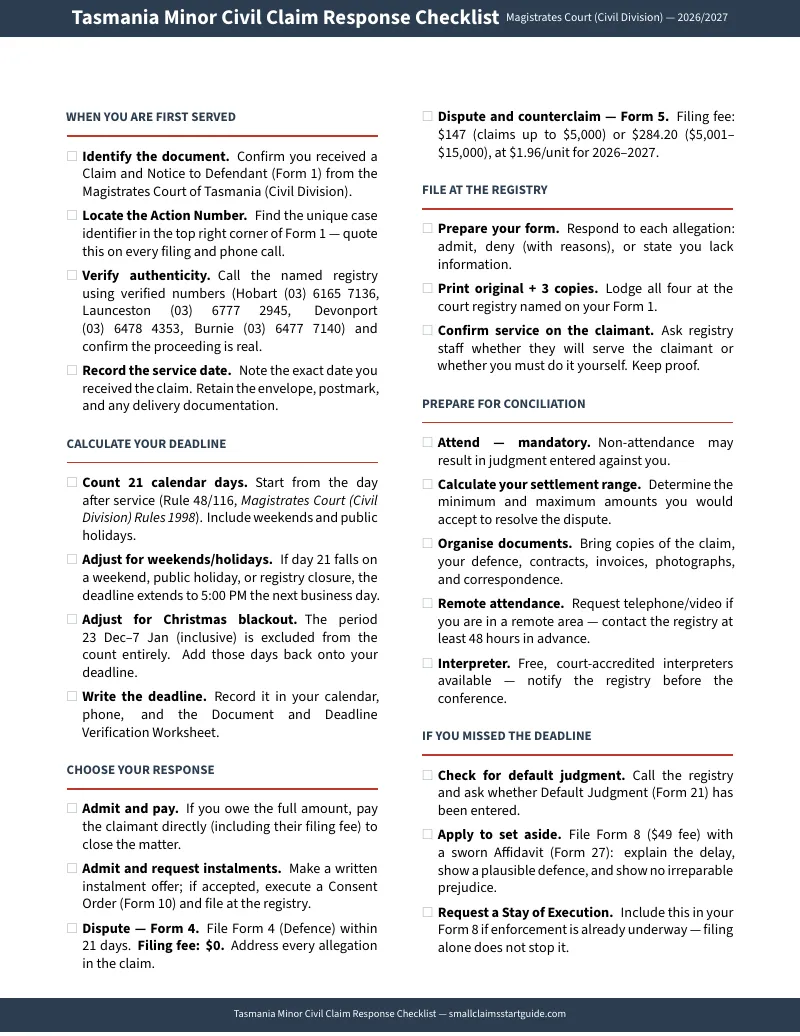
Download the free Tasmania Minor Civil Claim Response Checklist — a one-page overview of the response deadline, your four options, the document inventory, and the key contacts — or get the full Response Navigation Toolkit for the complete step-by-step guide with worksheets, evidence organisation tools, and hearing preparation.
Every day you wait is one day closer to the deadline. The 21 days started when you were served.
Frequently Asked Questions
What if the rules change after I buy?
We update the guide when the rules change. Email us any time, even years later, and we'll send you the current edition free.