You Won the Case. The Court Won't Collect the Money.
The Magistrates Court handed you a judgment. The 21-day waiting period has expired. And the other side has done nothing.
Now you are staring at a court website full of blank Word templates — Form 25A, Form 25E, Form 23 — with no indication of which one to file first, what to attach, or what happens if you get the sequence wrong.
A rejected filing means starting over. A premature garnishee means the order gets set aside. A warrant filed against an asset-free debtor means you are out $254.80 in court and bailiff fees with nothing to show for it.
The Enforcement Sequence System
This guide maps the entire enforcement pipeline from the day the payment deadline passes to the day you close the file — every form, every fee, every waiting period, in the exact order the Magistrates Court of Tasmania requires.
It is not a list of options. It is the sequence: what to file, what to attach, who to serve, how long to wait, and what to file next. Each step tells you exactly what the court registry expects so your paperwork is accepted the first time.
What's Inside
- Pre-enforcement solvency screen — before you pay a single filing fee, a structured check to assess whether the debtor has attachable income, bank funds, or seizable property. This one step can save you $254.80 in wasted court fees.
- Oral examination workflow — how to apply for an examination of the debtor under oath, including the $3.50 filing fee, the affidavit requirements, and what questions to ask to uncover hidden assets.
- Two-stage garnishee maps — the provisional-to-final process for both wage and bank account garnishees, with the 21-day objection window between each stage clearly marked. Skipping a stage is the most common reason garnishee applications are rejected.
- Warrant to sell property — when to instruct the bailiff, what the $49 filing fee and $205.80 execution fee cover, how the sale works, and what the bailiff cannot touch (including the $3,000 tools-of-trade exemption).
- Instalment order procedure — when a debtor can pay but not all at once, how to formalise a payment plan through a consent order so you have an enforceable schedule instead of a verbal promise.
- Payment tracking ledger — a reusable log for recording partial payments, court disbursements, and enforcement costs so you always know the exact balance outstanding.
- Case closure procedure — how to file a notice of discontinuance or satisfaction when the debt is fully paid, including what happens if you leave the judgment open on the court record.
- Cross-border enforcement — when the debtor or their assets are in another state, how to register the Tasmanian judgment interstate under federal law.
Who It's For
- Self-represented individuals who won a judgment in the Magistrates Court (minor civil claims up to $15,000) and have not been paid
- Sole traders and contractors chasing an unpaid invoice after a court win, who cannot afford to lose more billable hours sitting in court registries
- Office administrators and bookkeepers delegated to recover company debts, who need a repeatable filing process they can document for their directors
- Family helpers assisting a relative with enforcement paperwork — the guide is written so the named judgment creditor can review, sign, and submit every form themselves
Why Not the Free Forms?
Every enforcement form is available for free on the Magistrates Court website. That is not the problem.
The problem is sequence. The court website gives you 39 separate form templates with no workflow connecting them. It does not tell you that a wage garnishee requires two filings with a mandatory 21-day gap between them, that the affidavit of service must be witnessed by a JP before lodging, or that you need to check for active stay applications before filing anything at all.
Registry staff cannot help — they are legally prohibited from giving procedural guidance or filling out forms. Legal Aid and community legal centres prioritise debt defence, not debt collection. And hiring a solicitor at $350–$600 per hour makes no economic sense on a claim under $15,000.
This guide fills the gap between blank forms and a solicitor's office. It puts every step in order, flags the common mistakes that cause rejections, and gives you the forms, fees, and deadlines on one page.
Your Safety Net
Full refund, no time limit. If the guide does not give you what you need, email [email protected] and you will get your money back.
This is an independent educational guide — not legal advice, not a court publication, and not affiliated with any court, tribunal, or government body.
Get Started
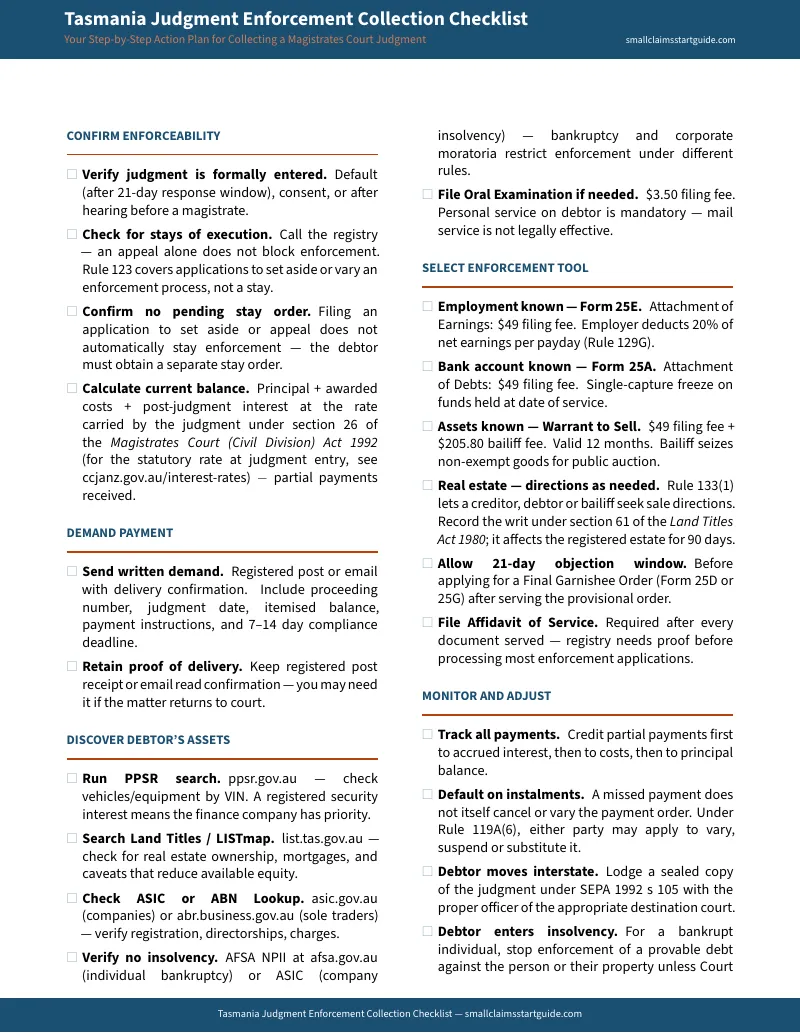
Download the free Tasmania Judgment Enforcement Collection Checklist to see the enforcement options at a glance. When you are ready for the full step-by-step procedure, the complete guide is available for .
Frequently Asked Questions
What if the rules change after I buy?
We update the guide when the rules change. Email us any time, even years later, and we'll send you the current edition free.