You've been served. Now what?
A courier, a registered letter, or someone at your door — and suddenly you're holding court papers with a deadline stamped on them. The 28-day clock is already running. Miss it, and the applicant can ask the court to enter judgment against you without a hearing.
The problem isn't that you can't find information. The SA courts website has forms. The Law Handbook has chapters. Community legal centres have phone lines with hold music. The problem is that none of it is in order. You're jumping between government PDFs, portal login screens, and dense legal prose while a statutory deadline counts down — and every source assumes you already know which form to file, which portal screen to use, and what "discovery" means.
The 28-Day Response System
This guide turns scattered court rules into a single, printable workflow that follows your timeline — from the day you're served to the day after the hearing.
It's built specifically for the South Australia Magistrates Court Minor Civil Claims Division (claims up to A$12,000), using the current Uniform Civil Rules 2020 form numbers, fee schedules, and CourtSA portal steps. Every chapter maps to a phase of your response, in the order you need to do things.
What's Inside
- Reading the claim papers — what Form 1 and Form 1S actually say, what the applicant is asking for, and the three things you need to identify before doing anything else
- Deadline tracking worksheet — count your 28-day window correctly from the date of service, mark key milestones, and log every filing so nothing falls through
- Defence filing walkthrough — step-by-step instructions for completing Form 51S on the CourtSA portal (or Form 51 on paper), including which fields trip people up and how to structure your response
- Counterclaim guidance — when Form 61S makes sense, the A$186 filing fee, and how to file a cross-claim alongside your defence without doubling your paperwork
- Evidence and discovery organiser — a structured approach to the Form 73A List of Documents (due within 14 days of filing your defence), with an indexing worksheet so you walk into conciliation with everything labelled and in order
- Hearing preparation — what to expect at a directions hearing, conciliation conference, and trial when you're representing yourself, including what to bring and how the process works under Section 38(4) of the Magistrates Court Act 1991
- After the decision — your options if the judgment goes against you, including the Form 182A review process, realistic timelines, and when to get legal help
- Default judgment chapter — what happens if you miss the 28-day window, how Form 76B works, and the process for applying to set a default judgment aside
Who This Guide Is For
- A homeowner served over a fencing dispute, retaining wall, or property damage claim
- A small business owner or sole trader facing an unpaid invoice or breach-of-contract claim
- An uninsured driver or car seller served after a collision or private sale
- A former tenant or landlord whose dispute ended up in the Magistrates Court
- A family member helping someone else understand and respond to court papers
Why Not Just Use the Free Resources?
You should. The Courts Administration Authority website (courts.sa.gov.au) publishes every form. The Legal Services Commission's Law Handbook explains the law in detail. If you qualify for free legal advice, contact the Legal Services Commission Helpline on 1300 366 424 — that's always the right first call for anyone in financial hardship.
This guide doesn't replace those resources. It organises them. The Law Handbook explains what the rules are. This guide shows you what to do first, what to do next, and what to file when — with the form numbers, the portal steps, and the deadlines in the order you actually need them. Registry staff can help you use the portal, but they're legally prohibited from telling you what to write in your defence. This guide bridges that gap with plain-English instructions for structuring your response.
One afternoon with the guide versus days of tab-switching between government PDFs, portal help screens, and legal jargon you have to decode paragraph by paragraph.
What This Guide Does Not Do
This guide covers procedure. It does not give legal advice, assess the strength of your case, predict outcomes, or tell you what arguments to make. It is not produced by, endorsed by, or affiliated with the SA Magistrates Court, the Courts Administration Authority, or any government body. If you need advice on the merits of your dispute, speak to a lawyer.
Your Purchase
You get instant access to the complete 54-page guide plus 9 printable worksheets and reference tools — deadline calculator, response route decision tree, defence preparation worksheet, document organiser, hearing preparation checklist, settlement evaluation worksheet, agency communication log, key forms reference, and the quick-start response checklist. It's a one-time purchase — no subscription, no recurring charge. Full refund, no time limit. If it's not useful, email [email protected] and you'll get your money back.
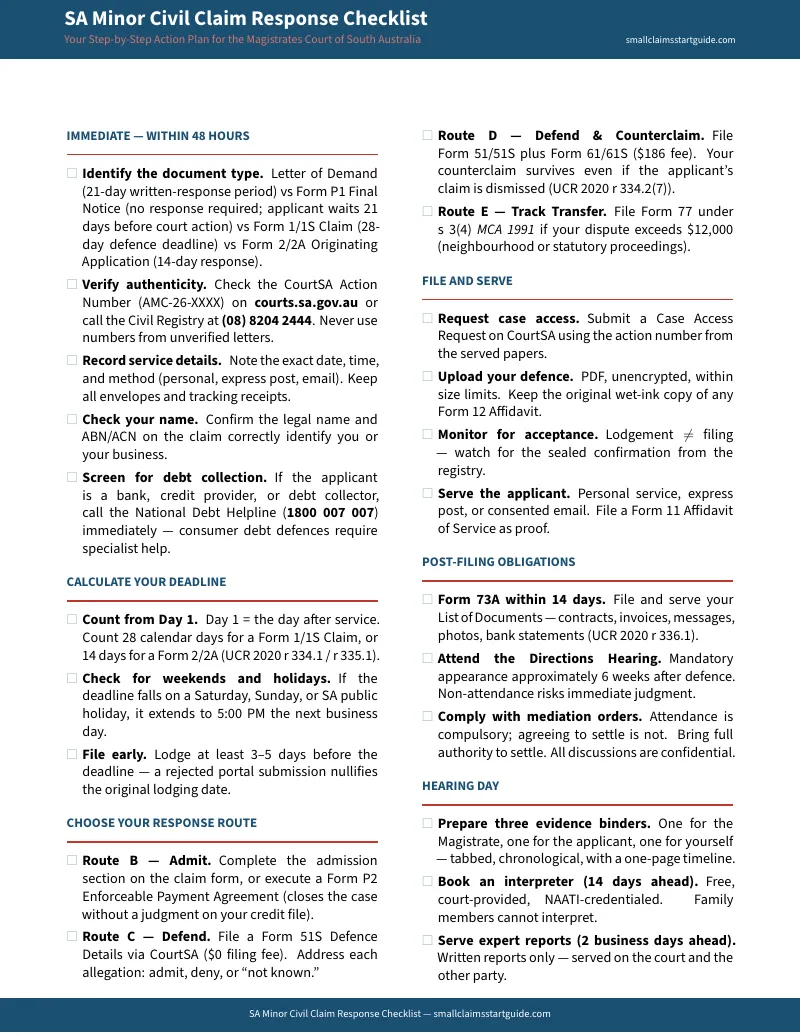
The free checklist shows you what to do. The full guide shows you how.
Get the full guide —