You Won the Order. They Haven't Paid. Now What?
You sat through the NTCAT hearing, presented your evidence, and the tribunal agreed: the other side owes you money. Then the payment deadline passed — and nothing happened. No transfer, no phone call, no plan.
So you went back to the NTCAT website looking for the next step, and discovered something nobody mentioned at the hearing: NTCAT cannot collect the money for you. It cannot freeze a bank account, garnish wages, or send anyone to seize property. To do any of that, you need to register the order in the NT Local Court and use a completely different set of forms, fees and procedures that NTCAT's website barely mentions.
That gap — between winning at NTCAT and actually getting paid — is where most creditors get stuck. The information exists across government websites, legislation databases, and legal handbooks, but it is scattered, written for lawyers, and gives you the rules without telling you what to do first.
The NT Enforcement Roadmap — From Registration to Satisfaction
This guide replaces the dozens of tabs, phone calls to registry clerks, and forum posts that most self-represented creditors piece together over weeks. It puts every enforcement step into one document, in the order you actually need to do it:
- NTCAT-to-Local Court registration walkthrough — how to get the certified monetary order, prepare the affidavit of amount unpaid, and lodge both at the Local Court registry so the order becomes an enforceable judgment
- Enforcement tool selection framework — a structured decision path that matches what you know about the debtor (employer, bank, property, nothing at all) to the right enforcement mechanism, so you do not pay a filing fee for a tool that cannot reach the debtor's assets
- Examination summons question checklist — the debtor must attend court and answer questions about their finances under oath; the checklist tells you exactly what to ask about employment, bank accounts, vehicles, property and business interests
- Attachment of earnings walkthrough — step-by-step instructions for applying to garnish the debtor's wages, including the form, the filing fee, and what happens when the employer receives the order
- Attachment of debts walkthrough — how to freeze the debtor's bank account through the Local Court, from drafting the application to serving the bank
- Warrant of seizure and sale — when and how to send the sheriff to seize and sell the debtor's property, what the sheriff can take, and what is protected by statutory exemptions
- Fee and interest planning matrix — every filing fee, service cost and post-judgment interest calculation on one page, so you can weigh the cost of each tool against the outstanding balance before you commit
- Payment ledger and satisfaction protocol — a printable tracker for instalment payments and partial recoveries, plus the procedure for filing a notice of satisfaction once the debt is fully paid
Who This Is For
This guide is for anyone in the Northern Territory holding an unpaid NTCAT monetary order and wanting to collect it without a lawyer. That includes homeowners chasing a contractor who took a deposit and disappeared, sole traders with unpaid invoices, tenants owed a security deposit, and anyone else who won at NTCAT for a claim up to $25,000 and has not been paid.
It is not for people who need to file a claim at NTCAT (see the filing guide) or people responding to a claim (see the response guide).
Why Not Just Use the Free Resources?
Every NT Local Court form is free. The NT Law Handbook explains every enforcement tool. Legal aid services can answer questions during an appointment.
The problem is not access — it is assembly. The NTCAT website tells you to register the order in the Local Court, then stops. The Local Court website lists forms by rule number, not by task. The Law Handbook explains the legal principles but does not walk you through completing a particular application. Registry clerks can hand you a form but are legally prohibited from telling you which tool to choose or how to fill it in. And hiring a solicitor to handle enforcement routinely costs A$2,000 to A$8,000 — often more than the debt itself.
This guide sits between the free forms and a lawyer. It takes the same rules, the same forms, and the same procedures that are publicly available and organises them into a single step-by-step workflow you can follow from your kitchen table.
What You Get
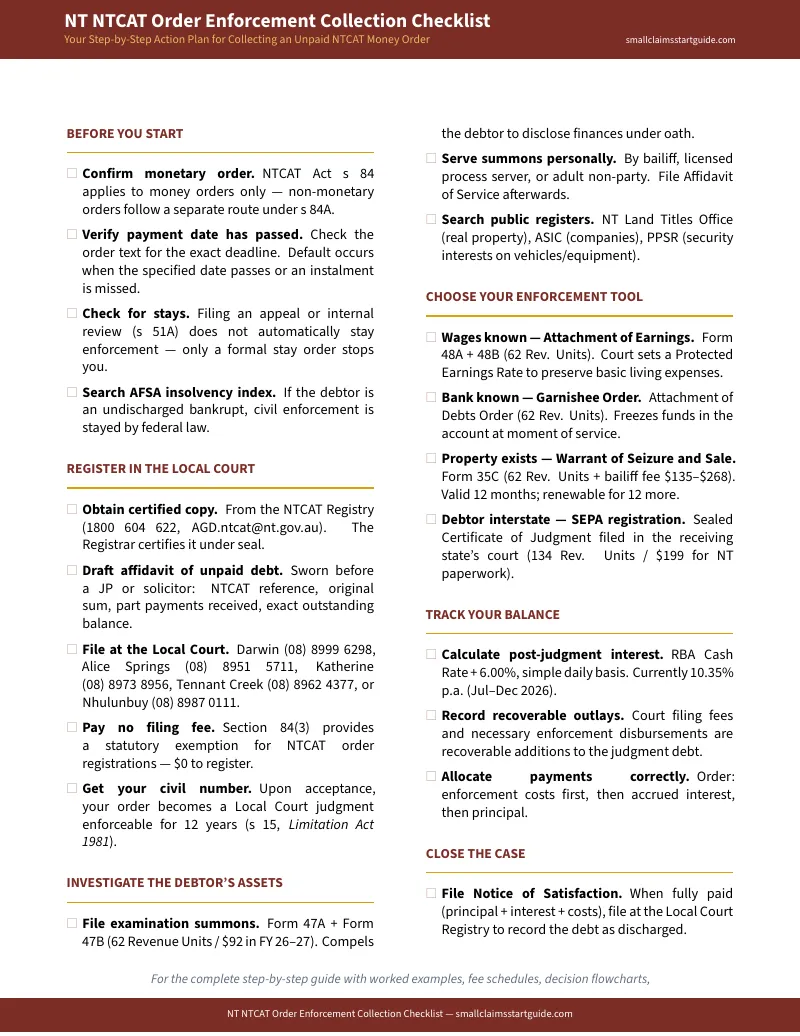
The paid download includes 8 PDFs: the full 14-chapter enforcement guide covering every step from NTCAT registration to case closure, the enforcement checklist, and 6 printable worksheets — the enforcement decision matrix, the examination question checklist, the fee reference card, the payment ledger, the proof of service tracker, and the enforcement timeline planner. All formatted for printing and screen reading.
The free checklist gives you a one-page summary of the enforcement options, forms and exemptions so you can see the full picture before committing to the guide.
Satisfaction Guarantee
Full refund, no time limit. If the guide does not help, email [email protected] and you will get your money back.
Independent procedural guide. Not legal advice. Not affiliated with NTCAT, the NT Local Court, the NT Government, or any legal aid organisation. All official court forms are available free from the NT Local Court and NTCAT websites.
Frequently Asked Questions
What if the rules change after I buy?
We update the guide when the rules change. Email us any time, even years later, and we'll send you the current edition free.