The Papers Arrived. The Hearing Date Is Set. You Don't Know What to Do First.
A customer has filed a consumer claim against you at NCAT. The Notice of Listing gives you a date, a file number, and a venue — but no instructions. No form to fill in. No written defence to file. Just a hearing date and the unspoken message: be ready, or the Tribunal Member decides without you.
You search the NCAT website and find fifteen separate pages covering respondents, evidence rules, conciliation, online services, and post-decision options — each written from a neutral administrative standpoint, none telling you what to do in what order. You call the registry, and they confirm they cannot give you legal advice. You look at solicitor rates — A$350 to A$650 per hour — for a tribunal that generally does not award legal costs, making legal representation economically impractical for most consumer disputes.
The NCAT Response Procedure Companion puts the entire response process into a single document you can print, annotate, and carry into the hearing room — from the day the papers arrive to the day after the decision.
What makes this different from the free government pages
NCAT's website is authoritative. It is also fragmented. The respondent information is on one page. The evidence rules are on another. The conciliation procedures are buried in a third. The online services portal lives on a separate domain. The fee schedule for set-aside applications is in a PDF you have to know exists to find.
This guide reorganises all of it into a single chronological workflow with printable worksheets you will not find on any government page:
- Notice and Directions Log — a fillable tracking sheet that converts the hearing date, evidence deadlines, and any directions from the Tribunal Member into a structured action plan. Every deadline the Tribunal sets goes in one place, not scattered across handwritten notes.
- Conciliation Settlement Boundaries Worksheet — before you walk into mandatory conciliation, you work out your three numbers: your preferred outcome, your acceptable compromise, and your walk-away position. Respondents who enter conciliation without settlement boundaries accept terms they regret or reject offers they should take.
- Master Evidence Index — a pre-formatted, numbered template for indexing witness statements, invoices, correspondence, photographs, and expert reports in the format the Tribunal expects. NCAT does not provide an index template. It tells you to organise your documents logically, then leaves you to guess what that means.
Everything inside, chapter by chapter
- Reading and authenticating the papers — what each document in the service packet means, how to verify authenticity through the NCAT registry, and how to identify the file number and document barcode you need to link your case online
- Service rules — how deemed service works, why the clock can start before you physically hold the papers, and what to do if service was defective (attend the hearing anyway and raise it as a preliminary matter)
- Your four response routes — disputing the claim, admitting and negotiating an outcome, making a settlement offer, or filing a cross-application — with the procedural consequences of each, not just a description
- The hearing-date system — how NCAT's Notice of Listing differs from the Local Court's 28-day defence deadline, why there is no Defence form to file, and what happens if you do nothing (an ex parte order)
- NCAT Online Services — registering your individual account or eOrganisation profile, linking the case using the document barcode from your Notice, uploading evidence, and requesting telephone or video attendance
- Conciliation preparation — what happens at the mandatory conciliation session, how to use the Settlement Boundaries Worksheet, and how consent orders work if you reach an agreement on the day
- Evidence preparation — building a numbered, indexed bundle with witness statements, correspondence, invoices, and photographs that meets NCAT submission standards
- Hearing day — what to expect from the Tribunal Member, how hearings run for unrepresented respondents, what to bring, and how ex parte proceedings work if the other side does not attend
- After the decision — the Application to Set Aside or Vary Decision (for missed hearings, A$133 standard fee), the Internal Appeal to the Appeal Panel (questions of law, A$540, strict 28-day deadline), and how to tell which route applies
- NCAT vs Local Court — a side-by-side comparison table so you stop confusing court rules with tribunal rules
- Printable worksheets — Notice and Directions Log, Evidence Index Cover Sheet, Conciliation Settlement Boundaries Worksheet, Hearing Day Preparation Checklist, Post-Decision Action Tracker, and Authority to Act checklist for corporate respondents
Who this is for
You are a trader, tradesperson, or small business owner in New South Wales who has been served with a consumer claim at NCAT. Your customer says the work was defective, the goods were faulty, or the service was unsatisfactory — and they want money, a repair, or a replacement. The claim is under A$100,000, which means it is in NCAT's Consumer and Commercial Division, and you are expected to represent yourself.
- A contractor served by a homeowner over allegedly defective or incomplete work
- A retailer or service provider served over a refund, warranty, or consumer guarantee dispute
- A sole trader or small business owner served by a customer over goods or services
- A car dealer or repairer served over a vehicle defect or warranty claim
- A former landlord or tenant whose dispute has moved into a consumer claim (not the specialist Tenancy List)
This guide covers consumer claims in NCAT's Consumer and Commercial Division. It does not cover home building disputes (specialist Home Building List), residential tenancy disputes (specialist Tenancy List), private vehicle sales between individuals (Local Court), or debt-collection claims from lenders, credit card companies, or collection agencies. Each chapter lists the free help available for out-of-scope matters.
Why not just use free templates and search results?
Generic response templates on Etsy and Gumroad under keywords like "NSW Small Claims Defence" or "NCAT Response Template" are almost always breach-of-contract response letters designed for the Local Court. They assume you need to file a formal Defence within 28 days — a court rule that does not apply at NCAT. Using one can lead you to submit paperwork the tribunal did not ask for, or worse, to wait for a deadline that does not exist while the actual hearing date passes.
The NCAT website covers every aspect of the process — but from a neutral, administrative perspective distributed across dozens of pages. No fillable evidence indexes. No conciliation preparation worksheets. No step-by-step portal linking guide. No post-decision route map that distinguishes a set-aside application from an appeal.
Law firm consultations start at A$350 per hour. For a dispute under A$10,000, the consultation can cost more than the claim is worth. Under NCAT rules, parties bear their own legal costs, so even if you win, you do not recover what you spent on the solicitor.
Your purchase is protected
Full refund, no time limit. If the guide is not what you expected, email [email protected] and you will get your money back. No form, no waiting period, no questions.
This is an independent publication. Small Claims Start Guide is not affiliated with NCAT, the NSW Department of Customer Service, Legal Aid NSW, or any court, tribunal, or government body. The guide explains procedure — it does not give legal advice, assess the merits of any defence, or predict outcomes.
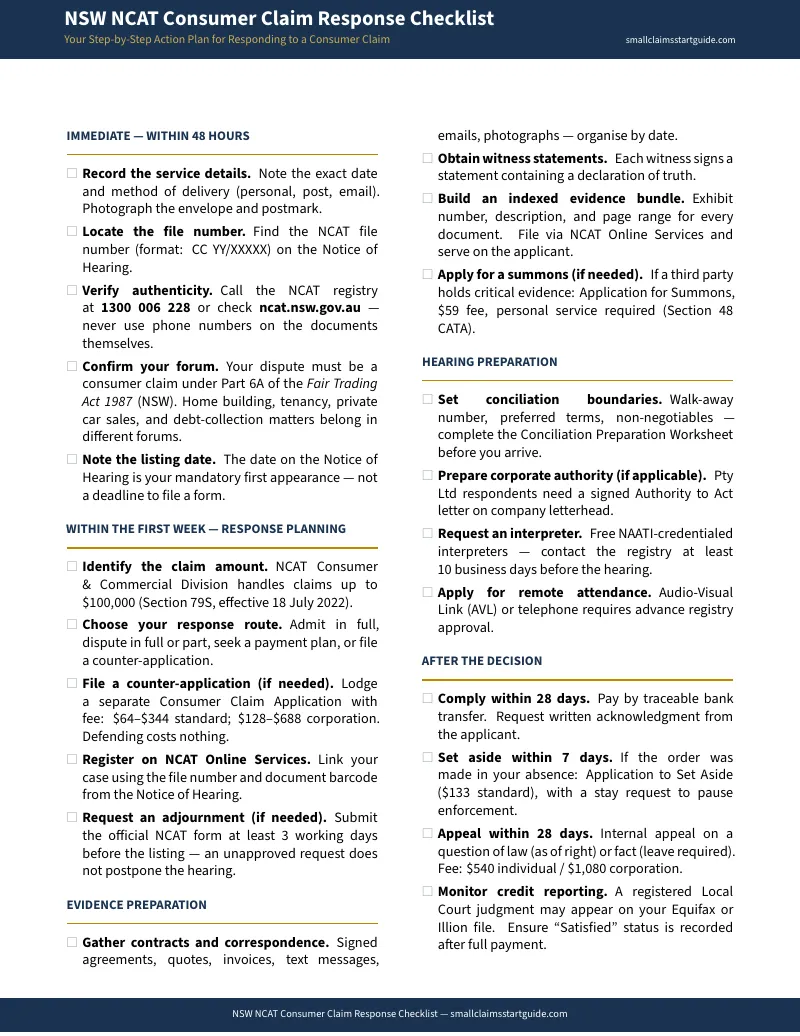
The free checklist shows you the steps. The full guide shows you how to do each one.
Download the free checklist to see the response timeline, your four options, and the immediate tasks. If you need the complete walkthrough — evidence indexing, conciliation preparation, hearing day logistics, and post-decision options — the full guide picks up where the checklist leaves off.