You Won at NCAT. The Respondent Still Hasn't Paid. Now the Real Work Starts.
You sat through the hearing. You made your case. NCAT ruled in your favour and issued a money order. You expected the other side to pay within 28 days — and they didn't. So you contacted NCAT, and they told you something nobody warns you about: NCAT cannot enforce its own orders.
No asset seizures. No wage garnishment. No Sheriff at the door. The Tribunal that decided your case has no statutory power to make the other side hand over the money. That responsibility falls entirely on you — through a Local Court enforcement system most people don't even know exists.
The NSW Order Enforcement Roadmap
This is not a legal textbook and it is not a solicitor's letter. It is a procedural roadmap — a step-by-step guide that takes you from an unpaid NCAT order through the Local Court enforcement tools and out the other side with either the money collected or a clear-eyed assessment of why it cannot be collected right now.
The guide exists because the alternative is paying a debt recovery solicitor upwards of A$800 in legal fees, or spending weeks piecing together scattered government websites, Reddit threads, and court registry pamphlets that never quite answer your actual question: what exactly do I file, in what order, and how much will it cost?
What's Inside the Guide
- Section 78 certification walkthrough — how to request the free certificate from NCAT that converts your tribunal order into a document the Local Court will accept, including what to do if the registry rejects your filing
- Local Court registration (Form 45) — completing the form, paying the fee, and understanding the difference between Small Claims Division (up to $20,000) and General Division ($20,001–$100,000) registration
- Examination Notices and Orders (Forms 52/53) — the two-step process for forcing the debtor to disclose their bank accounts, employer, income, and property under oath, including what happens if they refuse to attend
- Garnishee orders for bank accounts and wages (Forms 69/70) — how to redirect the debtor's funds directly to you, with the Protected Earnings Amount thresholds and minimum balance rules that determine how much you can actually collect from each pay cycle
- Writs for Levy of Property (Form 66) — directing the Sheriff to seize and sell the debtor's possessions, with a breakdown of what is exempt and when the A$1,113 execution fee makes financial sense
- Post-judgment interest ledger — two worked examples calculating the amount owed at the 10.35% statutory rate, with a running ledger format you can adapt for your own case
- Solvency assessment before you spend — a practical framework for evaluating whether the debtor is judgment-proof before you commit non-refundable court fees
- Interstate enforcement — using the Service and Execution of Process Act when the debtor moves to another state
- Case closure — filing the acknowledgment of satisfaction and having the judgment marked as paid once you collect
The guide comes with five standalone printable tools: an enforcement decision flowchart, a judgment debt ledger, a UCPR form pre-filing checklist, a debtor contact log, and a solvency pre-check worksheet — each designed to print and bring to the registry counter or keep beside your case file.
Who This Guide Is For
- Individual consumers who won a money order at NCAT (Consumer and Commercial Division) and are still waiting for payment
- Family members helping a parent or relative navigate the post-hearing enforcement process
- Sole traders and small business owners recovering an unpaid NCAT order without hiring a solicitor
Why Not Just Use the Free Government Websites?
The free resources from Legal Aid NSW, NCAT, and the Local Court are legally authoritative — and this guide cites them throughout. But they are scattered across multiple agencies, each covering one piece of the puzzle. Legal Aid explains certification. The NCAT website explains that it can't help with enforcement. The Local Court publishes fee schedules. The UCPR portal hosts blank forms. None of them tells you, in one place, which tool to use when, how to calculate the total owed including interest and costs, or how to evaluate whether the debtor is worth pursuing before you spend money on court fees.
This guide consolidates the entire post-NCAT journey — from the certified order to case closure — into a single offline resource you can print, annotate, and bring to the registry counter.
What You Won't Find Here
This guide covers procedure — forms, fees, deadlines, and steps. It does not give legal advice, predict how a case will turn out, or tell you how to argue before a registrar. It is not published by NCAT, the Local Court, or any government body. If your case involves corporate insolvency, cross-border complications, or a debtor who has filed for bankruptcy, the guide directs you to Legal Aid NSW and community legal centres that provide free legal assistance.
Satisfaction Guarantee
Full refund, no time limit. If the guide does not help you, email [email protected] and we will refund you in full — no questions, no deadline.
Get Started
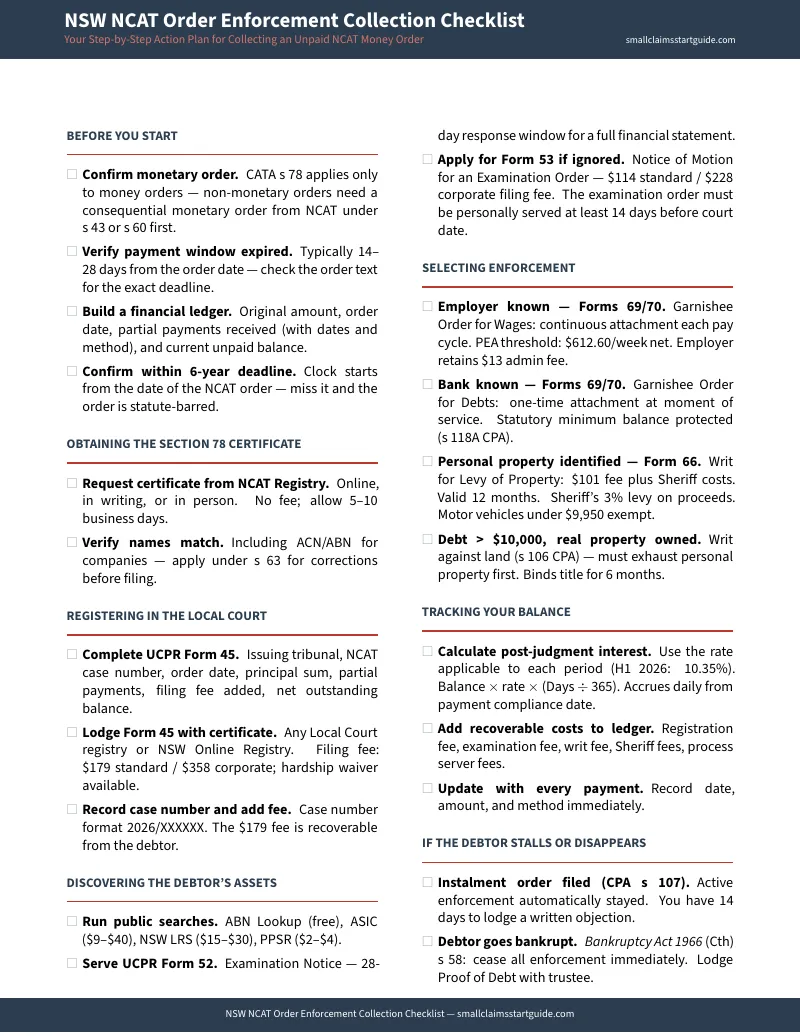
Download the free checklist to see the enforcement steps at a glance. If you want the full guide — with detailed form instructions, interest calculations, exemption breakdowns, and the solvency assessment framework — get the complete guide for .