You're owed money. ACAT can get it back — if you file the paperwork right.
The contractor took your deposit and disappeared. The invoice has been sitting unpaid for months. The seller refused your refund. You know the ACT Civil and Administrative Tribunal handles disputes up to $25,000 — but the ACAT website is a maze of practice notes, PDF forms and legislative references that assume you already know the process.
One wrong attachment, one missed deadline, one improperly served document — and your claim stalls, gets rejected or lapses entirely. ACAT automatically rejects emailed filings over 40 pages or with more than three attachments. Proceedings that sit inactive for six months lapse without warning. And registry staff, helpful as they are, cannot tell you how to prepare your case.
The ACAT Filing Sequence — every step mapped, every deadline tracked
This guide turns the scattered official information into one clear sequence. Instead of piecing together practice notes, fee determinations and form instructions across a dozen government pages, you follow a single path from your first demand letter to the tribunal hearing and beyond.
It is not a shortcut and it is not legal advice. It is the filing procedure itself — organized the way you actually need to follow it, with the compliance traps flagged before you hit them.
What's Inside
- Jurisdiction check — confirm your claim fits ACAT's $25,000 limit, falls within the time limits and is not a tenancy, fair work or other excluded matter
- Letter of demand framework — structure your pre-filing demand with the elements ACAT expects to see, including the statutory interest calculation
- Form-by-form filing walkthrough — which application form to use, what to attach, how to pay the fee (and how to avoid the automatic email rejection rules)
- Service tracking log — record every delivery attempt with dates, methods and tracking numbers so your affidavit of service is airtight
- Preliminary conference preparation — what to expect, how to draft your Summary Statement and Statement to the Convenor, and what settlement looks like
- Hearing evidence checklist — organize documents, photos and witness statements into the index format ACAT members actually want to see
- Deadline calendar — the 21-day response window, 28-day appeal limit and 6-month lapsing rule on one page so nothing slips
- Post-order next steps — what to do when you win (and what to do when the other side does not pay, including the hand-off to Magistrates Court enforcement)
Who This Is For
- Homeowners chasing a contractor who took a deposit and walked off
- Sole traders and freelancers with an unpaid invoice under $25,000
- Buyers refused a refund for defective goods or services
- Neighbours with a property damage or boundary fence bill
- Small landlords owed money outside the residential tenancy system
- Anyone in the ACT who wants to understand the ACAT civil dispute process before deciding whether to file
Why Not Just Use the Free Information?
You should. The ACAT website publishes every form, every fee schedule and every practice note for free — and this guide links to all of them. What ACAT does not provide is the sequence. Their information is organized by topic (fees on one page, forms on another, conferences on a third), not by the order you actually need to do things.
That gap is where filings get rejected. An emailed application with four attachments is automatically returned. A claim served by regular post instead of the prescribed method gets challenged. A proceeding left idle for six months lapses and you start over. The guide puts every step in order and flags these compliance traps before they cost you time or money.
Free legal help exists too — Care Consumer Law runs a duty lawyer at ACAT every Monday, and Legal Aid ACT offers phone advice. The guide lists every service and explains what they can and cannot do. It works alongside free advice, not instead of it.
Satisfaction Guarantee
Full refund, no time limit. If the guide is not what you expected, email [email protected] and we will process it — no questions, no forms.
Get Started
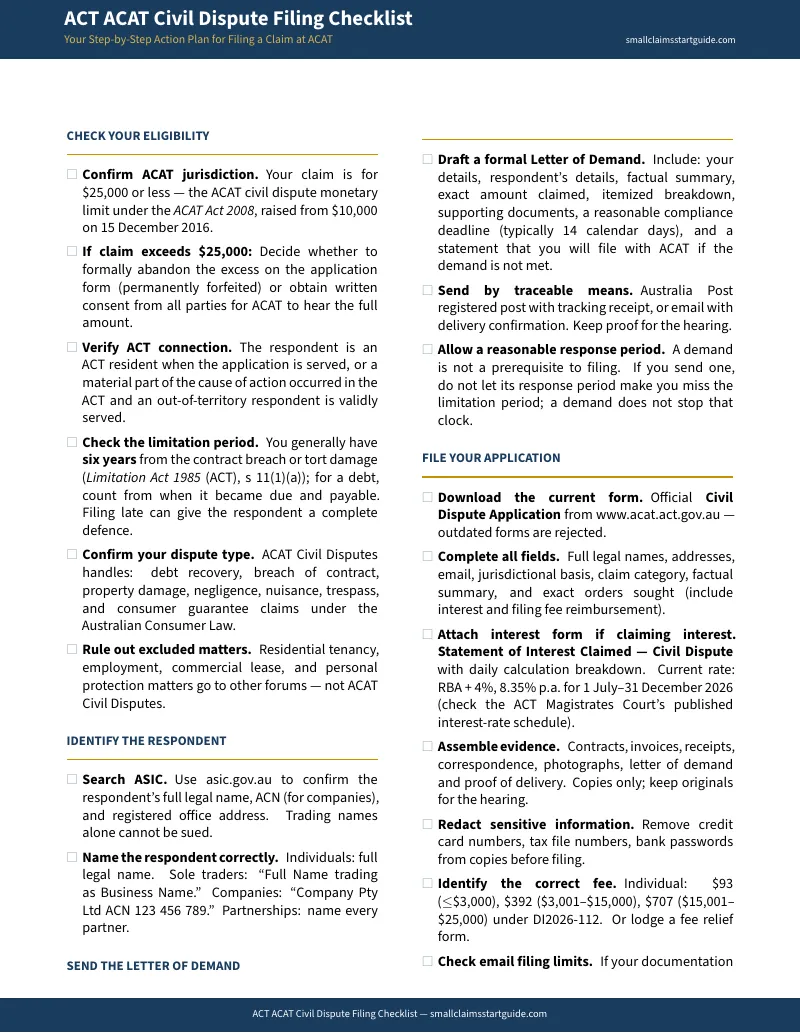
Download the free ACT ACAT Civil Dispute Filing Checklist to see the steps at a glance. When you are ready for the full walkthrough — every form, every deadline, every compliance check — get the complete guide for and follow the process from demand letter to hearing day.
Frequently Asked Questions
What if the rules change after I buy?
We update the guide when the rules change. Email us any time, even years later, and we'll send you the current edition free.